
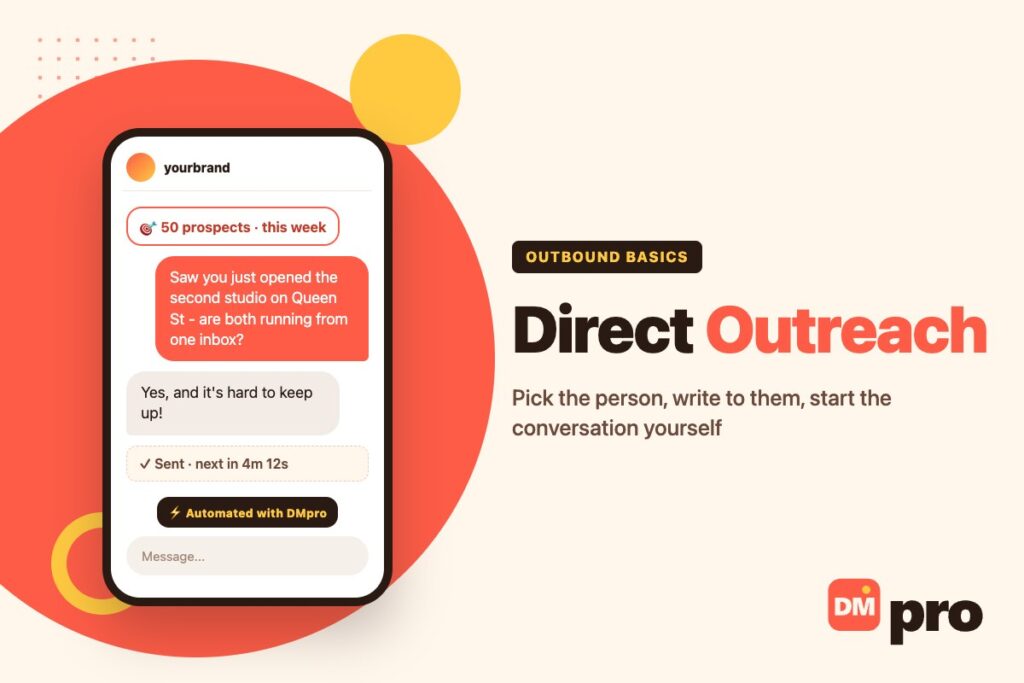
Most marketing is a net: you publish, you advertise, and you hope the right person swims into it. Direct outreach is a line. You pick the person, you write to them, and you start the conversation yourself. It takes more effort per contact, and in return you know exactly who you reached and when.
It is also the fastest part of DM marketing to switch on. Content takes months to compound and ads stop the day the budget does; a researched message can start a conversation this afternoon.
This guide covers what direct outreach is, how it differs from inbound and from plain cold outreach, the channels and when each fits, a four-line message structure, a weekly process, and how to scale it with two tools built for the most time-consuming channels: the DMpro Chrome extension on Instagram and TikTok, and contactID for reaching businesses through their websites.
Key Takeaways
What Is Direct Outreach?
Direct outreach is contacting a specific person or business with a message meant only for them, to start a business conversation. There is no algorithm deciding who sees it and no waiting for a form fill: you picked the recipient on purpose.
The Four Traits of Direct Outreach
You choose the recipient
The list is deliberate, not whoever happened to click an ad.
You initiate
The prospect has not asked for anything yet, so the message has to earn attention.
It is one to one
Even at volume, each message should read as though it was written for a single person.
It has one goal
Usually a reply or a short call – not an immediate sale.
Direct Outreach vs Cold Outreach
The terms overlap but describe different things. Cold describes the relationship: the person does not know you. Direct describes the method: you contact them yourself rather than broadcasting. Most cold outreach is direct, but direct outreach can also be warm – a message to someone who follows you, commented on your post, or bought from you last year.
Direct Outreach vs Other Ways to Find Customers
Direct outreach does not replace the other channels; it covers what they cannot. Content compounds, ads buy reach, referrals convert best – and direct outreach is what you use when you need specific customers on a timeline you control.
| Approach | Who you reach | Time to first conversation | Main limitation |
|---|---|---|---|
| Direct outreach | Exactly who you pick | Days | Effort grows with the list |
| Inbound content and SEO | Whoever searches | Months | You cannot choose who arrives |
| Paid advertising | Whoever matches the targeting | Days, for a budget | Stops when spending stops |
| Referrals | Whoever your network knows | Unpredictable | Cannot be switched on at will |
It fits best as one part of a written outreach strategy, alongside the channels that bring people to you.

Why Direct Outreach Still Works
Every year someone declares outreach finished, and every year it keeps booking meetings. The reasons are structural.
Speed and Precision
You can start conversations today, and if you only want dental clinics in one city, only dental clinics in that city hear from you.
Fast, Honest Feedback
Fifty replies teach you more about your positioning than a month of analytics, and changing a message costs nothing.
What Stopped Working
Untargeted blasting. Identical messages to thousands of strangers fail on every channel now, which is why the cold DM blast is dead while researched, personal outreach keeps performing.
Cold vs Warm Direct Outreach
Not every direct message goes to a stranger. Where a person sits on the cold-to-warm scale should change how you open, which channel you use and how much follow-up to plan.
Warm: People Who Already Know You
Past customers and old leads
A short, friendly note about something new. They already trust you; do not over-explain.
Followers and engagers
Reference the interaction – the comment, the story reply – and ask a genuine question. An Instagram or TikTok DM is the natural channel.
Cold: People Who Have Never Heard of You
Right-fit people on social
Creators, shop owners and founders you researched. Open with one detail from their profile and ask an easy question.
Businesses with a website
Clinics, firms, agencies and software companies. A short business note through their website’s contact form or by email, with their name in the subject.

Direct Outreach Channels
Pick the channel your prospect already checks, not the one you find most comfortable.
Social DMs
Instagram and TikTok DMs suit creators, ecommerce brands, local services and founder-led businesses. They read like a message from a person and are often seen the same day. Our Instagram DM outreach guide covers the profile setup and pacing.
Website Contact Forms
The contact form on a company’s site goes to an inbox someone is paid to monitor, and it reaches many small businesses that publish no email address. It is one of the most overlooked direct channels for B2B.
Email, LinkedIn and Phone
Email remains the default for formal B2B and larger companies. LinkedIn suits corporate roles and professional services. Phone is slow per contact but still unbeaten for high-value deals.
How to Run Direct Outreach, Step by Step
Run this as a weekly loop with a fresh batch of prospects rather than a one-off push whenever the pipeline looks thin.
Define exactly who you want
Industry, size, location, and the trigger that makes now the right moment – a new location, a launch, a job posting, a visible gap on their site.
Research one specific detail
You need one true, specific thing per prospect. If you cannot find it in two minutes, skip that name and move on.
Write four short lines
Start with the detail, connect it to the problem you solve, add a short result if you have a real one, and finish with a question they can answer in a word. Leave out attachments and calendar links.
Follow up twice
Leave three or four days between messages, and make each one bring something fresh: a relevant example, a number, or a smaller way to start. A clear no ends the sequence.
Track and refine
Record what you sent and what came back. Change one thing at a time – the opener, the offer or the audience – so you can see what moved the reply rate.

How to Write a Direct Outreach Message
Most weak outreach fails in the first line. The same message, part by part:
Weak vs Strong, Line by Line
Opener
Weak: “Hi, hope you are doing well!” Strong: “Saw you just opened the second studio on Queen St.”
Reason
Weak: “I work with lots of businesses like yours.” Strong: “You are now running two locations from one Instagram inbox.”
Value
Weak: “We offer a full suite of solutions.” Strong: “We helped a studio your size cut reply time from a day to an hour.”
Ask
Weak: “Do you have 30 minutes this week for a demo?” Strong: “Worth a quick look? Happy to send a two-minute example.”
Keep the Ask Small
“Worth a look?” beats a calendar invite because saying yes costs nothing. The call comes one message later, once the person has already replied.
How to Scale Direct Outreach Without Losing the Personal Touch
The research and the first line are what make direct outreach work, and they are also what make it slow. Two tools take over the repetitive part on the channels where it is most painful.
Instagram and TikTok: the DMpro Extension
The DMpro Chrome extension takes a brief you write once and turns it into a different DM for every profile, using the person’s display name, bio text and audience size. Send one profile at a time with Auto-Send, or work through a list of handles as a campaign with a daily limit and random gaps. It sends from the Instagram or TikTok login already open in Chrome, so no credentials change hands.
Built-in brakes
New users start in Safety Mode: 20 DMs a day, spaced 3 to 6 minutes apart, with an automatic pause if Instagram shows a warning.
Honest limits
Automated messaging may still conflict with Instagram’s terms of use, and Meta’s spam policy targets repetitive and high-frequency messaging. Keep it personal and slow.
Businesses With a Website: contactID
contactID works through a list of websites, finds each contact form and submits your message with tags such as {{website_name}} filled in for every business. A pre-flight report flags sites without a form and businesses you already contacted, and credits are only used when a form actually goes through.
Common Direct Outreach Mistakes
When replies dry up, it is almost always one of these.
| Mistake | What to do instead |
|---|---|
| Writing to a list instead of a person | One detail per prospect that only they would recognise |
| Pitching in the first message | Earn the reply first; pitch in the conversation |
| A wall of text | Four short lines – most people read on a phone |
| Stopping after one message | Two follow-ups, each adding something |
| Sending faster than a person could | Daily caps and random gaps on social channels |
| No records | Log every contact so you can tell a copy problem from a targeting problem |
Run Your Direct Outreach With DMpro
Direct outreach on social platforms lives or dies on the first line. The DMpro Chrome extension writes that line from each prospect’s own profile, then sends the whole message for you from your account, one profile or a whole list at a time.
For prospects who are easier to reach through their website, contactID delivers your message through each site’s contact form. Together they cover the two direct channels that take the most time by hand.
- A DM written from each Instagram or TikTok profile
- One-click Auto-Send or list campaigns
- Daily limit and random delays you control
- Contact-form outreach through contactID
- Pre-flight check so nobody is contacted twice by accident
- Keeps messages one-to-one at higher volume
- No social media password shared
- Free starting tier on the extension
- Does not cover phone or LinkedIn
- Replies come to your own Instagram or email inbox, not a separate tracker
Conclusion
Direct outreach is the part of growth you can switch on. Instead of publishing and hoping, you decide who you want to talk to and write to them. The channel is a detail; the research behind the first line decides whether anyone answers.
Start with fifty names you can say something specific to – warm ones first. Write four lines each, follow up twice, and track what comes back. Repeat the loop weekly, and bring in tools only once the message is earning replies by hand.
The DMpro extension drafts a message from every prospect’s profile and handles the sending, at the pace you set.
Start with the DMpro extension