
Search for an influencer marketplace and you get lists. Twelve platforms, fifteen platforms, ranked against each other as though they were the same kind of product.
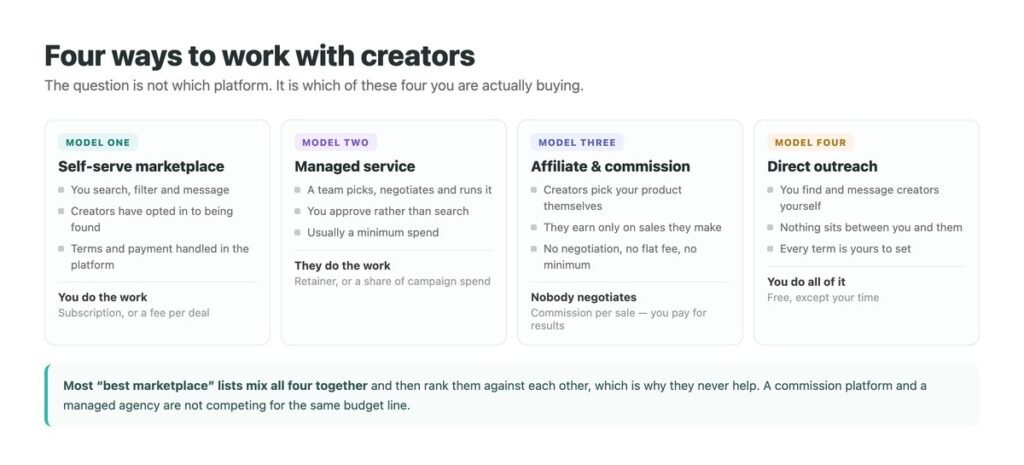
They are not. At least four distinct models get filed under the same phrase, they charge in completely different ways, and two of them are not really marketplaces at all. A managed agency and a commission-only affiliate platform are not competing for the same budget line, so ranking one above the other tells you nothing.
This page sorts the four models, sets out how each is priced, and gives the six questions worth asking before you pay anyone. If what you need is the message rather than the platform, writing outreach a creator will answer is the other half of the job.
Key Takeaways
Four Things Called the Same Name
Before comparing anything, work out which of these you are actually shopping for. Almost every disappointing platform decision is really a mismatch between the model bought and the job needed.
The first is a self-serve marketplace: a searchable pool of creators who have opted in to being found, where you filter, message, agree terms and pay through the platform. You do the work; the platform provides the inventory and the plumbing.
The second is a managed service. A team selects creators, negotiates, and runs the campaign while you approve. It is an agency with a software front end, and it is priced like an agency, usually with a minimum spend.
The third is commission-based. Creators choose your product themselves from a catalogue and earn a percentage of what they sell. There is no negotiation and no flat fee, which also means no risk of paying for a post that converts nothing.
The fourth is not a platform at all: direct outreach, where you find creators yourself and message them. It costs nothing but your time, and for a small number of high-value partnerships it is frequently the correct answer.

How Each Model Charges You
The pricing structure tells you more about a platform than its feature list does, because it determines what the platform is optimising for.
| Model | You pay | You carry the risk when | Fits |
|---|---|---|---|
| Self-serve marketplace | Subscription, or a fee per deal | A paid post underperforms | Regular campaigns, in-house team |
| Managed service | Retainer or a share of spend | You are paying whether or not it works | Large budgets, no internal capacity |
| Commission / affiliate | A percentage of sales made | Never – you pay on results | Ecommerce with a wide catalogue |
| Direct outreach | Nothing but time | Your time was the budget | A few high-value partnerships |
The commission model is the least understood of the four and the easiest to test, because a failed campaign costs nothing. An affiliate product marketplace lets creators browse a catalogue, pick what suits their audience and earn on each sale – which suits a brand with many products better than one with a single hero item.
Opted In, or Scraped?
This is the single most useful question to ask a self-serve marketplace, and the answer is rarely on the pricing page.
Some platforms are genuine marketplaces: creators signed up, built a profile, set rates and agreed to receive briefs. Others are search engines over public data, indexing accounts whose owners never opted into anything. Both will show you an impressive number of creators.
The difference shows up entirely in your reply rate. A brief sent to someone who joined a platform to receive briefs is expected; the same brief sent to an account scraped from a hashtag is a cold DM with extra steps, and it performs like one. If a platform advertises millions of creators, it is almost certainly the second kind – and you are buying a search tool, which is fine, as long as you know that is what you bought.
Six Questions Before You Pay Anyone
None of these are answerable from a comparison list, and every one of them has cost somebody a quarter’s budget.
- Who pays the creator, and when? Escrow on delivery, net-30, or you handling invoices. This decides whether good creators take your brief seriously.
- Are the creators opted in? A searchable index of public profiles is not a marketplace, whatever it is called.
- What does the fee attach to? A subscription bills whether or not you run anything; a commission bills only when something sells.
- Who owns the content afterwards? Usage rights are the term brands assume and creators charge for. Ask whether the platform sets a default and what it is.
- Is disclosure built into the brief? The legal obligation exists regardless. A platform that handles it removes a risk you would otherwise carry alone.
- Can you leave with your relationships? If the creators you found are only reachable inside the platform, the subscription stops being optional.

What You Still Have to Do Yourself
A platform is worth its fee when it removes work you would otherwise do. This is which work each model actually takes off you.
| Self-serve | Managed | Commission | Direct | |
|---|---|---|---|---|
| Finding creators | Platform | Platform | They find you | You |
| Writing the brief | You | Platform | You, once | You |
| Negotiating the fee | You | Platform | Nobody | You |
| Contract and usage terms | Platform default | Platform | Platform default | You |
| Paying the creator | Platform | Platform | Automatic on sale | You |
| Disclosure in the brief | Varies | Usually | Varies | You |
| Tracking who said what | You | Platform | You | You |
Commission platforms remove the most steps because there is nothing to negotiate – a creator browsing an affiliate catalogue picks a product, posts, and is paid on what sells, with no brief exchanged at all. The trade is that you give up control over who represents you.
Why Every List You Read Is Slightly Wrong
This category consolidates constantly, and the articles ranking for it do not keep up. Two examples, both of which still appear as standalone entries in lists published this year.
Klear was a well-known influencer marketing platform. Its own domain now redirects to Meltwater’s influencer marketing suite – it is a product line inside a larger company, not a marketplace you sign up to.
YouTube BrandConnect has been renamed twice. It started as FameBit, became BrandConnect after the self-serve side was shut down, and in 2026 was folded into YouTube Creator Partnerships. Any list still describing it as a self-service marketplace for creators is describing something that stopped existing years ago.
The practical lesson is not to distrust every list; it is to check the platform’s own site before you build a plan around it. A redirect tells you more about a company’s future than a review does.
The Honest Case for Skipping Platforms Entirely
If you need three creator partnerships a year, no platform will pay for itself. The subscription costs more than the time it saves, and the creators worth working with are findable without it.
The route that works at that scale is unglamorous: start with people already interacting with your account, work sideways through their category rather than upwards through follower counts, and write each approach yourself – the same discipline as any other direct outreach. Reply rates from a warm, specific, direct message are higher than from any platform brief, because the message is better rather than because the channel is – which is also why sponsored posts from creators who already liked you outperform the ones you bought cold.
Platforms start earning their place when the volume makes tracking impossible – when you cannot remember who was offered what, which briefs went out in March, or who declined and should not be contacted again in June. That is an organisational problem rather than a discovery one – the same one any DM outreach at volume runs into – and it is worth recognising which of the two you actually have before paying to solve the wrong one.
The Problem Is Usually Tracking, Not Finding
Somewhere around the fortieth creator, the spreadsheet stops being true. DMpro keeps every creator conversation in one inbox with the offer attached to it, so a follow-up knows what was proposed and nobody gets the same opener twice.
It is not a marketplace and it does not find creators for you. It handles the part that breaks after you have found them.
- Every creator conversation in one inbox, across Instagram, TikTok and WhatsApp
- The offer and terms attached to each thread
- Messages written per creator rather than filled from a template
- Safe pacing so volume never becomes a spam signal
- Reply and acceptance rates visible per campaign
- Follow-ups that know what the first message offered
- Nobody contacted twice with the same opener
- No subscription tied to a creator database you may not need
- Free plan covering 250 conversations a month
- It does not discover creators – that part is still yours or a marketplace’s
Conclusion
Decide which of the four models you are buying before you compare anything, because the comparison only makes sense inside a model. Self-serve costs a subscription, managed costs a retainer, commission costs nothing until something sells, and direct outreach costs your time.
Then ask the six questions, and check the platform’s own website rather than a list. In a category where the best-known names have been renamed, redirected and absorbed, the most recent thing you can read about a platform is the platform itself.
Every creator conversation, every offer made, in a single shared inbox.
See how it works