
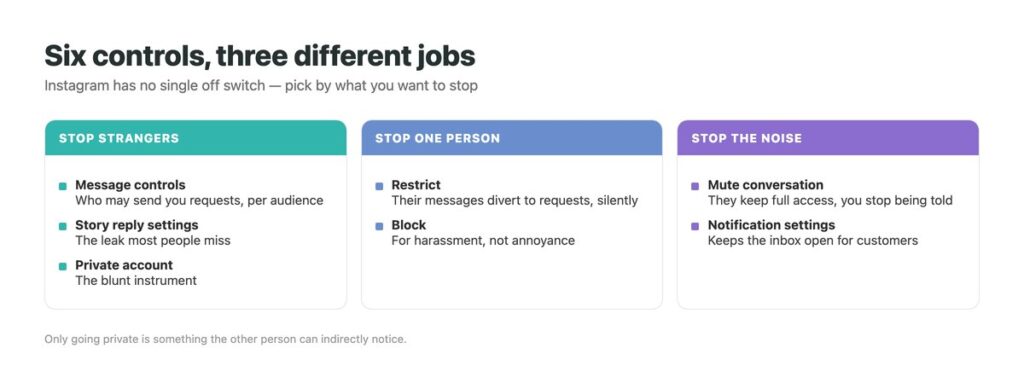
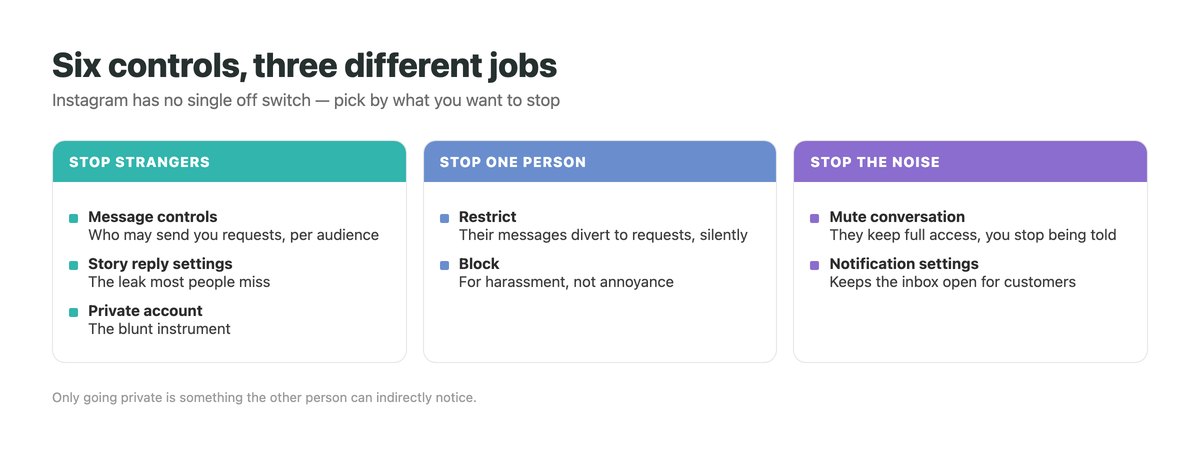
Instagram does not have one button that turns direct messages off. What it has is a set of controls scattered across privacy, notifications and per-account settings, and which one you want depends on whether you are trying to stop strangers, stop one person, or just stop the buzzing.
Below are all six approaches, what each one actually blocks, and who can still reach you afterwards.
Key Takeaways
The Six Options at a Glance
Pick by outcome rather than by menu. Each row stops something different.
| Method | Stops | They can tell | Best for |
|---|---|---|---|
| Message controls | Requests from a chosen audience | No | Cutting off strangers |
| Story reply settings | Replies to your stories | No | The most common leak |
| Restrict | Their messages reaching your inbox | No | One person, quietly |
| Mute | Notifications only | No | Noise, not people |
| Private account | Most strangers, everywhere | Indirectly | A blanket reset |
| Notification settings | Alerts, not messages | No | Focus without changing access |
Method 1: Limit Who Can Message You
This is the closest thing to an off switch, and it is where you should start.
Open Settings and Privacy
Tap the menu on your profile, then Settings and privacy.
Find Messages and Story Replies
It sits under How others can interact with you.
Set Each Audience Separately
You get separate controls for your followers, people you follow, and Others on Instagram. Set the last one to not receive requests and strangers stop reaching you.
Handle Group Invites Too
There is a separate control for who can add you to groups. Set it to people you follow if group spam is the problem.
Save and Test
Ask a friend who does not follow you to try. It should fail silently on their side.
Method 2: Turn Off Story Replies
This is the leak almost everyone misses. Story replies arrive as normal DMs or requests even when your message controls are tight, because they are governed separately.
- The setting sits beside message controls under Messages and story replies.
- You can allow replies from everyone, from people you follow, or turn them off entirely.
- Turning them off does not hide your stories; it only removes the reply box.
- Reaction emoji are covered by the same control on most accounts.
Method 3: Restrict Someone
Restricting is the option for a specific person you do not want to block outright. It is deliberately undetectable.
- Their messages go to the requests folder instead of your inbox.
- They cannot see when you are online or whether you read anything.
- Their comments on your posts are visible only to them unless you approve.
- They are never told, and nothing changes on their side.
- You can restrict from their profile menu or from the chat thread itself.
Method 4: Mute a Conversation
Muting is about noise, not access. The person keeps full ability to message you; you simply stop being told about it.
- Swipe on a chat, or open it and use the menu, then choose Mute messages.
- You can mute messages and calls separately.
- The thread still shows unread markers when you open the app.
- Nobody is notified, and the sender sees no difference.
Restrict vs Mute vs Block
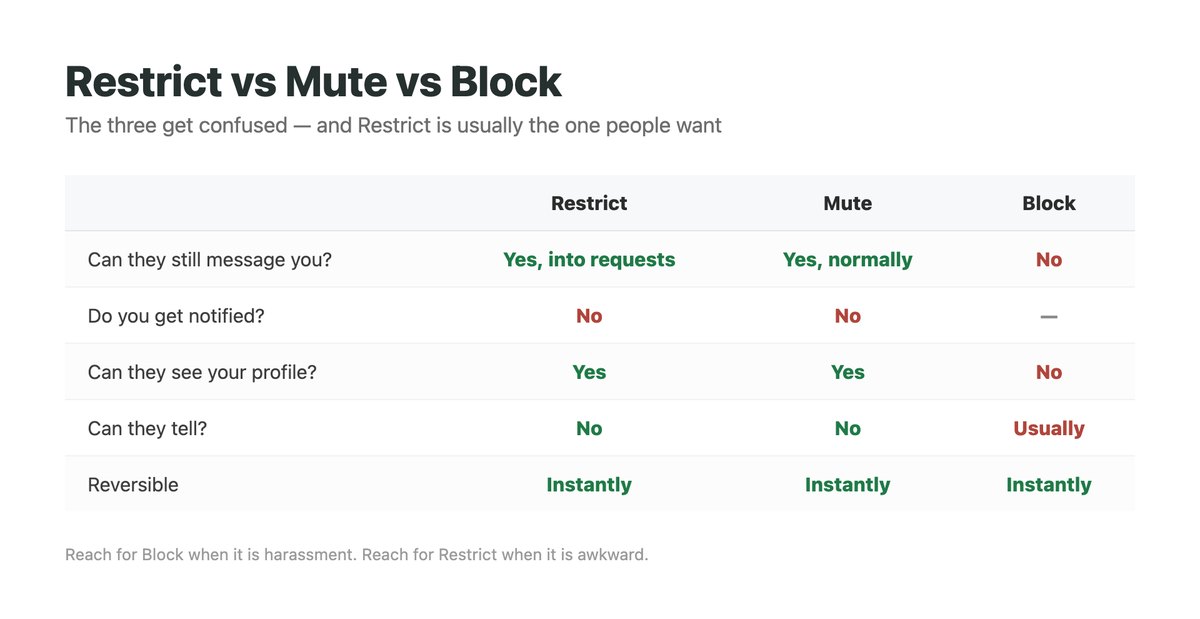
These three get confused constantly, and choosing the wrong one is why people end up blocking someone they only wanted to quieten.
| Restrict | Mute | Block | |
|---|---|---|---|
| Can they message you? | Yes, into requests | Yes, normally | No |
| Do you get notified? | No | No | N/A |
| Can they see your profile? | Yes | Yes | No |
| Can they tell? | No | No | Usually, eventually |
| Reversible | Instantly | Instantly | Instantly |
If the situation is harassment rather than annoyance, blocking messages outright is the right tool and the etiquette question does not apply.
Method 5: Switch to a Private Account
Going private is the blanket approach. Only approved followers see your content, and the pool of people who can message you shrinks accordingly.
- Strangers can still send requests unless you also tighten message controls.
- Your existing followers are unaffected.
- It changes how your posts are discovered, so it is a real trade-off for a business account.
- It is instantly reversible.
- If discovery matters to you, weigh it against reaching people through DMs first.
Method 6: Turn Off Notifications Only
If the messages are fine and the buzzing is not, leave access alone and change notifications instead. Settings → Notifications → Direct messages lets you switch message alerts off entirely, or limit them to people you follow.
This is the option most people actually want. It keeps the inbox working for customers and enquiries while giving you your attention back.
If the goal is fewer interruptions rather than fewer messages, pair it with scheduled replies so answers still go out on time.
If DMs Are Where Your Customers Are
Turning messages off is the right answer for a personal account. For a business account it is usually the wrong one, because the people who cannot follow you yet are exactly the ones who want to buy.
The better fix is to make the volume manageable: answer the repetitive questions automatically, keep everything in one inbox, and reserve your attention for the threads that need it. That is the same reasoning behind checking your message requests rather than switching them off, and behind treating the inbox as a CRM.
It also helps to know the ceiling you are working within – Instagram’s message limits apply to replies as well as outreach, and the basic DM etiquette still applies at volume.
Make the Inbox Manageable Instead of Silent
DMpro answers the repetitive questions in your own tone, pulls Instagram, TikTok, WhatsApp, Telegram, LinkedIn and Messenger into one inbox, and hands you only the conversations that need a person.
You describe the automation in plain English and the AI assembles it, so there is no flow builder to learn. Free plan included; see the pricing page for the comparison.
- Answers the repetitive messages so you do not have to
- Escalates only what needs a human
- Keeps the channel open while the noise stops
- Filters obvious spam before you see it
- One inbox across six channels
- Quiet inbox without a closed sales channel
- Customers still get an instant answer
- You choose what reaches you
- Free plan, no card
- Not a privacy control – Instagram’s own settings still do that
Conclusion
Instagram gives you six controls rather than one switch. Message controls and story reply settings stop strangers, restrict and mute handle one person, going private is the blunt instrument, and notification settings fix the noise without touching access.
Start with message controls, then check story replies, because that pair solves the problem for most people. If the issue is one account rather than the crowd, restrict or block them instead.
If the DMs are business rather than nuisance, automating the answers beats switching the channel off – a closed inbox is a closed sales channel.
Start free with DMpro and let AI handle the repetitive DMs while you keep the conversations worth having.
Filter, do not close