
Instagram is where the decision starts, and almost never where it finishes. A sixteen-year-old saves a campus Reel two years before they apply; a thirty-four-year-old watches a course explainer at eleven at night and messages three providers before going to bed. Educational marketing campaigns fail when they are built for the second of those people and posted for neither.
Pew’s December 2025 survey of US teenagers found that about six in ten use Instagram, with YouTube close to universal and WhatsApp climbing to roughly a quarter. For institutions recruiting internationally, that last number matters more than it looks.
This guide is written for two groups who search for the same thing and need different answers: admissions and marketing teams at schools, colleges and universities, and course creators selling their own programmes. The content advice overlaps. The funnel does not.
Key Takeaways
Two Very Different Jobs
Before anything else, be clear which of these you are doing. The content can look identical and the campaign still fail because the objective was borrowed from the other one.
Institutional Recruitment
A school, college or university selling a place that costs thousands and eighteen months of someone’s life. The decision is slow, made jointly with parents, and shaped as much by city, cost and belonging as by the course. Your campaign’s job is to get onto a shortlist of five and stay there, not to close anything.
Course and Programme Sales
A creator, bootcamp or training provider selling something that starts next month. The decision is fast, individual, and driven by a specific outcome – a job, a certification, a skill. Here the DM is not the start of a relationship; it is most of the sale.
What They Share
Both are selling a future version of the person watching. Both are trusted more when the person on camera is a student rather than a marketer. And both convert in private messages rather than in comments – which is the part most institutional accounts are least equipped for. Our guide to DM marketing covers that discipline generally; this one covers the education version.
Content That Fits the Stage
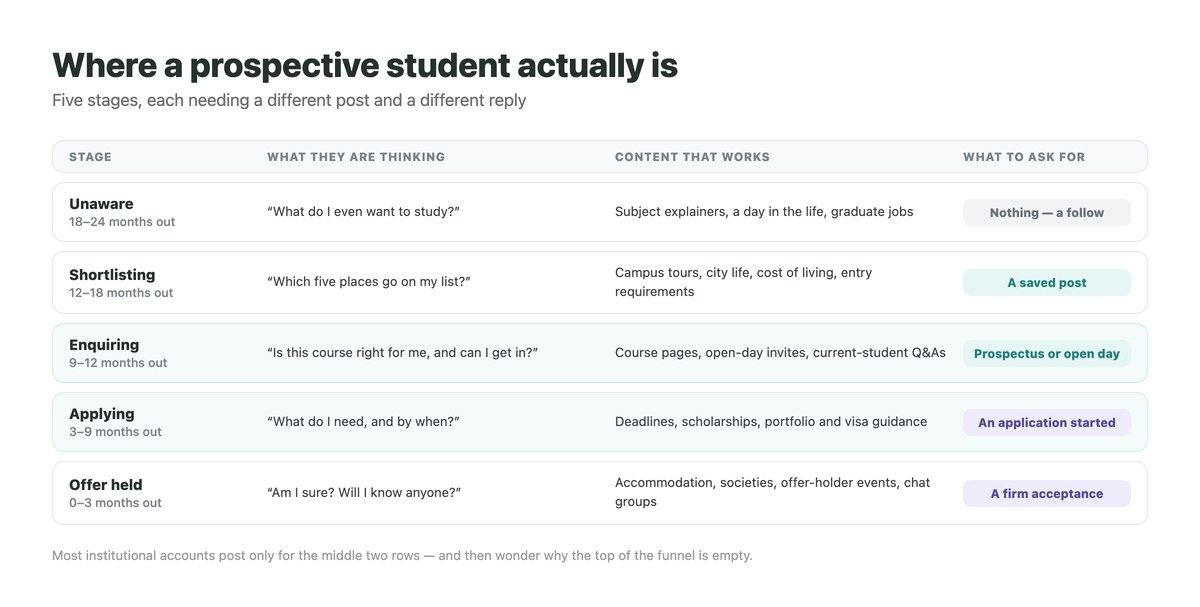
Work down the list above and ask what you have published this month for each row. The gaps are usually at both ends.
For People Who Do Not Know You Yet
Subject-led content, not institution-led. Someone deciding between physiotherapy and nursing is not searching for your name, so publish the comparison, the day in the life, the graduate salary reality, the thing nobody tells you about the first year. This is also the content that travels furthest, because it is useful to people who will never apply – the same principle behind any good Instagram lead magnet.
Subject explainers
One programme, one question, one current student. The most reliably watched format in education.
Graduate outcomes
What the person on camera is doing now, and what they earn. Specific, honest, unglamorous.
The honest downside
What is hard about the course. Publishing this buys more credibility than any ranking claim.
For People Shortlisting
Now they want to picture themselves there. Campus and city content does the work, and the campaigns worth copying are the ones built from students’ own material rather than a photographer’s.
Student-made campus series
Rutgers ran #HowWeMetAtRU on how students met each other; the University of Connecticut’s Worth Repeating series put alumni and students on camera about their own backgrounds. Both are formats you can run with no budget.
Hashtags that mean something
Stanford Engineering’s #IAmAnEngineer and Boston University’s #TerrierTuesdays work because they name a recurring series, not because they are popular tags. A hashtag is a shelf, not an audience.
Cost and practicalities
Rent, travel, what a week actually costs. Almost nobody publishes it, and every applicant is searching for it.
Competitions with a cheap prize
The University of British Columbia asked students to share their favourite study spots for a small gift card. The prize is irrelevant; the user-generated content is the point.
For People Holding an Offer
The least-served stage and the one with the most revenue attached, because an applicant who declines at this point cost you everything and returned nothing. Accommodation walkthroughs, society introductions, offer-holder Q&As and – most effective of all – a way to talk to someone who is already on the course. A broadcast channel for offer-holders costs nothing to run and does the job a mailing list does badly.
Your Students Are the Campaign
Influencer marketing in education does not mean paying a creator. It means handing the account to the people who are already living the thing you are selling.
Ambassadors and Takeovers
A rota of current students posting from their own week beats any produced campaign, because applicants can tell the difference instantly. Pay them properly – an hourly rate or a fee per takeover – and the quality holds up over a year rather than three weeks.
Give a brief, not a script
One theme per takeover and a list of things they must not film. Everything else is theirs.
Cover the unglamorous
Laundry, the bus, the library at midnight, the food. This is what applicants are actually trying to picture.
Include international students
If you recruit internationally, the visa, the arrival and the first fortnight are the content with the highest conversion value you can publish.
Keep the archive
Takeover content is reusable for two or three years. Most institutions let it expire in stories and lose it.
Faculty and Alumni
Academics are underused and often excellent on camera when the brief is a single question from their own field. Alumni carry the outcome proof. Neither needs a follower count – their credibility comes from the role, not the audience.
Safeguarding and Consent
If any of your students are under eighteen, written consent from a parent or guardian before anyone appears on camera is not optional, and neither is a policy on what ambassadors may post about other students. Agree it before the first takeover, not after the first complaint.
Turning Reach Into Enquiries
This is where educational accounts leak. A course Reel reaches forty thousand people, two hundred comment “info?”, and a member of staff replies to thirty of them the following Tuesday.
Use a Keyword Instead of the Link in Bio
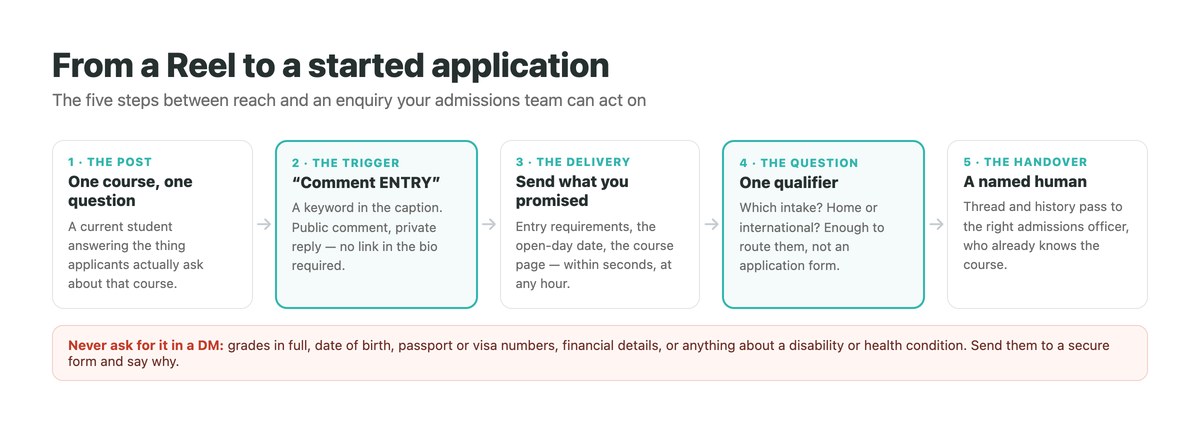
End the post with “comment ENTRY and I’ll send the requirements”. The comment is public, which helps the post’s reach; the reply is private, which starts a conversation you can follow. DMpro watches for the keyword on Instagram’s official Messaging API and answers within seconds, at whatever hour the comment arrives – which for international applicants is usually the middle of your night. Our comment-to-DM guide covers the setup.
One keyword per programme
ENTRY, OPENDAY, FEES, SCHOLARSHIP. Word, contains and exact matching mean near-misses still get answered.
Deliver first, ask second
Send the requirements or the open-day link before you ask anything. The exchange has to be in their favour.
Ask one qualifying question
Which intake? Home or international? Enough to route them, and nothing that belongs on a form.
Hand over to a named person
The thread and its history pass to the admissions officer for that course, who opens a conversation already half-finished. Our DM chatbot guide covers where the handover should sit.
Answer Speed Decides the Shortlist
Applicants message several institutions in one sitting. The first substantive reply frames every comparison that follows, and a three-day response time reads as an answer about how you will treat them for three years. An automated first reply is not a substitute for a human one – it is what buys the human time to write a good one.
Where the Conversation Should Continue
WhatsApp for international recruitment, because that is where those families already are and Pew’s figures show teen use of it still rising. Instagram for domestic school leavers. Email for anything that needs a record. DMpro runs across Instagram, TikTok, Messenger, WhatsApp and Telegram with a single inbox behind them, so a conversation that starts under a Reel and continues on WhatsApp is still one thread. Our WhatsApp automation guide covers that channel in detail.
What Automation Must Not Do
It cannot message people who have not contacted you, and nothing can DM every new follower – Instagram’s API has no follow event. It also should never be the only thing an applicant ever speaks to. Set a clear handover point and staff it, and say plainly in the first message that a person will follow up – our DM template guide has wording that does this without sounding automated. Instagram’s messaging documentation covers the built-in tools that sit alongside this.
What to Measure
Follower count is the metric education marketing teams are asked for and the one that predicts least.
| Objective | Metric that matters | What to change if it is flat |
|---|---|---|
| Reach new prospects | Saves and shares on subject content | Post about the subject, not the institution |
| Get onto shortlists | Profile visits and follows from non-local audiences | Publish cost, city and practicalities |
| Generate enquiries | Keyword comments and DMs started | Add one clear instruction to every post |
| Convert enquiries | Enquiry-to-application rate by course | Cut the response time and name the human |
| Protect offer-holders | Offer-to-enrolment rate | Run offer-holder content and a chat group |
| Sell a course | Cost per enrolment from DM conversations | Qualify earlier with one better question |
Whatever you track, track it per programme. Institutional averages hide the two courses that are working and the two that need the budget.
Rules That Apply to Education and Not to Retail
Recruiting students is regulated in ways selling trainers is not, and a DM channel is exactly where those rules get broken accidentally.
Never Collect Sensitive Data in a Message
No full grades, dates of birth, passport or visa numbers, financial circumstances, or anything relating to health or disability. Social platforms are not a secure channel and the message history is not your record system. Route people to a form and tell them why you are doing it – applicants find that reassuring, not obstructive.
Minors Change the Calculus
If your audience includes under-eighteens, assume a parent is reading over their shoulder, keep conversations short and factual, and have a policy for what staff may and may not discuss in a DM. Parents are a second audience in school and sixth-form marketing, and content aimed squarely at them converts well.
Be Accurate About Outcomes
Employment rates, salaries, accreditation and rankings are claims you can be held to. Cite the source in the caption. An unverifiable outcome claim in a Reel is the single easiest way for an education account to end up in a complaint.
Disclose Paid Student Posts
If an ambassador is paid, the post is advertising and needs the paid partnership label. It costs nothing in credibility when the content is honest, and hiding it costs a great deal when someone notices.
A Term’s Worth of Campaign, Concretely
If you are starting from an account that posts graduation photos twice a year, this is a realistic first twelve weeks.
Weeks 1-4: Build the Raw Material
Recruit six student ambassadors across your largest programmes, agree a fee and a consent form, and film a batch of subject explainers – one question per course, answered by someone studying it. Set up one keyword per programme so every post has somewhere to send people.
Weeks 5-8: Publish and Answer
Three posts a week, each ending with a single instruction. Watch which keyword gets used most; that programme is where the demand is. Reply to every enquiry within the hour during working days, automatically outside them, and log where each one came from.
Weeks 9-12: Narrow and Repeat
Drop the formats nobody saved. Double the ones that produced enquiries. Add offer-holder content if you are in that part of the cycle, and start the international channel if a quarter of your enquiries are coming from outside the country – which, once the subject content starts travelling, they usually are.
Answer Every Prospective Student the Moment They Ask
DMpro watches for the keyword under your course posts, sends the entry requirements or the open-day link within seconds, asks the one question that routes the enquiry, and hands the thread to the right person with its history intact.
It works over the official Instagram, TikTok, Messenger, WhatsApp and Telegram APIs, which matters for international recruitment, and the free plan covers 250 conversations a month – enough for most single-programme campaigns to prove the idea before anyone signs a budget.
- Keyword replies on comments, story replies and DMs
- A different flow per programme or intake
- Buttons that route home and international applicants
- Wait-for-reply steps that capture an email for follow-up
- One inbox across Instagram and WhatsApp
- Enquiries answered at the hour they arrive, in any time zone
- Official API connection – no password sharing, no scraping
- Free plan large enough to test one programme properly
- It cannot message new followers – the API has no follow event
- It is a first reply, not a replacement for an admissions officer
Conclusion
Educational marketing campaigns on Instagram work when they are built around an eighteen-month decision rather than a posting schedule. Publish for the stage people are actually at, put current students on camera, and give every post one clear instruction.
Then close the gap that costs most institutions their enquiries: answer immediately, ask one qualifying question, and hand a real conversation to a named person. The content gets you onto the shortlist. The reply is what keeps you there.
Keyword comments answered in seconds, routed to the right admissions officer – free for 250 conversations a month.
Start free with DMpro