
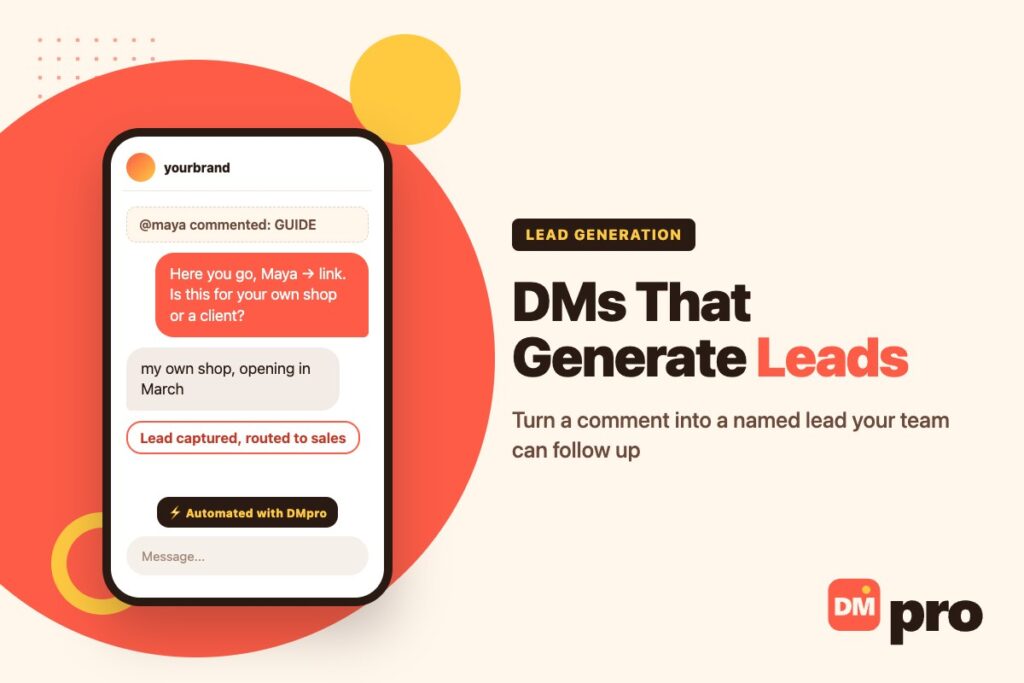
A lead is not an email address. It is a named person with a reason to talk to you and a note about what they wanted. Instagram DMs produce those better than almost any channel a small business has, because the conversation starts with the customer asking rather than with you interrupting.
What stops most accounts is the order. They ask for the email before they have helped, send a form link instead of an answer, or try to reach strangers in bulk and end up restricted. None of that is necessary, and the fix is mostly a matter of sequence.
This guide covers where DM leads actually come from, the first reply for each one, the single question that qualifies someone without interrogating them, when to ask for contact details, and how to hand the lead on. It sits alongside our guide to DM marketing; for the freebie that starts the conversation, see Instagram lead magnets.
Key Takeaways
What Counts as a Lead in a DM
Worth settling before any tactics, because it changes what you optimise for.
Three Things, Not One
A person you can reach again
A handle is enough to start. An email is better, but it is not the entry requirement.
A reason they contacted you
The product, the question, the problem. This is what makes a follow-up welcome instead of annoying.
A way to tell whether they are a fit
One fact – their market, their timing, their use case – that tells you whether to spend more time.
Why Volume Is the Wrong Target
A hundred addresses collected by asking everyone who said hello will convert worse than fifteen conversations where you know what the person wanted. The DM channel is good at the second thing and bad at the first, so build for it.

The Four Doors, and the First Reply for Each
Each arrives with a different amount of context, so the same opening message cannot work for all of them.
A Comment Keyword
The highest-intent door there is: the person read your caption and did what it asked. Reply privately with exactly what you promised, then ask one question. Our comment-to-DM guide covers the mechanics; the thing to get right here is that the delivery comes first and the question comes after.
A Story Reply
They reacted to something you were already showing them, so acknowledge that before anything else. “Glad the blue one caught your eye” does more work than any opener, because it proves a person read it.
A First-Time DM
Someone arrives with a specific question – price, shipping, availability. Answer it in the first line. Deflecting a price question to “DM us for prices” when they have just DMed you for prices is the single most common way accounts lose a sale in the inbox.
A Click-to-Message Ad
Paid traffic lands in the DMs with the ad still in mind, so repeat the offer in your own words before qualifying. These conversations carry the ad’s context with them – our guide to click-to-Instagram-Direct ads covers how that works.
And the Fifth Door: You Message First
Outbound is not a lead source in the same sense – nobody asked to hear from you, so the reply has to be earned before anything is requested. It also runs on different rules: Instagram’s official API cannot message people who have not contacted you, which is why outbound needs a browser extension rather than an automation platform. Our Instagram DM outreach guide covers that side properly.
The Sequence That Produces a Lead
Five steps, in this order. Changing the order is what breaks it.
Deliver what was promised, immediately
The link, the price, the size chart, the answer. No preamble, no “thanks for reaching out” paragraph before it. Speed matters more than polish here: a decent answer in ten seconds beats a perfect one the next morning.
Ask one question
Not three. The best ones sort rather than interrogate: “Is this for your own shop or a client?” or “Are you looking for this month or later in the year?” Timing questions get honest answers far more often than budget questions.
Say something useful with the answer
If they say they are a reseller, send the trade terms. If they say March, tell them what lands in February. This is the step most accounts skip, and it is the one that makes the next ask reasonable.
Then ask where to send the rest
Now an email request makes sense, because there is something specific to send. “Want me to email you the full range when it lands?” converts far better than a request for details with nothing attached to it.
Write down what they wanted
A name with no context is a cold lead in two weeks. The note – what they asked, what you sent, what they said about timing – is what makes the follow-up welcome.

Where the Lead Goes Next
Capturing is the easy half. Most DM leads are lost after the conversation, not during it.
Out of the Inbox, Into Something You Can Search
Instagram’s inbox is a stream, not a list. A lead you can only find by scrolling is a lead you will forget, which is why anything beyond a handful a week needs somewhere else to live – a sheet at minimum, a CRM if you have one. We cover the options in the Instagram DM CRM guide.
What to Record
Handle and first name
Enough to pick the conversation back up without re-reading it.
What they asked for
In their words, not your category names.
The qualifying answer
Market, timing or use case – whichever you asked.
What you promised
The thing you said you would send. Breaking this is how a warm lead goes cold.
The Follow-Up
One, with new information, at the time they told you. “The sizes you asked about just landed” is a follow-up. “Just checking in” is a reason to be muted. If they gave you a month, write it down and use it.
What to Measure
Four numbers, in the order a conversation moves through them.
| Metric | What it tells you | If it is low |
|---|---|---|
| Conversations started | Whether people have a reason to message at all | Add one clear instruction per post |
| Reply rate to your first message | Whether the first reply actually helped | Deliver before you ask anything |
| Qualified conversations | Whether the right people are arriving | Change who the content is for, not the question |
| Contact details given | Whether the ask came after the value | Move the email request one step later |
| Follow-ups that got a response | Whether your notes are good enough | Record what they wanted, not just who they were |
Track these per door if you can. Comment keywords and first-time DMs usually convert several times better than click-to-message traffic, which changes where the next post’s call to action should point.
What Not to Do
Three habits that cost accounts more than they earn.
Gating
Requiring a follow, a like or a comment before you hand something over is named directly in Meta’s spam policy as the kind of engagement-gating it acts against. Invite people to comment a keyword by all means – just keep another route to the same thing open.
Bulk Messaging From a List
Uploading a spreadsheet of usernames and sending everyone the same message is the fastest way to a sending restriction, and no amount of word-swapping makes it safe. Spinning “Hi” into “Hello” changes nothing about the pattern: identical structure, sent at machine speed, to people who never asked. If outreach is the job, do it slowly and write for the person – see our DM templates for structures that survive that.
Asking for Sensitive Details
Card numbers, passwords, full dates of birth, ID or passport numbers do not belong in a social inbox, whatever the customer is willing to type. Move anything like that to a secure form and say why – people find the explanation reassuring. Instagram’s own messaging documentation covers the built-in tools around the inbox.
Answer Every Lead in Seconds, Qualify Them in One Question
DMpro watches for your comment keyword, sends the thing you promised within seconds, asks the question you chose, and keeps the answer attached to the conversation – so the follow-up a week later starts with what they actually wanted.
It runs on the official Instagram, TikTok, Messenger, WhatsApp and Telegram connections, so it can answer anyone who contacts you first. The free plan covers 250 conversations a month, and on Pro the captured details sync out to a CRM.
- Keyword replies on comments, story replies and DMs
- Buttons that sort people before a human reads anything
- A wait-for-reply step that stores the answer, email or phone
- One inbox with the full history for every person
- CRM sync on Pro, so leads leave the inbox
- Nobody waits until morning for an answer
- The qualifying answer is captured, not remembered
- Free for the first 250 conversations a month
- It only answers people who message you first
- Cold outreach needs the separate Chrome extension
Conclusion
Instagram DMs generate leads when the sequence is right: deliver what was promised, ask one question, use the answer, then ask where to send the rest. Everything else – the automation, the CRM, the reporting – is scaffolding around that order.
Get the order wrong and the channel looks broken. Get it right and the inbox becomes the most honest lead source you have, because every person in it arrived by asking.
Instant replies, one qualifying question, and the answer saved with the conversation – free for 250 conversations a month.
Start free with DMpro