
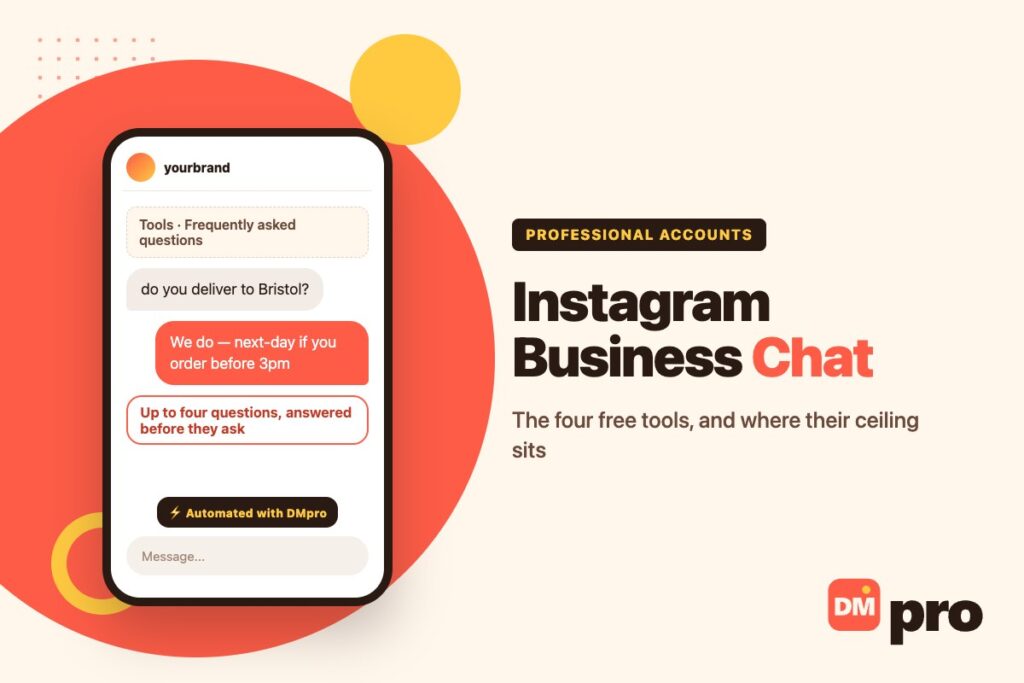
Instagram business chat is not a single feature you switch on. It is the set of messaging tools that appears when an account becomes a professional one – a few automatic replies, a small library of canned answers, and a shared inbox if you connect a Facebook Page.
All of it is free, most of it takes ten minutes to configure, and a surprising share of business accounts have never set any of it up. That is the first thing worth fixing, before anyone considers buying something.
This covers what each tool actually does, the limits each carries – the FAQ feature allows four questions, not forty – and the point at which a growing inbox stops fitting inside them.
Key Takeaways
What Business Chat Actually Is
Worth settling first, because the phrase gets used for several different things and people go looking for a setting that does not exist under that name.
A Toolset, Not a Feature
There is no switch labelled “business chat”. What exists is a group of messaging tools that become available once an account is a professional one – Business or Creator – and they sit in different places in the app rather than in one menu.
This is why guides disagree about where to find things. The FAQ feature lives under Messages, the away message lives in your professional settings, and message controls sit under privacy.
What It Costs to Switch
Switching is free, reversible, and does not change who can see your posts or cost you followers. The one genuine trade-off is that a professional account cannot be set to private – if being private matters more than the messaging tools, this is not for you.
Business or Creator
Both unlock the messaging tools. The practical difference is in categories, contact buttons and which insights you get, rather than in what you can do with messages. A shop should pick Business; an individual whose name is the brand usually fits Creator better.

The Four Built-In Tools
Each is genuinely useful and each has a limit that guides tend to leave out. The limits are the reason a growing account eventually needs something else.
Frequently Asked Questions
The most underused of the four. Instagram’s page on setting up frequently asked questions on Chats explains that these appear when somebody tries to message your account, so they intercept the question before it is typed.
You reach them from Messages, then Tools, then Frequently asked questions, and switch on the Show Questions toggle. Each entry takes a question and an optional automated response.
The limit is four
Instagram allows up to four questions. Choose the four that genuinely repeat, not the four that show your range.
Write them as the customer would
Phrase them the way a customer would type them. “Do you deliver to my area?” gets tapped; “Shipping information” does not.
The answer is optional, and should not be
A question with no automated response just opens a conversation you still have to answer by hand.
Saved Replies
Canned answers you insert with a shortcut rather than retyping. Useful, and frequently misunderstood: nothing sends automatically. A saved reply saves you typing while you are already in the app, which means it does nothing at all at midnight.
Our guide to Instagram quick replies covers how they are set up and the three different features that share the name.
The Away Message
An automatic reply outside the hours you set. The one worth spending five minutes writing properly, because it is the only tool that works when nobody is there.
A good away message names a time and an alternative channel. “Thanks for your message!” is worse than nothing, because it confirms somebody read it and then nothing happens. Our guide to the Instagram away message covers the scheduling and what it should say.
The Instant Reply
One automatic acknowledgement the first time somebody messages you, regardless of the hour. Think of it as a receipt rather than an answer: it buys you a little patience, and only a little.
Setting It Up Properly, Once
Perhaps fifteen minutes in total, and most of it is writing rather than configuring.
Switch to a professional account
Settings, then Account type and tools, then Switch to professional account. Choose Business or Creator and a category that matches what you actually do.
Write down the questions you actually get
Before touching any settings, list the questions you answered in the last fortnight. The list is usually shorter than people expect and almost always has an obvious top four.
Set up the four FAQs with real answers
Messages, then Tools, then Frequently asked questions. Turn on Show Questions, add your four, and give every one an automated response rather than leaving it blank.
Write an away message that says something useful
Name when you will reply and where to go if it is urgent. Then set the schedule to the hours you genuinely work, not the hours you wish you worked.
Add saved replies for the next tier of questions
The ones that recur but are not in the top four. These save typing during the day.
Link a Facebook Page if more than one person answers
This is what brings Instagram messages into the shared Business Suite inbox, so colleagues can reply without passing a phone around or sharing a login.
Leave message controls alone
Under settings, message controls decide whether strangers can reach you at all. Switching requests off is the fastest way to stop spam and it also stops new customers, who are strangers too.
Where the Built-In Tools Stop
Nothing above is a compromise – it is free, native and sufficient for a long time. But each tool has a shape, and the shape stops fitting at a fairly predictable point.
Four Questions Is Four Questions
The FAQ feature offers a fixed menu before the conversation starts. It cannot respond to what someone actually asked, so the fifth most common question, and every variation of the first four, still arrives as a message a person must answer.
Nothing Reacts to a Comment
The built-in tools act on messages. A question left under a post, a reply to a story, a mention in someone else’s story – none of these trigger anything, and for most businesses that is where a good share of the interest actually shows up.
The Record Lives in the Inbox
There is no capture of a name, an email or a phone number, and nothing flows anywhere else. Every conversation stays an Instagram conversation, which is fine until somebody asks how many enquiries came in last month.

Past the Ceiling
When the inbox stops fitting into somebody’s afternoon, the next step is a connection through Instagram’s official API rather than a bigger effort inside the app.
What That Changes
DMpro connects through the official API and answers based on what was actually asked rather than from a fixed menu of four – hours, price, delivery, availability, whatever repeats for you. It also triggers on comments, story replies and mentions, not only on direct messages.
Details from the conversation can be captured and sent to a CRM, and anything it cannot handle goes to a person with the whole thread attached rather than as a notification to start from scratch. Our guide to Instagram DM CRM covers organising that side.
What It Does Not Change
The rule underneath everything. A connection through the official API still waits for the customer to message first, and so does any legitimate tool: there is no compliant way to send unsolicited direct messages to people who have not contacted you, whatever a given product claims.
If reaching people who are not already talking to you is the goal, that is outbound work on a different channel – our guide to Instagram DM outreach covers how it is actually done, from your own account and at human pace.
One Inbox, Several Platforms
The same connection covers WhatsApp, Messenger, TikTok and Telegram, which matters more than it sounds: customers use whichever app is already open, and the business that answers consistently across all of them is usually just the one that stopped checking four apps separately.
Common Questions, Settled
The things people search for immediately after setting any of this up.
| Question | Answer |
|---|---|
| How do I turn business chat off? | Switch back to a personal account, or turn off each tool individually |
| How many FAQs can I add? | Four, each with an optional automated response |
| Do saved replies send automatically? | No. They insert text; you still press send |
| Is business chat private? | Conversations are, but a professional account itself cannot be set to private |
| Do I need a Facebook Page? | For the shared Business Suite inbox, yes. For the in-app tools, no |
| Can I message people first? | Only people who have messaged you. That applies to every official connection |
| Does switching cost followers? | No. Switching does not change who sees your posts |
Getting the Most Out of It
Three habits that make more difference than any configuration.
Check the Requests Folder
Messages from people who do not follow you are filed separately and must be accepted before they appear in your main list. For a business, that folder is where new customers are – and it is the one most people never open. Our guide to Instagram DM requests covers how it behaves.
Rewrite the FAQs Every Few Months
The four questions that repeat change with your stock, your season and your pricing. A set written last year is answering questions nobody is asking.
Answer Fast, Not Beautifully
Most people messaging a business have messaged two others at the same time. The reply that arrives first usually wins, and it rarely wins on wording.
Set Up the Free Tools First. Then This.
Instagram’s four FAQs and an away message cover a real amount of ground, and cost nothing. The point they stop is when the fifth question, and every rewording of the first four, still lands on somebody to answer by hand.
DMpro picks it up there: it connects through the official API, answers based on what was actually asked, triggers on comments and story replies as well as messages, and passes the conversations that need judgement to a person with the thread already in front of them.
- Answers chosen by the question, not a fixed menu of four
- Triggers on comments, story replies and mentions too
- Official API connection, so no password is shared
- Contact details captured and sent to your CRM
- WhatsApp, Messenger, TikTok and Telegram in the same inbox
- The repeating questions stop reaching a person
- Comments and story replies are not left unanswered
- Any colleague can pick up a thread with full context
- It still cannot message anyone who has not messaged you
- Not worth setting up before the free tools are configured
Conclusion
Instagram business chat is four free tools, and most accounts that have switched to a professional account have never configured any of them. Four FAQs with real answers, an away message that names a time and an alternative, saved replies for the next tier of questions, and a linked Page if more than one person answers – that is an afternoon’s work and it handles a great deal.
Know the limits while you set them up. Four questions is four; saved replies need you present; nothing in the app reacts to a comment or a story reply. Those are the edges that decide when something more is worth paying for.
And whatever you use, the rule underneath does not move: the customer messages first. Any product promising to open conversations with people who have not contacted you is describing something Instagram does not permit, whatever it costs.
Answers chosen by what was asked, on Instagram’s official API. Free plan to start.
Try DMpro free