
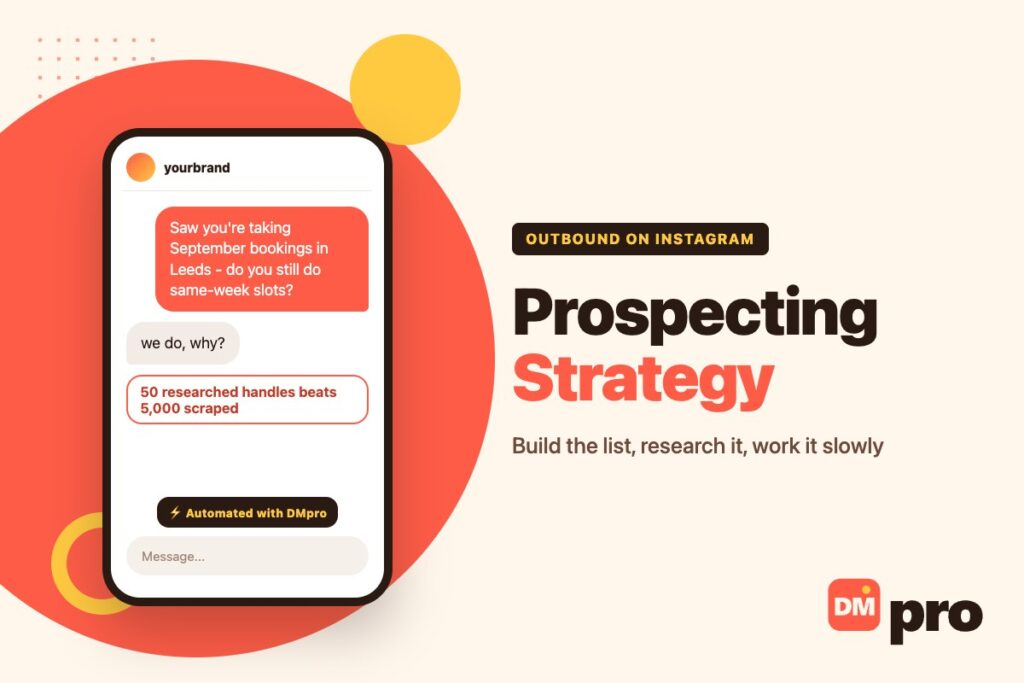
Most Instagram prospecting fails before a single message is sent, because the list is wrong. Five thousand handles scraped from a hashtag will out-perform nothing at all, and will cost you an account restriction on the way. Fifty names you chose deliberately will fill a week.
So this is a strategy about the list rather than the pitch: who qualifies, where those people come from in order of warmth, what thirty seconds of research per name buys you, and what pace keeps the account healthy. The message itself is covered properly in our Instagram DM outreach guide, and the templates in DM templates.
The short version: prospecting is a sorting problem, not a sending problem. Everything below is about sorting.
Key Takeaways
Decide Who Actually Qualifies
Before any searching, write down what makes someone worth a message. Three lines is enough, and without them every later step is guesswork.
The Three Lines
The category
What they do, narrow enough that a stranger could repeat it. “Independent bridal shops”, not “retail”.
The signal
Something observable that says they might need you now – a launch, a hiring post, a complaint, a sold-out item, an event.
The disqualifier
What takes someone off the list immediately. Usually a size, a market or a tool they already use.
Why the Disqualifier Matters Most
A prospecting list without an exclusion rule grows until it is meaningless. The disqualifier is what keeps it short enough to research, and researching is the only part that changes reply rates.

Where the Names Come From
In order. Exhaust each source before moving down, because warmth falls faster than volume rises.
People Who Already Engaged With You
Saves, comments, story replies, shares, people who tagged you. They reacted once, which is more intent than any hashtag can show. Almost nobody works this list deliberately, which is exactly why it is the best one.
Engagers on Similar Accounts
The people writing real comments under creators and businesses in your category have proven interest in the subject rather than in one account. Read the comment before you add the name – a thoughtful question is a prospect, an emoji is not.
Local, Event and Category Searches
City tags, venue tags, event hashtags and bio keywords. These produce volume and little warmth, so they only work when the research step is done properly. Searching the way a customer would – a city plus a category, not a broad industry tag – keeps the quality up.
What Not to Use
Bought lists, scraped follower dumps and anything exported from a third-party tool that harvested profiles. There is no signal in them, the contact details are usually wrong, and collecting profile data at scale runs against Instagram’s terms of use. Our piece on what Instagram treats as spam covers where the line sits.

Thirty Seconds Per Name
This is the whole method. It does not scale, and that is the point.
Open the last three posts
You are looking for something time-bound: a launch, a move, a hire, a complaint, a sold-out product, an event they are going to. Anything that makes a message relevant this week rather than in general.
Read the bio and the link
City, category, whether they take bookings, who they serve, what they sell. Half the disqualifications happen here, in about four seconds.
Write one line only they could receive
“Saw you’re taking September bookings in Leeds” is research. “Love your content” is not. If the line would make sense sent to a hundred accounts, it has not done its job.
Add the one relevant fact
What you do, in a single sentence, connected to the thing you just referenced. Not your founding story and not a feature list.
Finish with a yes-or-no question
Small enough to answer between appointments. “Want me to send the dimensions?” beats any request for a call, and a short clause giving them permission to decline raises replies rather than lowering them.
Working the List Without Losing the Account
The research protects reply rates. Pacing protects the account, and the two are separate problems.
Volume Is Not the Variable, Sameness Is
Instagram does not publish a messaging limit, and restrictions arrive on pattern as much as on count: identical structure, perfectly regular timing, a long run of messages to people who never contacted you. Our Instagram DM limit guide has the working numbers by account age, and mass DMing covers the ramp.
A Workable Rhythm
Start low
Twenty a day on an established account, fewer on a new one, and build over weeks rather than days.
Vary the gaps
Uneven spacing between sends. Perfectly regular intervals are the easiest pattern there is to detect.
Stop on a warning
If Instagram shows a block or a warning screen, stop for the day. Pushing through turns a warning into a restriction.
One follow-up, with news
Two to four working days later, and only if it carries something the first message did not.
Where a Tool Helps, and Where It Does Not
No tool should pick the list for you – that is the part that decides the result. What is worth handing over is the repetition: the DMpro Chrome extension reads each profile, drafts the opening line from what is actually on it, spaces the sends unevenly, stops at the daily number you set and pauses by itself if the platform pushes back. It runs in the browser you are already signed into, on Instagram and TikTok, so no password changes hands.
What to Track, by Source
Measure the list, not the effort. These four columns tell you which source to keep working.
| Source | Messages sent | Reply rate | What to do |
|---|---|---|---|
| Engaged with you | Small | Highest by far | Work it to exhaustion before anything else |
| Engagers on similar accounts | Medium | Good | Keep, and tighten which accounts you pull from |
| Local and event searches | Medium | Mixed | Keep only the searches that produced replies |
| Category searches | Large | Low | Cut unless the research step is genuinely being done |
| Bought or scraped | Any | Near zero | Stop |
Keep the record somewhere searchable rather than in your head – a sheet is enough to begin with, and our DM CRM guide covers what to do when it outgrows one.
Three Risks Worth Planning For
These were the whole of the original version of this article, and they are still real – they are just not a strategy on their own.
Bot Engagement Distorts Your Targeting
Automated accounts inflate likes and follows on the posts you are mining for prospects, so a list built purely from engagement can be partly fictional. Read the comments rather than counting them; a sentence about the product is a person, a string of emoji often is not.
You Are Handling Other People’s Data
Names, handles, cities and notes about someone’s business are personal data in most jurisdictions, whatever platform they came from. Keep the list somewhere access-controlled, write only what you need for the conversation, and delete it when a prospect says no. Scraping profiles at scale to build that list is its own problem, separate from how you store it.
Reputation Travels Faster Than Outreach
A bad cold DM gets screenshotted and posted, and on Instagram that reaches your actual customers. The practical guard is the same as the strategy: if the message could have gone to anyone, do not send it. Our piece on whether the cold DM is dead covers why the generic version stopped working, and Meta’s spam policy sets out what crosses into enforcement.
Keep the Judgement, Hand Over the Repetition
Choosing who goes on the list, and what the first line says, is the work that earns replies. Everything after that is mechanical: the DMpro Chrome extension reads each profile, writes the opener around what it finds, and sends from your own Instagram or TikTok account at a pace you decide.
It starts low on a new account, keeps the gaps uneven, stops at your daily number and pauses on the first warning. When replies come back, DMpro can answer the inbound side over the official APIs, free for the first 250 conversations a month.
- A shortlist you build, pasted in or uploaded as a CSV
- An opener drafted from each profile, not a template
- Instagram and TikTok from one extension
- Uneven gaps and a daily ceiling you choose
- An automatic stop the moment the platform pushes back
- The research still shows in every message
- Nothing leaves your own logged-in browser session
- Pairs with a free inbound plan for the replies
- It will not build or qualify the list for you
- The browser has to stay open while a campaign runs
Conclusion
An Instagram prospecting strategy is a list strategy. Define who qualifies and who does not, work the warm sources before the cold ones, and spend thirty seconds per name so the first line could only have been written for that person.
Then go slowly. Start at twenty a day, vary the gaps, stop at the first warning, follow up once with something new, and judge each source by replies rather than by how many names it produced. That is the whole method, and it beats volume every time it is actually followed.
Personalised first lines on Instagram and TikTok, sent from your own account with a daily cap you set.
Get the DMpro extension