
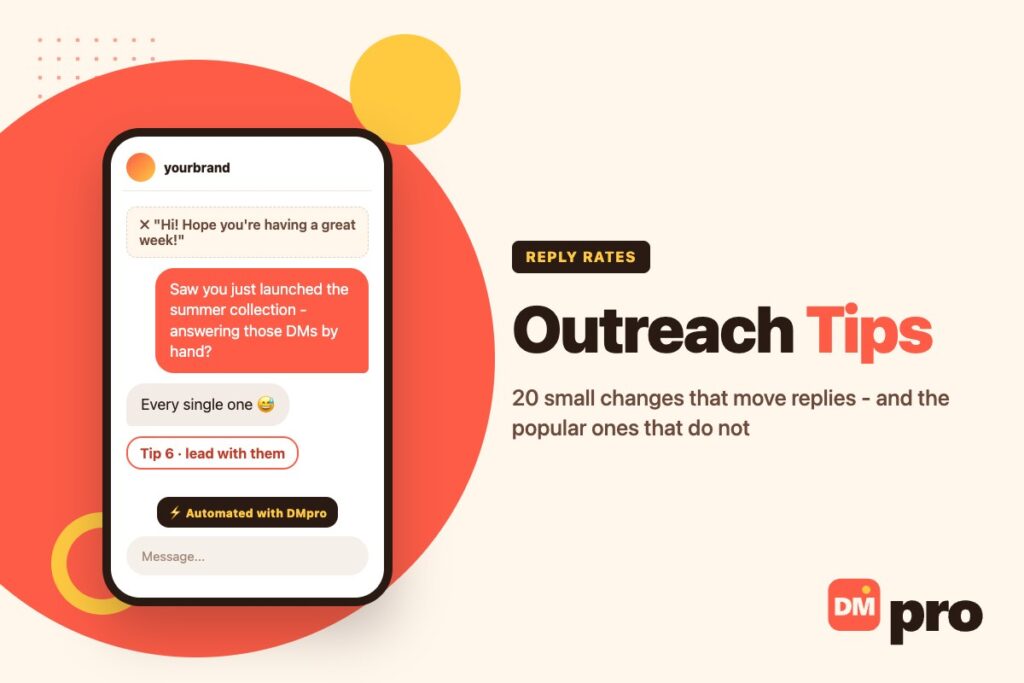
Most outreach advice is about the message. Most outreach results are decided before the message: by who is on the list and whether you had anything specific to say to them. Fix that first and average copy performs well. Skip it and brilliant copy still gets ignored.
The tips below apply whether you reach people by email, through website contact forms or in the DMs that sit at the centre of DM marketing. They are grouped by the stage they affect, followed by the popular advice that sounds smart and does nothing, and a simple way to test any tip properly.
At the end you will see which tips a tool can carry for you – the DMpro Chrome extension for Instagram and TikTok DMs and contactID for contact forms – and which ones stay yours.
Key Takeaways
The Short Version: Four Rules Behind Every Tip
Almost every tip below is an application of four rules. If advice you read anywhere does not serve one of them, it is decoration – the test at the heart of any working outreach strategy.
The Four Rules
Be relevant
Message people for whom your offer is obviously useful right now.
Be specific
Prove you looked, in the first line, with something checkable.
Be brief
Short messages get read; long ones get closed.
Be persistent, briefly
Two or three follow-ups, then stop cleanly.

Tips 1-5: Building the List
This is where the leverage is. The same message sent to a tighter list outperforms a rewritten message sent to a loose one.
Who to Include
1. Cut the list until it hurts
If you cannot say why this person, remove them. Fifty researched names beat five thousand scraped ones.
2. Hunt for triggers, not just fits
A recent launch, a job posting, a new location. A trigger gives you a reason to write today rather than someday.
3. Mine your competitors’ engaged followers
People who comment under a competitor are already interested in the category.
Who to Leave Out
4. Prefer people who can say yes
A perfect message to someone with no authority is a polite dead end.
5. Keep a do-not-contact list
Nothing burns goodwill faster than pitching someone who already said no.
Tips 6-10: The First Message
Four lines at most. The difference a specific opener makes shows up line by line.
Ignored vs Answered
- Opener. Ignored: “Hi, hope you’re having a great week!” Answered: “Saw you just launched the summer collection.”
- Reason. Ignored: “I work with brands like yours.” Answered: “You’re answering those DMs by hand, right?”
- Proof. Ignored: “We have years of experience.” Answered: “We cut a similar store’s reply time to under an hour.”
- Ask. Ignored: “Do you have 30 minutes for a demo?” Answered: “Want the 2-minute version?”
The Five Rules for Message One
6. Lead with them, not you
The first words should be about the prospect.
7. Delete the compliment
“Love your content” is among the most-deleted openers there is.
8. No links in message one
They read as a pitch and can hurt delivery.
9. Make the ask tiny
“Worth a look?” converts better than a calendar invite.
10. Read it aloud before sending
If it sounds like a brochure, rewrite it.
Tips 11-15: Following Up
Follow-ups are where most people leave results on the table – not because they send too few, but because they send the wrong kind. A bump with nothing new in it, sent the next morning, reads as pressure rather than persistence.
How Many and How Often
11. Send two or three, not one
Most replies come after the first message; stopping at one throws most of them away.
13. Space them out
Several days apart, not daily.
What to Say
12. Never write “just bumping this”
Add something: an example, a result, a shorter offer.
14. Change the angle, not just the words
If the first was about time saved, try cost or a case study.
15. Close the loop politely
“I’ll leave it here – happy to reconnect later” keeps the door open and often gets a reply by itself.

Tips 16-20: Timing and Pacing
Timing matters far less for whether a message converts and far more for whether your account survives the campaign. Treat this section as account hygiene.
Protect the Account
16. Spread sends across the day
Bursts look automated; irregular gaps look human.
17. Stay well under the ceiling
Instagram publishes no official DM limit, and Meta’s spam policy targets high-frequency and repetitive messaging. Stay well below anything that has triggered a warning.
18. Warm new accounts first
A brand-new profile that starts messaging strangers gets restricted quickly.
Protect the Conversation
19. Reply fast when they respond
Interest decays in hours, not days.
20. Run it weekly, not in bursts
Fifteen messages a day beats five hundred sent in a panic at quarter end.
Channel-Specific Tips
The fundamentals carry across channels, but each has one thing that matters more than the rest.
| Channel | What matters most | Common mistake |
|---|---|---|
| Instagram or TikTok DM | Your profile – they check it before replying | Messaging from an empty profile |
| Website contact form | Brevity and naming the company | Pasting a long email sequence into the form |
| Cold email | Deliverability and a warmed domain | Sending volume from a cold domain |
| A credible headline and work history | Pitching in the connection request |
On social, the profile does half the selling before your message is read, which is why Instagram DM outreach starts with the profile. For commercial email in the US, the CAN-SPAM Act adds its own rules: honest subject lines, a postal address and a working opt-out.
Popular Tips That Do Not Work
These circulate because they are easy to write about and easy to do. That is the problem: they feel like progress without touching the list or the first line.
Tweaks That Change Little
Chasing the perfect send time
Relevance swamps timing. A good message on a Tuesday afternoon beats a bad one at the ideal hour.
Adding more merge tags
A first name is not personalisation, and everybody can tell.
Seven-step sequences
After three, you are annoying people who have already decided.
Tactics That Backfire
Fake urgency
“Only two spots left” from a stranger reads as a scam.
Voice notes to strangers
High effort, and often unwelcome from someone unknown.
Sending more
When replies drop, the instinct is volume; the fix is almost always the list. Volume without relevance is what made the cold DM blast die.
How to Test a Tip Properly
Any tip is a hypothesis until it works for your list and your offer.
Change one thing
If you rewrite the opener and switch channels at the same time, you learn nothing. Change one variable and keep everything else fixed.
Give it enough messages
Five sends tell you nothing. Aim for a few dozen per version before drawing a conclusion.
Measure the right step
A weak reply rate with healthy profile views is a copy problem. A weak positive-reply rate with a healthy reply rate is a targeting problem.
Write down the result
A simple log stops you re-testing the same idea next quarter, and turns scattered attempts into something you learn from. The same discipline runs through good sales outreach.
Which Tips a Tool Can Carry
The judgment tips – who to contact, what to offer, how to follow up – stay with you. The discipline tips are exactly what software is good at, because people forget them under pressure.
On Instagram and TikTok: the DMpro Extension
The DMpro Chrome extension covers tips 6, 16 and 17. It drafts each DM from the person’s own name, bio and follower count, so the message starts with them; it puts random delays between sends; and it enforces a daily cap, with Safety Mode for new users at 20 a day and automatic pauses when Instagram shows a warning. It does not send follow-ups for you – tips 11 to 15 stay manual.
On Contact Forms: contactID
contactID covers tips 5, 8 and 10 for website outreach. Its Contacted before check flags companies you already messaged before anything is sent, and a deliverability check scores each message and flags too many links, ALL CAPS, spam-trigger phrases, a missing personalisation tag, a message that is too long or has no clear ask. A/B split testing compares the submission success rate of two messages.

Put the Mechanical Tips on Autopilot
Tips 16 and 17 are the ones people break first when a campaign gets busy. The DMpro Chrome extension keeps them for you on Instagram and TikTok – random gaps, a daily cap and an automatic stop on warnings – while drafting each opener from the prospect’s own profile. You can try it on 10 free messages a month.
For outreach to companies through their websites, contactID checks every message against the same rules as tips 8 and 10 before it goes out, and stops you pitching a company twice.
- Openers drafted from each prospect’s profile
- Random delays and a daily cap on every campaign
- Automatic pause when Instagram shows a warning
- Contacted before check for website outreach
- Message check for links, caps, length and personal tags
- Keeps the discipline tips when you are busy
- Your own account sends every DM
- Free tier to test on real prospects
- No automatic follow-ups – tips 11 to 15 stay manual
- Does not replace a good list or offer
Conclusion
If you only take three of these: cut the list until every name has a reason, spend most of your writing time on the first line, and follow up twice with something new. Those three move reply rates more than the other seventeen combined.
Everything else is refinement, worth doing once the fundamentals work and only one change at a time. Then make it a weekly habit rather than a quarterly panic – consistency is the tip nobody puts on a list, and it beats all of them.
Random gaps, daily caps and a personal opener for every profile – built into the DMpro extension.
Try the DMpro extension