
Most Instagram strategy guides are written for someone with a marketing team. They assume a content calendar, a design resource, somebody to watch the analytics, and enough hours that doing fifteen things reasonably well is realistic.
A small business has none of that. It has an owner with perhaps three hours a week, and those hours are competing with actually running the business. So the useful question is not what else to add. It is what to stop doing, because almost every list of Instagram tactics is mostly things that will not pay you back at your size.
This goes through what to drop first, what the recent hashtag change means, where the hours genuinely return something, and the four numbers worth looking at once a month.
Key Takeaways
Start by Cutting, Not Adding
Every tactic below is defensible for a brand with staff. At three hours a week each one is a direct subtraction from replying to customers, which is the activity that produces money.
Hashtag Research
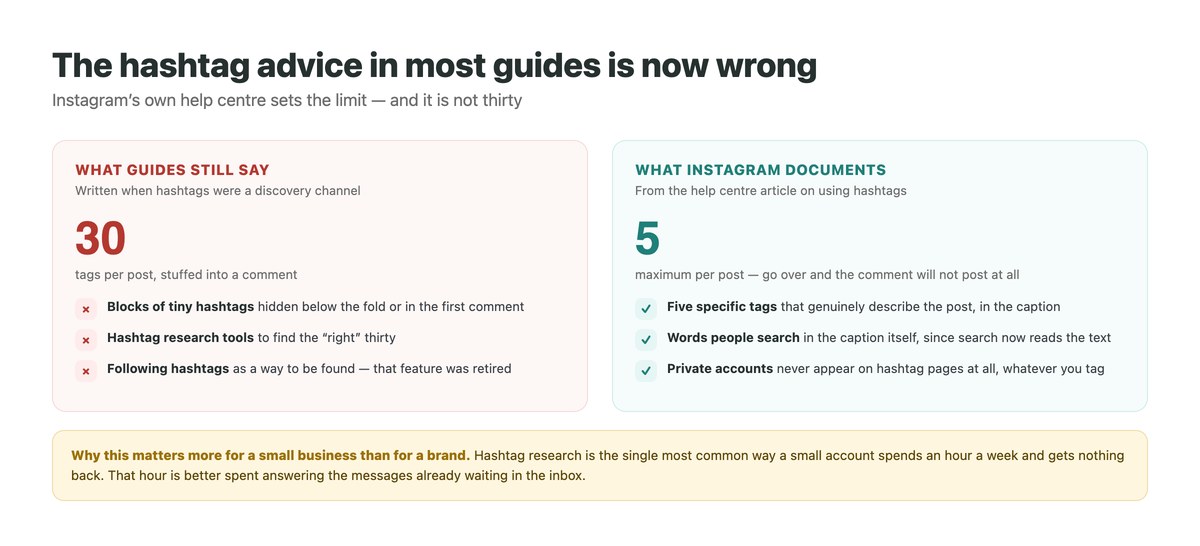
This is the clearest cut, because the rules changed underneath it. Instagram’s own help page on using hashtags states that you can use up to five tags on a post, and that a comment containing more than five will not post at all.
So the thirty-hashtag block, the research tools that find them, and the hour a week spent maintaining lists of them are all built on a limit that no longer exists. Instagram also retired the ability to follow hashtags, and its head has said publicly that hashtags do not boost reach – so even within the five you are allowed, the return is categorisation rather than distribution.
Posting Every Day
Daily posting is advice for accounts whose content costs nothing to produce. For a business where the owner is also the photographer, it guarantees four thin posts and one good one per week, and the four thin ones are what most people see.
Post when you have something worth showing. The account that posts twice a week and answers every message beats the account that posts daily and replies on Thursdays. If you want the timing question settled too, our guide to the best time to post on Instagram covers what actually moves and what does not.
Chasing Followers
A follower count is the most visible number and the least useful one. A joinery business with four hundred local followers who book is in better shape than one with nine thousand scattered across three continents.
Follower-growth tactics – follow-for-follow, giveaway farming, engagement pods – produce exactly the audience that will never buy from you, and then dilute your reach because they do not engage with what you post.
Competitor Audits
Worth doing once, properly, and then not again for a year. The recurring version becomes a way of feeling productive without changing anything, and it tends to produce imitation rather than difference.
Your Profile Is the Only Page That Converts
Everything else on Instagram is discovery. The profile is where somebody who is already interested decides whether you are real and whether to message you, and it is the thing small accounts revise least.
The Name Field Is Searchable
The name field – not the handle, the one underneath it – is indexed by Instagram’s search. “Marta Silva” tells search nothing; “Marta Silva | Dog Grooming Leeds” tells it what you do and where. This is a five-minute change most accounts never make.
The Bio Answers Three Questions
What you sell, who it is for, and what to do next. Not a mission statement, not a quote. A visitor is deciding in about two seconds whether this account is the thing they were looking for.
If you serve one city, say the city. Local specificity converts better than broad appeal for every business that cannot ship.
Highlights Are Your FAQ
Prices, hours, delivery, before-and-afters, reviews. Every question that arrives in your DMs more than twice belongs in a highlight, and every one you add is a message you do not have to answer by hand.
Name them for the question, not the mood
“Prices” and “Delivery” get tapped. “Vibes” and “BTS” do not, because nobody is looking for them.
Four is plenty to start
Built from the four questions you answered most last month. Add more only when a fifth question starts repeating.
Update the one that goes stale
A highlight showing last winter’s prices costs you more trust than having no highlight at all.
One Link, Pointed Somewhere Specific
Not the homepage. Point it at the thing people in your DMs keep asking for – the booking page, the menu, the current offer – and change it when the answer changes.
Where the Hours Actually Go
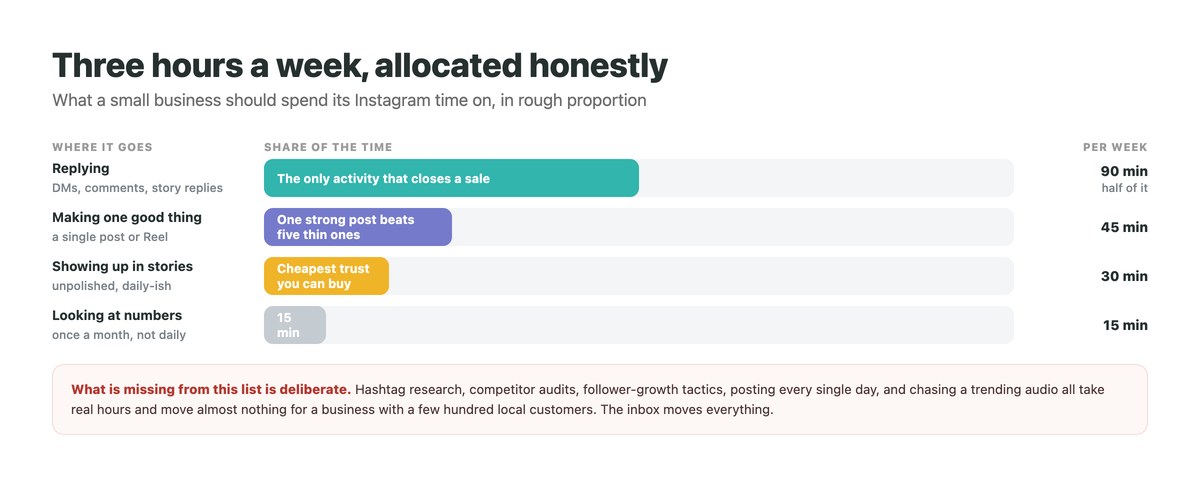
If three hours is the budget, this is roughly how it should be divided. The proportions matter more than the numbers.
Half of It Belongs in the Inbox
This is the part that feels like admin and is actually sales. Someone who messages a small business has already decided they are interested; the only question left is whether anyone answers before they lose interest or ask someone else.
Comments and story replies count as the inbox too. A question left visible under a post is also a public demonstration of whether you reply.
One Good Thing a Week
A single post or Reel that you actually put effort into: the finished job, the new stock, the thing you make shown being made. One of these beats five posts of stock photos and quotes, and takes less total time.
Stories, Unpolished
Stories are the cheapest trust a small business can buy because they are supposed to look unedited. The van, the workshop, the queue, the dog. Five minutes a day, no production.
They also carry the most useful interactive tools – polls, question stickers – which turn passive viewers into people who have messaged you once, which makes the second message much easier.
Numbers, Monthly
Fifteen minutes a month. Daily checking tells you nothing a month would not, and it changes what you post in response to noise.
The Inbox Is Where a Small Business Closes
Worth separating out, because it is the half of the budget and the half people treat as an interruption rather than as the work.
Speed Beats Polish
A fast, plain answer converts better than a careful one written three hours later. Most enquiries to a small business are simple – do you have it, how much, when can you, do you come to my area – and the person is messaging two or three businesses at once.
Answer the question first
Then add the detail. A reply that opens with three sentences of greeting reads as a template.
Say the price
Refusing to give a number in the DM is the single most common reason a small-business enquiry goes quiet.
Close with one question
Something answerable in a word, so the conversation has somewhere to go.
The Questions Repeat More Than You Think
Write down the questions you answer in a week and you will find five or six covering most of it. Those belong in your highlights, in your bio, and in saved replies so they take seconds rather than minutes.
Instagram’s own saved replies handle the simplest version of this and cost nothing. Our guide to Instagram quick replies covers how they are set up and where they fall short.
When Answering by Hand Stops Scaling
DMpro takes over the repetition: it connects through Instagram’s official API, answers the questions that keep arriving – hours, price, availability, delivery – and hands anything unusual to you with the conversation attached, so you pick up a thread rather than start one.
It covers WhatsApp, Messenger, TikTok and Telegram the same way, which matters when customers reach you on whichever app they already have open. Our playbook on selling on Instagram DM covers the conversation itself, and DM marketing goes deeper on turning those threads into a repeatable funnel.
Do Not Buy Automation Before You Need It
If you get four messages a week, answer them yourself. Automation earns its place when the inbox stops being something you can clear in a sitting, and not before – a half-configured bot answering four people badly is worse than answering them late.
The Four Numbers Worth a Monthly Look
Ignore the rest. These four tell you whether the hours are working; the others tell you how you feel about them.
| What to look at | What it tells you | What to do about it |
|---|---|---|
| Profile visits | Whether discovery is working at all | If it is low, your posts are not reaching new people |
| Saves and shares | Whether a post was genuinely useful | Make more of whatever got saved |
| Link taps | Whether the profile converts the interest | If visits are high and taps are not, rewrite the bio |
| Messages received | The number closest to revenue | If it is rising, keep doing exactly what you did |
If you only track one, track messages. For a small business it is the metric nearest to money, and it responds within days to a change in how you post or how fast you reply.
What to Do in the First Fortnight
Starting from a neglected account, in order. None of this needs a budget.
Week One: Fix the Shopfront
Rewrite the name field to include what you do and where. Rewrite the bio to answer the three questions. Build four highlights from the questions you answer most. Point the link at something specific. This is perhaps ninety minutes and it is the highest-return ninety minutes available to you.
Week Two: Clear the Inbox and Start Replying Properly
Open the message requests folder – most small accounts have unread enquiries in there they have never seen, because Instagram files messages from people who do not follow you separately. Our guide to Instagram DM requests explains how that folder works. Answer everything in it, however old. Then set up saved replies for the five questions that repeat.
From that point the routine is the time budget above: reply first, make one good thing, show up in stories, look at numbers once a month.
The Enquiry Goes to Whoever Replies First
Someone messaging a small business has usually messaged two others as well. The job is almost never won on the quality of the answer; it is won on arriving before the others do.
DMpro answers the repeating questions the moment they arrive, on Instagram, WhatsApp, Messenger, TikTok and Telegram, and passes anything that needs you to you – with the conversation already in front of you rather than waiting to be reconstructed.
- Instant answers to hours, price and availability questions
- Official connections, so no password is shared
- Comment and story-reply triggers as well as DMs
- Customer details captured as the conversation happens
- A free plan, which is enough for a small account
- An enquiry at 9pm is answered at 9pm
- The same answers wherever the customer messaged
- You only read the conversations that need you
- Overkill if you get a handful of messages a week
- The repeat answers still need writing once, properly
Conclusion
The honest Instagram strategy for a small business is short, and most of it is subtraction. Stop researching hashtags, since Instagram now allows five and says they do not drive reach. Stop posting daily if daily means thin. Stop measuring yourself by followers.
Then spend the recovered hours on the two things that do work at your size: a profile that tells a stranger what you do and where in under two seconds, and an inbox that gets answered quickly. Everything else on the usual list of tactics is a brand’s problem, not yours.
If you do nothing else from this page, rewrite your name field to include your trade and your city, and open your message requests folder. Between them that is about twenty minutes, and for most small accounts it is the largest single improvement available.
Instant replies on Instagram and WhatsApp through official connections. Free plan to start.
Try DMpro free