
Two different questions get asked here and only one has a useful answer. Identifying a fake WhatsApp number is something you can do in about a minute. Tracing it back to a person is not something you can do at all, and every site promising otherwise is selling something.
Below are the signals that actually give a fake account away, what to do once you have spotted one, and a plain explanation of where the tracing myth comes from. It is part of our WhatsApp tips and troubleshooting guide.
If a stranger has messaged you about money, a job, a parcel or a wrong number, you are almost certainly in the right place.
Key Takeaways
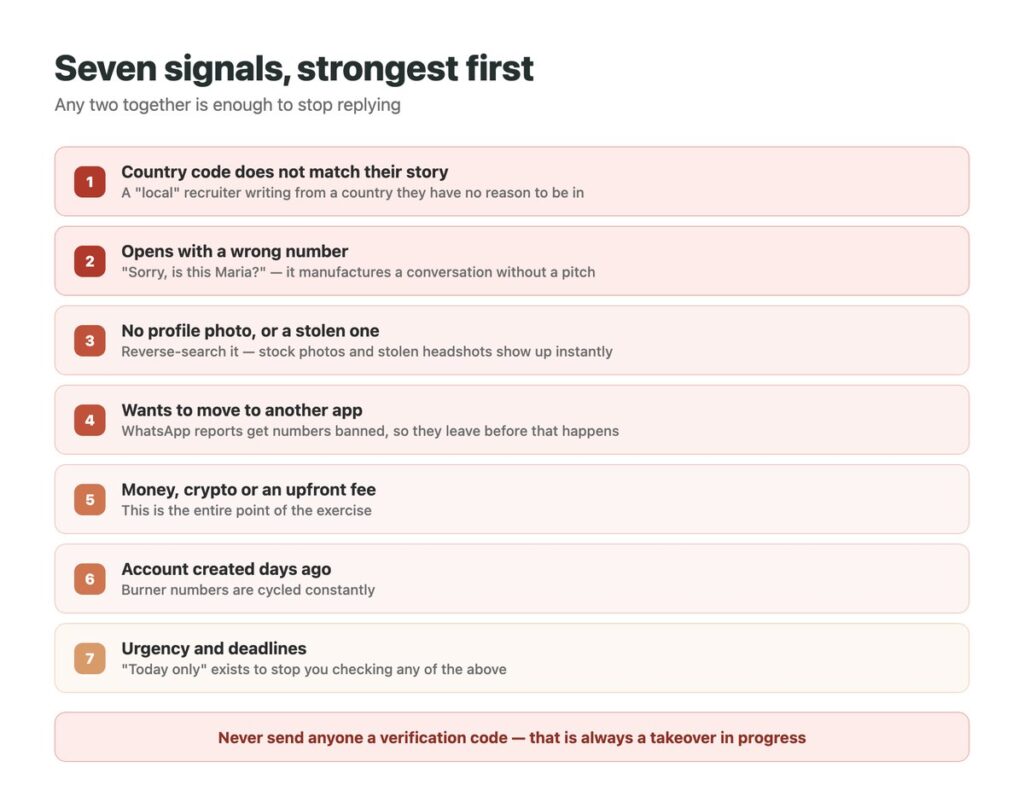
Seven Signals, Strongest First
Any two of these together is enough to stop replying.
| Signal | What it looks like | Why it gives them away |
|---|---|---|
| Mismatched country code | A “local” recruiter on a foreign number | Scam operations rent numbers wherever it is cheap |
| No profile photo, or a stock one | Empty profile or a stolen headshot | Real accounts accumulate history |
| Account created very recently | Nothing before this week | Burner numbers are cycled constantly |
| Opens with a wrong number | “Sorry, is this Maria?” | The oldest opener there is – it manufactures a conversation |
| Moves fast to another app | “Let’s talk on Telegram” | WhatsApp reports get numbers banned, so they leave |
| Money, crypto or a fee appears | Any investment or upfront payment | This is the entire point of the exercise |
| Pressure and deadlines | “Today only”, “act now” | Urgency stops people checking |
Checking a Number in About a Minute
None of this requires an app, and none of it tells the sender anything.
Read the Country Code Against Their Story
A recruiter for a local company writing from a country they have no reason to be in is the single clearest tell. Look up the prefix if you do not recognise it.
Open the Profile
Check the photo and the About text. A completely empty profile on an account messaging strangers is a strong signal on its own.
Reverse-Search the Photo
Drop the profile picture into any reverse image search. Stolen headshots turn up on stock sites or on someone else’s social profile immediately.
Notice What They Ask For
Money, crypto, a fee, a code, or a move to another app. Any one of those turns a suspicion into a decision.
Do Not Reply to Confirm
Replying tells them the number is live and being read, which is worth something to them even if you say no.

Why You Cannot Trace the Number Yourself
This is the part that disappoints people, and it is worth being direct about. A WhatsApp number is a phone number, and the link between a number and a person sits with the mobile operator that issued it. Operators do not publish that, and they release it only to law enforcement with a legal request.
That is not a WhatsApp limitation, it is how telephone numbering works everywhere. WhatsApp itself does not know who you are beyond the number, and the messages are end-to-end encrypted, so there is nothing for anyone to hand over even if they wanted to.
- No app can reveal the owner. If one could, it would be a data breach rather than a product.
- “Lookup” sites return the carrier and region at best, which the country code already told you.
- Paid tracing services resell that same public prefix data, or nothing.
- Location tracking is not possible from a message. Nothing in a WhatsApp message carries a location unless someone deliberately shares one.
- Uploading the number to a lookup tool hands your own data to a stranger to learn what you already know.
What Actually Works Instead
Since tracing is off the table, the useful actions are the ones that stop the account rather than identify the person.
- Report inside WhatsApp. Open the chat, tap the number, choose Report. This sends recent messages to WhatsApp and is what gets numbers banned.
- Block, after reporting. Blocking first can end the chat before the report captures anything.
- Do not delete the chat until you have reported it, for the same reason.
- Report to your national fraud body if money changed hands. That is the only route with any legal power.
- Warn whoever is being impersonated if the scam uses a real company’s name.
What Each Tool Can and Cannot Tell You
A blunt summary, because this is where most of the wasted effort goes.
| Tool | Actually returns | Does not return |
|---|---|---|
| Country code lookup | Country and sometimes region | Any identity |
| Reverse image search | Whether the photo is stolen | Who is behind the account |
| “Trace WhatsApp number” sites | Carrier and prefix data, or nothing | The owner, location or address |
| WhatsApp itself | Nothing about the sender | Any subscriber data |
| Law enforcement request | Subscriber records from the operator | Available to you directly |
The same rule applies on other platforms. Spotting a fake Instagram DM relies on exactly this pattern of reading signals rather than chasing identity.
Protecting Your Own Number
Most people arrive at this problem after their number has already been circulated. These reduce how often it happens again.
- Turn on two-step verification. This blocks the most common account takeover route outright.
- Restrict who sees your profile photo and About to your contacts. Scammers harvest both.
- Set who can add you to groups. Random group additions are a common harvesting method.
- Never share a verification code, including with someone who appears to be a friend. That is always a takeover in progress.
- Review the rest of your settings – securing your WhatsApp covers the full list.

If It Reached You Through Your Business
Businesses get a heavier version of this: scam messages arrive constantly, and separating them from real customer enquiries is the actual cost, not the scam itself.
The pattern is consistent enough to filter. Real enquiries reference something specific about your product; scams open with a wrong number, a job offer or an investment. Keeping that triage out of your own head is one of the practical reasons for treating the inbox as a managed queue rather than a notification list.
If that inbox is a WhatsApp Business number, the app’s own automatic replies do part of the triage for free by telling a real customer when you will answer – our guide to WhatsApp Business auto reply covers setting them up, and the fourteen-day rule that makes a working greeting look broken.
Filter the Noise From the Real Enquiries
DMpro answers genuine customer messages across WhatsApp, Instagram, TikTok, Telegram, Messenger and LinkedIn, and routes anything that needs a person, so scam and spam messages stop consuming your attention.
It runs in your own session and never asks for your password. Free plan with 250 conversations a month; see pricing.
- Handles real customer questions across six channels
- Routes anything unusual to a human instead of answering it
- Keeps every thread logged, so reporting is easy later
- Works inside WhatsApp’s own 24-hour service window
- Never asks for your password or verification code
- Genuine enquiries get answered, noise does not
- A record of every conversation if you need to report one
- One queue instead of six notification streams
- Free plan, no card
- Filters your business inbox – it cannot stop scam messages reaching a personal number
Conclusion
Identifying a fake WhatsApp number is quick: check the country code against their story, look at the profile, reverse-search the photo, and notice what they ask for. Any two signals together is enough.
Tracing the number to a person is not possible for you, or for any app. That link sits with the mobile operator and is released only to law enforcement.
So do the thing that works: report first, block second, delete last – and never send anyone a verification code.
Start free with DMpro and let genuine customer questions get answered while the noise gets filtered.
Filter your inbox free