
Germany is a strict market to run creator campaigns in, and the strictness is the reason to think carefully about who runs them. The labelling rules are set by statute and sharpened by a set of Federal Court of Justice decisions, and the burden of proof sits in an unusual place – which makes the quality of the contract between brand and creator a commercial question, not an administrative one.
So this covers the agencies, but starts with the rule that decides what any of them can put in a brief. Then nine agencies worth shortlisting, each described by how it positions itself, with no founding years, network sizes or price claims – those are the parts of an agency listicle that go stale within a quarter.
Finally, what the work costs, and the two routes that do not involve an agency at all. If you are weighing another market at the same time, our guide to choosing an influencer marketing agency in Dubai runs the same comparison for the UAE.
Key Takeaways
Do You Actually Need an Agency in Germany?
Worth settling before you start comparing. An agency is bought for relationships, for accountability, and for someone to carry the brief through a market whose rules you may not know well.
What You Are Really Buying
Not access to creators – that is available through any marketplace and through a direct message. What an agency sells is a shortlist built from people they have worked with before, a contract that holds, and somebody whose job it is to make sure the post goes out correctly labelled. If you only need the database, an influencer marketplace does that part for a fraction of a retainer.
When It Is Not Worth It
A single campaign with a small budget rarely justifies a retainer, because the fee can exceed what reaches creators. The test is simple: if the agency fee is a large fraction of the creator budget, you are paying mostly for project management you could do yourself.
The Part Nobody Can Outsource
Advertiser liability. If a paid post goes out without a label, the brand behind it is exposed regardless of who briefed it. A good agency reduces that risk substantially. It does not transfer it.
The Labelling Rule That Shapes Every German Brief
This is the part of the German market that catches foreign brands, and it is worth understanding before a single agency call.
What the Statute Says
The operative provision is § 5a(4) UWG, the unfair competition rule on misleading by omission. Failing to make the commercial purpose of a commercial act identifiable is unfair, unless that purpose follows directly from the circumstances and the omission could lead a consumer to a decision they would not otherwise have taken.
The same provision then says a commercial purpose does not exist, for an act benefiting another company, where the person received or was promised no payment or similar consideration.
The Presumption Runs the Other Way
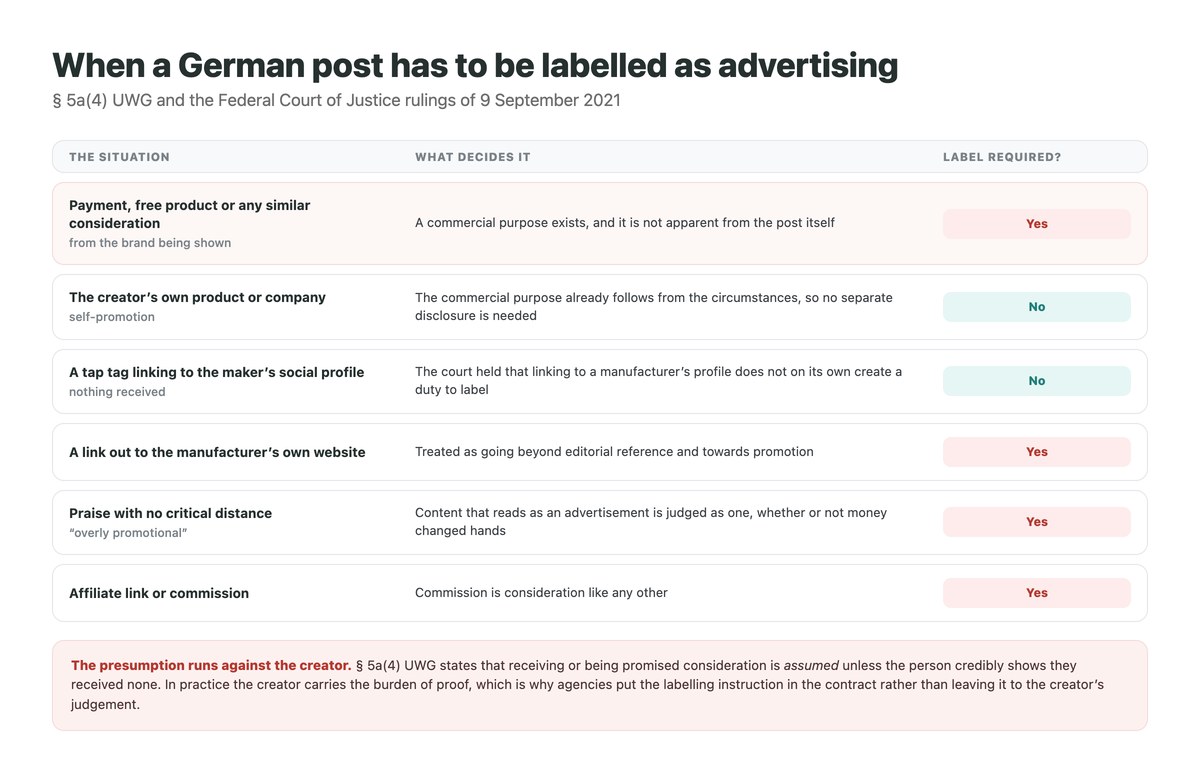
Then comes the sentence that makes German practice distinctive: receipt or promise of consideration is presumed, unless the person credibly shows they received none.
That reversal is why German briefs are specific about labelling in a way briefs elsewhere often are not. A creator who simply liked the product and posted about it still has to be able to demonstrate that, after the fact. Agencies handle this by putting the labelling instruction in the contract rather than leaving it to a creator’s reading of the rules.
What the Federal Court Settled in 2021
Three decisions handed down on 9 September 2021 – I ZR 90/20, I ZR 125/20 and I ZR 126/20 – dealt with tap tags in Instagram posts and drew the line now relied on in practice.
A post promoting the creator’s own business does not need a separate label, because its commercial purpose already follows from the circumstances. A tap tag pointing at a manufacturer’s social profile does not by itself create a duty to label. A link out to the manufacturer’s own website, or content so promotional that it carries no critical distance, does.
What This Means for Your Brief
Specify the label, not the sentiment
Name the wording and where it must appear. A brief that asks for ‘authentic enthusiasm’ and leaves labelling to the creator is the brief that produces a problem.
Treat gifted product as paid
A free item is consideration. The distinction between gifted and paid matters commercially; for labelling it mostly does not.
Cover affiliate links explicitly
Commission is consideration, and a creator adding their own affiliate link to your campaign post changes the position without telling you.
Nine Influencer Marketing Agencies in Germany
Listed in no particular order, each described by how it positions itself. None of them publishes standard pricing, so a shortlist always ends in a written proposal. Every agency below had a reachable site when this was written; vendor lists rot, so check before you call.
Alpha Pool
A Berlin agency working across celebrities, brand ambassadors and premium creators, mostly in beauty, fashion, lifestyle and travel, offering campaign work end to end rather than creator sourcing alone.
Consider it if
Brands that want a celebrity or premium-creator campaign run for them.
Glowstaff
Positions itself around campaigns built per client across Instagram, TikTok and YouTube, and says it works with startups through to large corporates on awareness and revenue goals.
Consider it if
Brands wanting one partner across the three main creator platforms.
Influxo
Focuses on matching brands to the right creators, and points to working relationships with German television as well as offering full talent management alongside agency services.
Consider it if
Campaigns where television and creator work overlap.
Das Kartell
A Berlin agency centred on brand communication through creator collaboration, with a deliberately direct, informal way of working and services offered in modules rather than one package.
Consider it if
Brands that want to buy parts of a campaign rather than all of it.
BUZZINTALENTS
Sits inside a wider advertising agency, so creator campaigns are planned alongside the rest of a digital programme rather than as a standalone activity.
Consider it if
Brands that want influencer work inside a broader media plan.
Lookfamed
Based in Gottingen rather than Berlin or Munich, and describes its approach as individual campaigns and long-running client relationships rather than one-off activations.
Consider it if
Brands planning a continuing programme rather than a single push.
Schach zu Dritt
A Berlin agency combining brand development, digital marketing and live events, with creator work as one strand of a larger creative offer.
Consider it if
Campaigns where an event or brand launch sits at the centre.
Influry
A Berlin agency presenting itself around data-led creator selection and performance campaigns across Instagram, Facebook and TikTok.
Consider it if
Brands that want creator spend judged on performance metrics.
Bold Creators Club
A Munich agency specialising in vertical video – TikTok and Reels – covering development, production and promotion of the formats themselves.
Consider it if
Brands whose campaign lives or dies on short vertical video.
German Influencer Agencies at a Glance
A quick way to narrow nine down to the three you will actually brief.
| Agency | Base or focus | Shortlist it for |
|---|---|---|
| Alpha Pool | Berlin, celebrity and premium creators | Beauty, fashion, lifestyle and travel at scale |
| Glowstaff | Instagram, TikTok and YouTube | One partner across the three main platforms |
| Influxo | Creator matching, television links | Campaigns spanning TV and social |
| Das Kartell | Berlin, modular services | Buying parts of a campaign, not all of it |
| BUZZINTALENTS | Inside a wider ad agency | Creator work planned with the rest of the media |
| Lookfamed | Gottingen, long-term programmes | A continuing relationship, not one activation |
| Schach zu Dritt | Berlin, brand and live events | Launches and events with a creator layer |
| Influry | Berlin, data and performance | Creator spend judged on performance |
| Bold Creators Club | Munich, vertical video | TikTok and Reels as the main format |
Deliberately missing from this table: founding years, roster sizes and prices. The previous version of this article carried all three, and all three were out of date within months.
How to Choose Between Them
Three proposals is the right number – enough to compare, few enough to read properly. Work through these in order.
Decide the format before the agency
A vertical-video campaign and a long-form YouTube integration need different agencies, and a short-video push may be better served by one of the TikTok marketing agencies than by a generalist. Picking the agency first and the format second is how brands end up paying a specialist to do something generic.
Ask who owns the creator relationship
Some agencies manage talent directly; others broker. It changes what happens when a creator is late, goes quiet, or wants to renegotiate mid-campaign.
Get the labelling clause in writing
Ask to see the clause they put in creator contracts. An agency that cannot show you one is managing the risk informally, which means you are carrying it.
Ask what happens to the content afterwards
Usage rights for paid media and for your own channels are negotiated separately from the post itself, and are a common source of a second invoice.
Ask for two references in your category
Not case studies, which are written to be flattering. Two clients you can email, in a category close enough to yours that the comparison means something.
Compare proposals on what reaches creators
Split every proposal into fee and creator budget. Two agencies quoting the same total can differ by a factor of two in what actually buys reach.
What German Agencies Cost
None of the nine publishes a price list, which is normal for the category and unhelpful for planning. What follows is how the commercial models differ rather than what any particular agency charges.
The Models You Will Be Quoted
Monthly retainer
A fixed fee for ongoing strategy, sourcing and management, with creator budget separate. Suits a continuing programme.
Project fee
One campaign, one fee. Easier to compare between agencies, and the usual starting point for a first engagement.
Percentage of creator spend
The fee scales with the budget, which aligns the agency with spending more. Ask what the floor is.
Performance element
A share tied to clicks, sales or sign-ups. Rare as a whole model, common as a component.
The Number That Matters
Whatever the structure, work out the proportion of your total that reaches creators. On a small budget an agency can easily consume half of it, which is the honest argument for running a first campaign yourself and bringing an agency in once the format is proven.
Running It Without an Agency
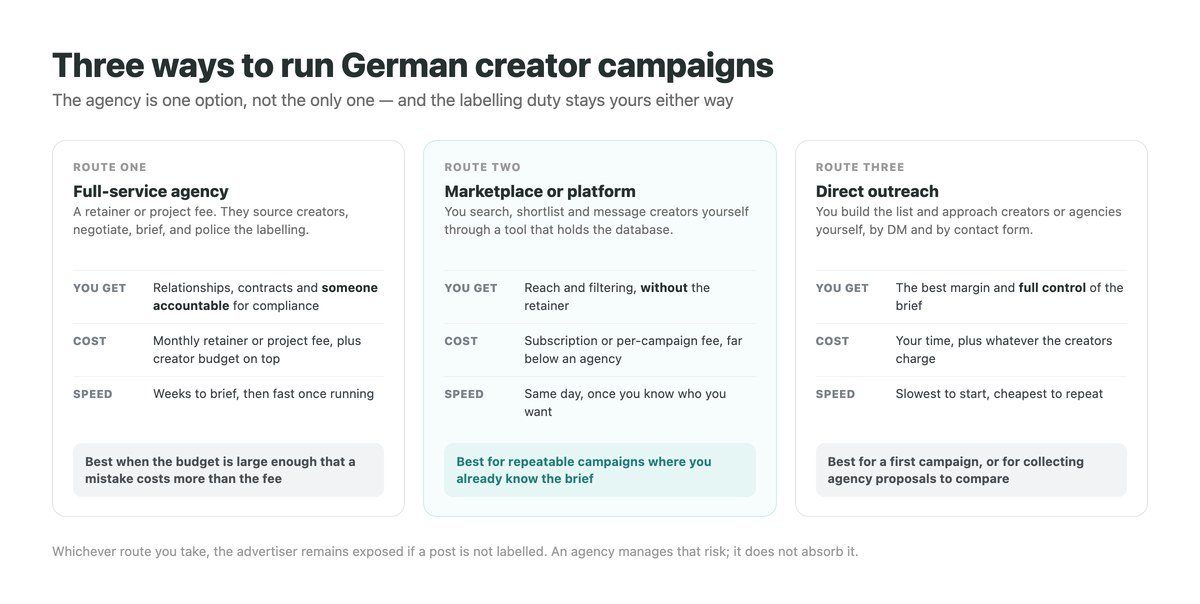
Two routes do not involve a retainer. Both take more of your time and both leave the labelling duty exactly where it was.
Approaching Creators Directly
For a first campaign this is usually the right call: you learn what German creators charge, what they will and will not do, and how long they take to reply – all of which make you a much better agency client later.
The DMpro Chrome extension handles the volume side of that, drafting a personal first message for each creator from their profile and sending it from your own account with daily limits and spacing. Our guide to influencer outreach covers what that first message has to contain to get answered.
Collecting Agency Proposals at Scale
The same tooling argument applies to the agencies themselves. German agencies almost all take new business through the enquiry form on their site rather than a public inbox, which makes comparing nine of them a tedious afternoon of copying the same paragraph.
contactID does that part: you give it the agency websites, it finds each enquiry form and submits your brief with the agency named, and it reports which sites had no form. It is the fastest way to turn a shortlist into a stack of proposals you can actually compare.
Handling the Replies
DMpro covers the other half once campaigns are live and creators start sending traffic at you – it answers the repeating questions on Instagram, Messenger, WhatsApp, TikTok and Telegram through official APIs and hands the real conversations to a person. Our guide to Instagram DM CRM covers keeping track of those conversations.
A Campaign Is Only Worth What You Answer
A German creator campaign lands in your DMs, not on your website. The spike arrives in an hour and the questions arrive in the creator’s timezone, not yours.
DMpro answers the repeating ones instantly on Instagram, Messenger, WhatsApp, TikTok and Telegram, captures contact details, and passes the real conversations to a person while the customer is still there.
- Instant replies on five channels through official APIs
- Comment, DM, story reply and mention triggers
- Contact details captured and routed to your CRM
- Hand-off to a person with the full thread
- A free plan to start
- A campaign spike does not go unanswered overnight
- The same answer wherever the creator sent people
- Staff only see conversations that need them
- It does not source creators or negotiate rates
- The repeating answers still need writing once
Conclusion
The agency question in Germany is narrower than it looks. Nine credible agencies and a dozen more besides will all source creators competently; what separates them is format specialism, who holds the creator relationship, and whether the labelling clause in their contracts is something they can show you on request.
Run the statute first. Under § 5a(4) UWG the law assumes a creator was paid unless they can show otherwise, which means every brief has to be explicit about labelling rather than leaving it to judgement. An agency that treats this as a formality is telling you how the first complaint will go.
And if this is a first campaign, consider running it yourself before you buy a retainer. You will learn what the market charges, and you will brief an agency far better in six months than you could today.
Instant replies across five channels through official APIs – free to start.
Start free with DMpro