
Nearly every list of influencer marketing platforms ranks them one to fourteen, which is the least useful thing you can do with them. These products are not competing on a single axis. A creator search engine and a payment-and-contracts workflow are different purchases that happen to share a category name.
Buying the wrong category is the normal failure, and it is expensive because almost everything here is sold annually. A team whose real problem is chasing thirty creators for deliverables buys a discovery tool, searches brilliantly, and still chases thirty creators by email.
So this sorts fourteen products by the job each is actually built for, says what each is worth considering for, and ends with the questions that decide a purchase – none of which a demo will raise on your behalf. No prices here: this category reprices and consolidates constantly, and a list of stale numbers is worse than none.
Key Takeaways
The Four Jobs These Tools Actually Do
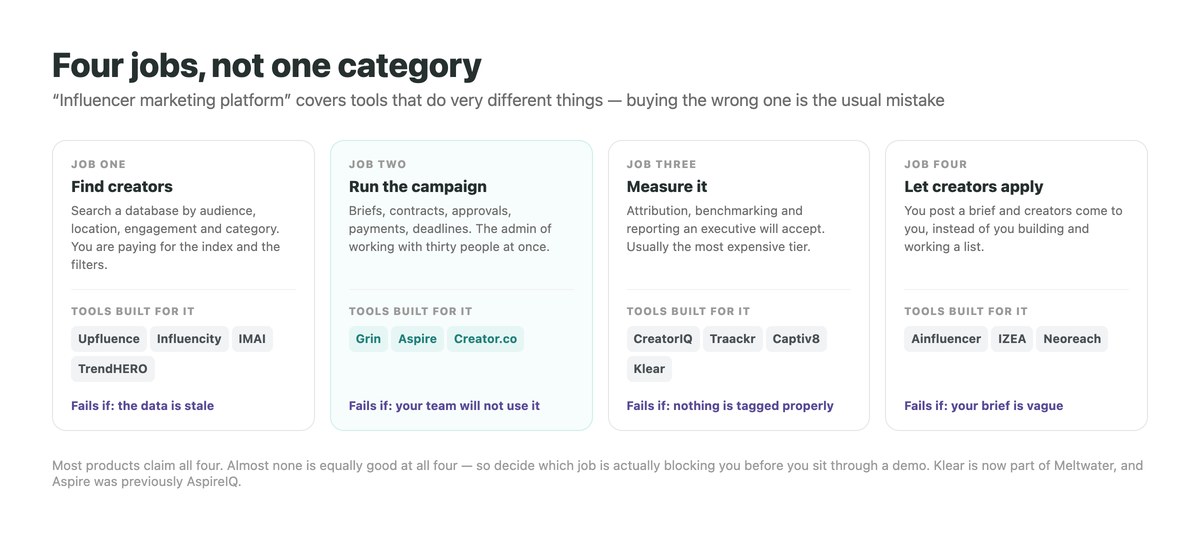
Start here, because the category name hides the only distinction that matters at purchase. Work out which job is blocking you now, and most of the shortlist disqualifies itself.
Finding Creators
A searchable index with filters: audience demographics, location, category, engagement behaviour. You are buying the database and the quality of its last refresh, not software.
The failure mode is stale or inferred data. Any discovery tool can produce a plausible-looking shortlist; the question is whether the numbers behind it are current.
Running the Campaign
Briefs, contracts, approvals, product seeding, deadlines and payment. This is the administrative weight of working with thirty people at once, and it is the job most teams underestimate until the second campaign.
The failure mode here is adoption. A workflow tool nobody on the team opens is worse than a spreadsheet everyone does.
Measuring It
Attribution, benchmarking and reporting in a form a finance or marketing director will accept. Generally the most expensive tier, and generally bought because somebody upstairs asked a question nobody could answer.
The failure mode is upstream: measurement platforms cannot rescue campaigns where links were never tagged and codes were never unique. The same buying logic applies one category over – our comparison of outreach software splits that market by channel rather than by rank.
Letting Creators Apply
The inverse model. You publish a brief and creators come to you, which removes list-building entirely and replaces it with a selection problem.
The failure mode is a vague brief, which produces volume rather than fit. Our guide to the influencer marketplace model goes into when this approach suits a brand and when it does not.
The Fourteen, Sorted by Job
Each description is how the product positions itself, with the job it is genuinely built around named first. Every vendor here was trading when this was written. There are no prices below, deliberately – this category reprices often enough that a published figure is a liability.
Upfluence
A large searchable creator index with filters for audience, location and category, plus tooling to pull creators out of your own customer list.
What job it is for
Discovery
Consider it if
You need to build shortlists repeatedly and want the search to do the work.
Influencity
Positions itself around audience analysis – who actually follows a creator rather than how many – with filtering built on that data.
What job it is for
Discovery
Consider it if
Audience quality matters more to you than follower count.
IMAI
A creator search and analytics product aimed at agencies managing several client rosters at once.
What job it is for
Discovery
Consider it if
You run campaigns for more than one brand.
TrendHERO
Known mainly for audience auditing: spotting bought followers and engagement that does not behave like a real audience.
What job it is for
Discovery
Consider it if
Your main worry is paying for fake reach.
Grin
Built around running the relationship end to end – outreach, briefs, product seeding, contracts and payment – with ecommerce integrations at its centre.
What job it is for
Campaign workflow
Consider it if
You send physical product and need the logistics tracked.
Aspire
Formerly AspireIQ. Covers the campaign cycle from brief to content approval to payment, with a creator marketplace attached.
What job it is for
Campaign workflow
Consider it if
The admin of many simultaneous creators is your bottleneck.
Creator.co
Combines a creator-opt-in marketplace with campaign management, aimed at brands that want to run programmes without building a list first.
What job it is for
Campaign workflow
Consider it if
You want applications and management in one place.
CreatorIQ
Enterprise-tier measurement and programme management, built for teams that have to report creator spend alongside other media.
What job it is for
Measurement
Consider it if
Your reporting goes to a CMO, not a channel owner.
Traackr
Focuses on benchmarking and the long-term view: tracking the same creator relationships and brand presence over time rather than campaign by campaign.
What job it is for
Measurement
Consider it if
You run a continuing programme and need trend data.
Captiv8
Analytics and campaign intelligence aimed at large brands, with an emphasis on performance measurement across a portfolio.
What job it is for
Measurement
Consider it if
You manage creator spend across several brands or regions.
Klear
Now part of Meltwater: klear.com redirects to Meltwater’s influencer marketing suite, so this is a module inside a wider media-intelligence product rather than a standalone purchase.
What job it is for
Measurement
Consider it if
You already use Meltwater, or want influencer data beside PR monitoring.
Ainfluencer
A creator marketplace where brands post campaigns and creators apply, describing itself as having no platform fees and offering a managed option.
What job it is for
Marketplace
Consider it if
You would rather receive applications than build a list.
IZEA
The oldest operator in the category, publicly traded, running a creator marketplace alongside a managed-services team.
What job it is for
Marketplace
Consider it if
You want the option of handing the whole programme over.
Neoreach
Pairs a creator marketplace with analytics and managed campaign services for larger programmes.
What job it is for
Marketplace
Consider it if
You want marketplace reach with reporting attached.
The Shortlist at a Glance
Read down the middle column first. If it does not match the job that is blocking you, the rest does not matter.
| Platform | Built mainly for | Shortlist it if |
|---|---|---|
| Upfluence | Discovery | Repeated shortlist building |
| Influencity | Discovery | Audience quality over follower count |
| IMAI | Discovery | Agencies running several rosters |
| TrendHERO | Discovery | Screening for bought followers |
| Grin | Campaign workflow | Physical product seeding at volume |
| Aspire | Campaign workflow | Brief-to-payment admin is the bottleneck |
| Creator.co | Campaign workflow | Applications and management together |
| CreatorIQ | Measurement | Reporting that reaches a CMO |
| Traackr | Measurement | Long-run programme benchmarking |
| Captiv8 | Measurement | Portfolio-wide performance analytics |
| Klear (Meltwater) | Measurement | You already run Meltwater |
| Ainfluencer | Marketplace | Receiving applications, not building lists |
| IZEA | Marketplace | Wanting managed services as an option |
| Neoreach | Marketplace | Marketplace reach with reporting |
Two entries moved under their old names. Klear now resolves to Meltwater’s influencer marketing suite rather than its own product, and Aspire was previously AspireIQ. Both changed inside the span of a normal content refresh cycle, which is the argument for sorting by job rather than by brand.
What to Ask Before the Trial
Demos are built to show strengths. These questions are the ones that decide whether you renew, so they belong in the first call rather than the eleventh month.
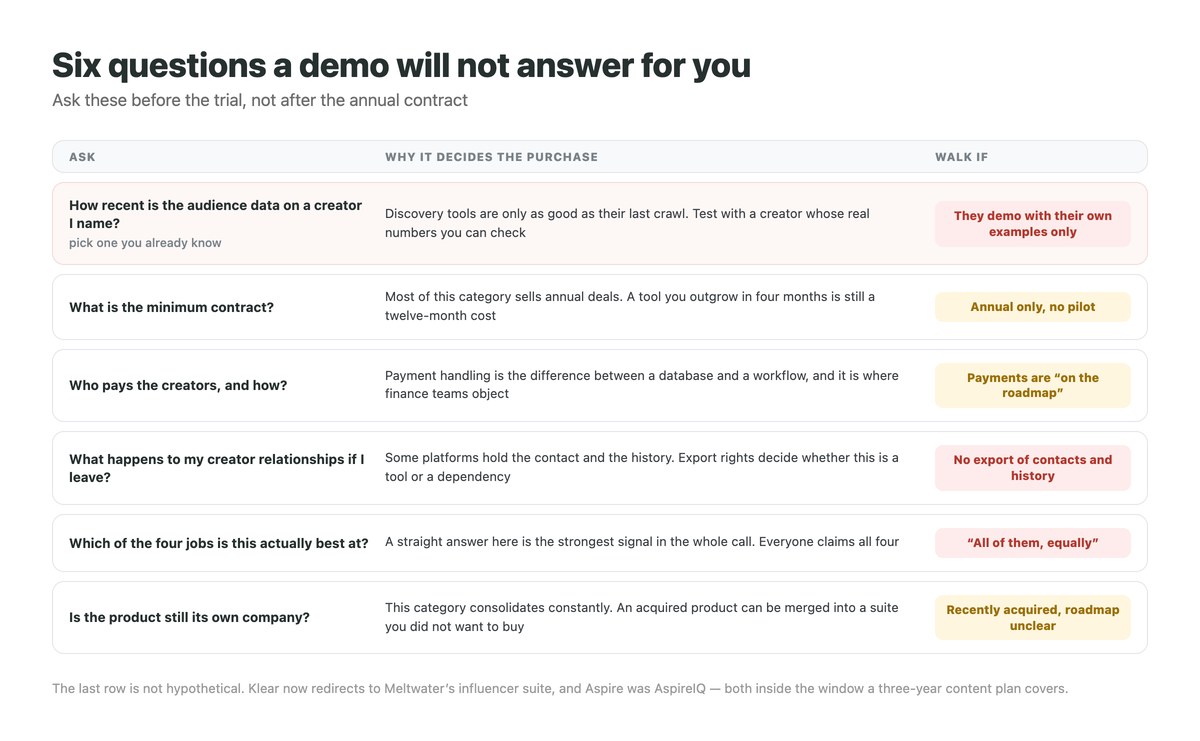
Test the data on a creator you already know
Name someone whose real reach and engagement you can verify independently, and ask the platform to pull them up live. Vendor demo accounts are curated; your test case is not.
Ask which of the four jobs it is genuinely best at
The answer is the single most informative moment in a sales call. A vendor who says ‘all of them equally’ is either not listening or not confident.
Establish the minimum contract and whether a pilot exists
Most of this category sells annually. A tool you outgrow in four months still costs twelve.
Find out who pays the creators
Whether the platform handles payment, in which currencies, and what your finance team has to do. This is where a workflow tool stops being a database.
Ask what leaves with you
Your creator contacts, the conversation history, the performance data. If none of it exports, you have bought a dependency rather than a tool.
Check whether the product is still its own company
The category consolidates constantly. An acquired product can be folded into a suite you never wanted, on a timeline nobody tells you about.
Agree who answers the messages
Campaigns produce conversations, and no platform on this list handles them. Decide before launch whose job that is.
Price it against an agency, not only against other tools
A platform plus your own team is one option; a retainer is another. Our guides to choosing a TikTok marketing agency set out what the fee actually buys.
What None of Them Does
Worth stating plainly, because it is the gap that costs brands the most and it falls outside every product on this list.
The Campaign Produces Conversations, Not Clicks
A creator posts, and the response arrives as questions: is this available, does it ship here, what size is she wearing, is the discount still live. They arrive within the hour, in volume, on whichever platform the post went out on.
Discovery tools do not see them. Workflow tools do not see them. Measurement tools count the post, not the twenty messages it produced and the three that went unanswered until Monday.
Answering Them Without Hiring for It
DMpro handles that side: it connects through the official APIs on Instagram, Messenger, WhatsApp, TikTok and Telegram, answers the questions that repeat, captures contact details, and passes anything genuinely new to a person with the thread attached. Our guide to Instagram DM CRM covers keeping those conversations once they start.
Reaching Creators and Agencies Before Any of This
If you are not ready to buy a platform at all, the manual route still works. The DMpro Chrome extension writes and paces a personal first message per creator from your own account – our guide to influencer outreach covers what that message needs to say.
And if you would rather compare agencies than tools, contactID submits the same brief through each agency’s own enquiry form, which is how you get proposals that are actually comparable.
The Platform Finds the Creator. Who Answers the Replies?
Every tool on this page stops at the moment the post goes live. That is also the moment the work starts arriving, as questions, from people who are ready to buy and will not wait until Monday.
DMpro picks it up there: instant answers to the questions that repeat, on Instagram, Messenger, WhatsApp, TikTok and Telegram, with contact details captured and the difficult ones handed to a person mid-conversation.
- Replies the moment a question arrives
- Five channels on their own official connections
- Comment, story reply, mention and DM triggers
- Contact details written into your CRM
- Hand-off with the whole thread attached
- The hour after a post goes live is not wasted
- One inbox regardless of where the campaign ran
- No password shared with anything
- It does not find creators or negotiate rates
- The repeat answers have to be written properly once
Conclusion
The ranking format that dominates this topic encourages exactly the wrong purchase. There is no best influencer marketing platform, because the fourteen here are not solving the same problem – and a brand that buys a discovery tool to fix a workflow problem will search beautifully while still chasing deliverables by email.
Name the job first. If you cannot find creators, buy discovery. If you can find them but the admin is drowning you, buy workflow. If somebody upstairs is asking what the spend returned, buy measurement. If you would rather be applied to than go looking, use a marketplace.
Then ask the questions a demo will not raise: test the data on a creator you already know, check the minimum term, and find out what leaves with you if you go. Klear becoming part of Meltwater, and AspireIQ becoming Aspire, both happened inside the window your contract will cover.
Official connections on five channels, one inbox, free to start.
Try DMpro free