
Canada looks like one market and behaves like two. A creator campaign here answers to three sets of rules at once – federal competition law, the advertising industry’s own code, and, if a single dollar of it reaches Quebec, a language statute that has nothing to do with advertising standards at all.
Most agency listicles skip all of that and go straight to the logos. The rules are the part that decides what an agency can actually deliver, so they come first here: what counts as a material connection, what the Competition Bureau says a disclosure has to look like, and what Quebec requires of a campaign aimed at its consumers.
Then nine agencies, each described by how it positions itself, with the two American ones labelled as such. No founding years, no roster sizes, no prices. For the same comparison in a market with one regulator instead of three, see our guide to choosing an influencer marketing agency in Germany.
Key Takeaways
The Three Sets of Rules
Worth getting straight before any agency conversation, because it changes which questions are worth asking them.
Federal: the Competition Act
The hard edge is federal. Failing to disclose a material connection between creator and brand can be treated as false or misleading under the Competition Act, and the Competition Bureau’s own Deceptive Marketing Practices Digest warns of significant monetary penalties.
Its definition of a material connection is deliberately wide: any relationship capable of affecting how consumers evaluate the creator’s independence, which takes in free product, discounts, and business or family ties as readily as a fee.
Industry: Ad Standards
Alongside the statute sits the Canadian Code of Advertising Standards, administered by Ad Standards, with influencer-specific guidelines. This layer is self-regulatory and runs on complaints, but it is where the detail about placement and wording lives, and agencies treat it as the working standard.
Provincial: Quebec
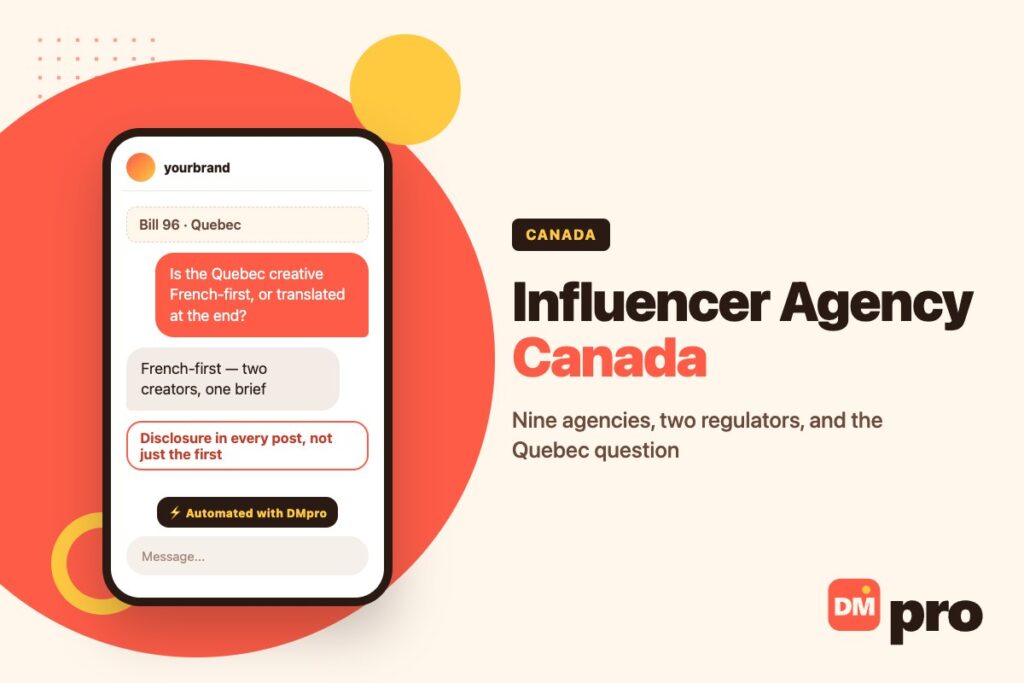
The one most national briefs forget. Under the Charter of the French Language, as amended by Bill 96, commercial advertising aimed at Quebec consumers must be available in French on terms at least as favourable as any other language – and that reaches websites and social content, not only packaging and signage. The stricter signage and trademark provisions took effect on 1 June 2025.
This is a planning constraint rather than a formality: it means French-language creators and French creative of comparable quality, decided at brief stage. Confirm the specifics for your campaign with Quebec counsel rather than with your agency’s account manager.

What a Disclosure Has to Look Like
The Bureau’s guidance is unusually specific about this, including about wordings that do not work – which makes it a useful checklist to hand an agency rather than a principle to argue about.
Wordings That Do Not Count
Vague thanks such as “Thank you Company X!” do not disclose anything. Relationship words used alone – “Ambassador”, “Partner” – are named as ambiguous. Abbreviations like “SP” and “Spon” are called out specifically.
The common thread is that each one requires the reader to already know what it means. A disclosure that needs decoding is not a disclosure.
Where It Has to Sit
As visible as possible, on the reasoning that consumers will not go looking for it. Not buried in a block of hashtags, not in the profile bio, and not behind a “more” link that has to be tapped to expand. It should be visible on every device rather than readable on desktop and clipped on a phone.
In Every Post, Attached to the Content
The guidance expects the disclosure in each post rather than once per campaign, and expects it to be inseparable from the content so that it travels with the post when somebody shares or reposts it. A caption-only disclosure fails that test the moment the video is reposted.
Both Sides Are Responsible
Creators must disclose; advertisers are expected to ensure that they do, and to satisfy themselves that the claims being made can be substantiated. An agency helps you discharge that duty. It does not hold it for you.
This is the single best question to put to a prospective agency: show me the disclosure clause you put in creator contracts, and tell me what you do when a creator posts without it.

Nine Agencies Working in Canada
No ranking is implied by the order. Each description is the agency’s own positioning. Two of the nine are American firms that appear on most Canadian lists because of their size, and they are labelled accordingly – it is a real distinction when you are asking who will be on your account. Every one had a working website on the day this was published.
Viral Nation
The largest name on this list, running creator campaigns and talent representation at a scale that suits national launches rather than single activations.
Where it is based
Canadian
Consider it if
A national campaign that needs volume and a team behind it.
Sightline Marketing
A smaller shop positioning itself around strategy and campaign management rather than roster size, which tends to mean closer attention per campaign.
Where it is based
Canadian
Consider it if
Brands that want a senior person actually on their account.
The Influence Agency
Toronto-based, offering creator work alongside wider digital services, so campaigns can be planned with search and paid media rather than in isolation.
Where it is based
Canadian
Consider it if
Creator spend that has to sit inside a broader plan.
The Aber Group
A digital agency where influencer work is one strand of a longer-running marketing relationship rather than a standalone product.
Where it is based
Canadian
Consider it if
An ongoing programme rather than a one-off push.
Influence Marketing
Positions itself specifically around creator campaigns rather than as a general agency with an influencer department.
Where it is based
Canadian
Consider it if
Wanting a specialist rather than a generalist.
Reshift Media
A digital agency with a strong multi-location and franchise practice, which is a genuinely different problem from a single national brand.
Where it is based
Canadian
Consider it if
Franchises and brands with many local outlets.
Hype
Works across social and creator campaigns with an emphasis on the content itself as much as on distribution.
Where it is based
Canadian
Consider it if
Campaigns where production quality carries the idea.
VaynerMedia
A large US agency with international reach rather than a Canadian specialist. Worth knowing it is on most Canada lists because of size, not because of a Canadian base.
Where it is based
US, works in Canada
Consider it if
Global campaigns where Canada is one market of several.
Village Marketing
A New York creator agency, part of the same group as VaynerMedia, again listed for reach rather than for Canadian specialism.
Where it is based
US, works in Canada
Consider it if
US-led campaigns extending north of the border.
Canadian Influencer Agencies at a Glance
Nine is too many to brief. Use this to pick three.
| Agency | Base | Shortlist it for |
|---|---|---|
| Viral Nation | Canada | National scale and talent representation |
| Sightline Marketing | Canada | Senior attention on a smaller account |
| The Influence Agency | Canada | Creator work planned with search and paid |
| The Aber Group | Canada | A continuing programme, not one campaign |
| Influence Marketing | Canada | A creator specialist rather than a generalist |
| Reshift Media | Canada | Franchises and multi-location brands |
| Hype | Canada | Campaigns carried by production quality |
| VaynerMedia | United States | Global campaigns including Canada |
| Village Marketing | United States | US-led work extending into Canada |
Absent from this table on purpose: founding dates, roster sizes and prices. The previous version of this page carried all three and every one of them had drifted out of date.
How to Run the Shortlist
Three written proposals, from the same brief. These are the questions that separate agencies rather than flattering them.
Ask the Quebec question first
Does the proposal include French-language creators and French creative, or does it assume a translation at the end? The answer tells you immediately whether they have run a genuinely national campaign before.
Ask to see the disclosure clause
The exact wording in their creator contracts, plus what happens when a creator posts without it. Your liability, their process.
Find out who is actually on the account
Particularly with the two American agencies. The people in the pitch are rarely the people doing the work, and the gap is wider the larger the agency.
Match the agency to the format, not the country
A short-video campaign and a long-form YouTube integration are different buys; our guide to the TikTok marketing agencies covers the specialist end of that.
Separate the fee from the creator budget
Every proposal should show both. Two agencies quoting an identical total can differ by half in what reaches creators.
Ask how they substantiate performance claims
The Competition Act requires claims to be supportable. If a creator will say your product does something, somebody needs the evidence before the post goes up.
Get two references you can email
Not case studies. Two clients, in a category close enough that the comparison tells you something.
What It Costs, and the Alternatives
No Canadian agency on this list publishes a price list, which is normal for the category. The commercial models are comparable even when the numbers are not.
The Shapes a Quote Takes
Retainer
A monthly fee for continuing strategy, sourcing and management, with creator budget on top. Suited to a programme.
Project fee
One campaign, one number. The easiest shape to compare across agencies and the usual first engagement.
Percentage of spend
Scales with the budget, which aligns the agency with spending more of it. Ask what the minimum is.
Bilingual uplift
Quebec creative is a second production, not a translation line item. Expect it to be priced as such, and be suspicious if it is not.
Going Direct Instead
If all you want is the creator database rather than the service wrapped around it, an influencer marketplace is a cheaper purchase outright. Otherwise, for a first campaign, approaching creators yourself is usually the better education and the cheaper mistake. You learn Canadian rates, which creators answer, and how much lead time a bilingual campaign really needs.
The DMpro Chrome extension takes the tedious half of that – composing an opening message per creator from their profile and pacing the sends so the account stays healthy. Our influencer outreach guide covers what the message itself has to do.
Getting Proposals Without the Legwork
Canadian agencies take new business through the form on their site, so comparing nine of them means filling in nine forms with the same brief.
contactID handles that: point it at the shortlist, and it finds each enquiry form, submits your brief with the agency named, and reports which sites had none. Nine answers to one identical brief is the only comparison worth making.
Catching What the Campaign Sends
A Canadian creator post produces its response as messages within the hour, in two languages if you did Quebec properly. DMpro answers the repeating questions through official platform connections and escalates the rest with the thread attached. Our Instagram DM CRM guide covers keeping those conversations from evaporating.
A Bilingual Campaign Needs a Bilingual Inbox
If the Quebec half of your campaign worked, half the questions arrive in French – and arrive at the same time as everything else, from a post that took four seconds to watch.
DMpro handles the repetition on Instagram, Messenger, WhatsApp, TikTok and Telegram over each platform’s official connection, collects the details that matter, and passes anything real to a person with the conversation already in front of them.
- Replies the moment a question arrives, on five channels
- Official platform connections, no password shared
- Triggers on comments, story replies, mentions and DMs
- Contact details routed into your CRM
- Escalation to a person with the full thread
- A campaign spike at midnight is not a lost night
- One place for every channel the campaign touches
- Staff open only what genuinely needs them
- It does not source creators or negotiate rates
- Your French replies still have to be written by somebody who speaks it
Conclusion
Choosing a Canadian agency is mostly choosing how seriously you take Quebec. An agency that treats French as a translation task at the end of production has not run a national campaign, whatever the case studies say, and the gap will show up as a rushed second shoot or a Quebec audience that was never really addressed.
After that, the questions are the ordinary ones made specific: show me the disclosure clause, show me who is on the account, show me the split between your fee and the creator budget. The Competition Bureau’s guidance is detailed enough to use as a checklist, and an agency that cannot meet it on paper will not meet it in the field.
And if this is a first campaign, run a small one yourself before you sign a retainer. You will learn Canadian rates, Quebec lead times and your own capacity to answer the messages – and you will brief far better for it.
Official platform connections, one inbox, and a free tier to start on.
Try DMpro free