
India has more creator agencies than any shortlist can usefully cover, and they differ far more than their websites suggest – a commission-based shoppable-content business and a retainer agency are not competing for the same brief at all. If you only want the creator database rather than the service around it, an influencer marketplace is a different purchase again.
Before any of that matters, though, there is a regime to understand. India’s advertising self-regulator sets disclosure rules that are broader than most brands expect, that put responsibility on the advertiser as well as the creator, and that impose qualification requirements on anyone posting about money or health.
So: the rules first, then ten agencies described by how they position themselves, then how to compare them, and what to do instead if you would rather keep the retainer. No founding years, no roster sizes and no prices, because those are the parts that go stale. For a parallel market under a very different legal regime, see our guide to choosing an influencer marketing agency in Germany.
Key Takeaways
The Rules That Decide Your Brief
India’s regime is self-regulatory rather than statutory, but it is detailed, it is enforced through the complaints process, and it reaches the advertiser as well as the creator. Reading it before you brief saves renegotiating afterwards.
Material Connection Is Broader Than Payment
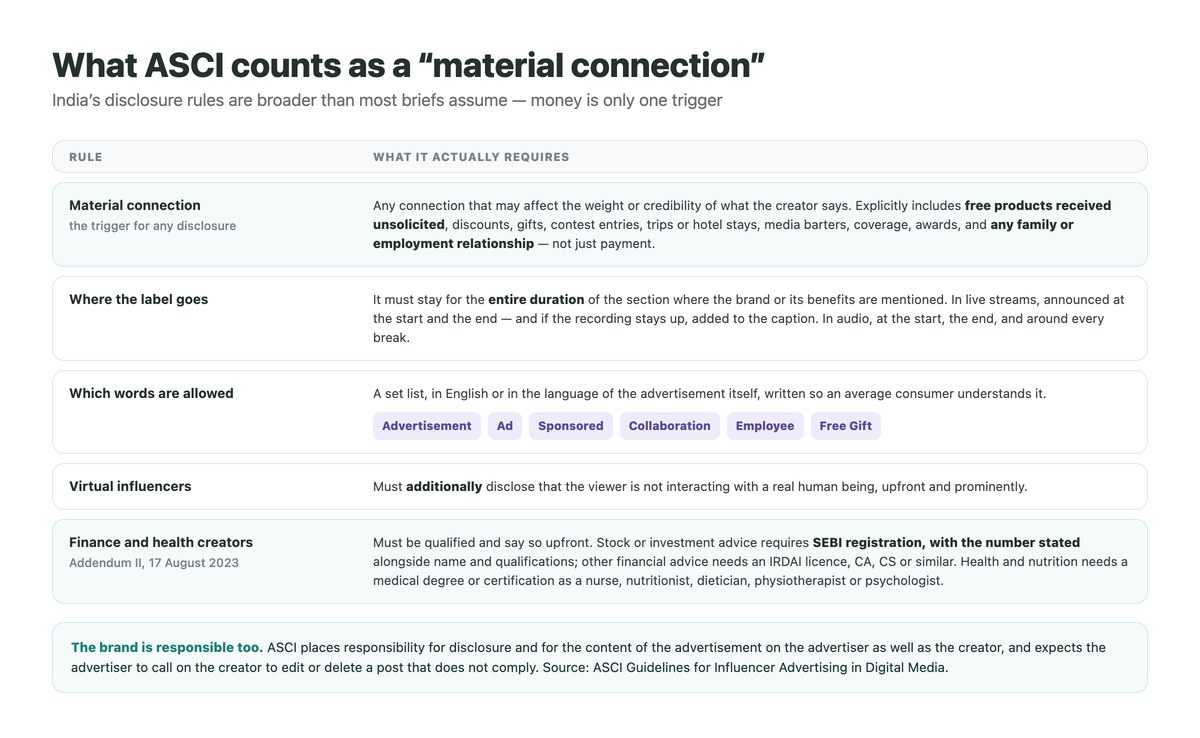
Under the ASCI guidelines for influencer advertising, disclosure is triggered by a material connection: any connection between advertiser and creator that may affect the weight or credibility of what the creator says.
The guidelines spell out what that includes, and the list is wider than most briefs allow for – monetary or other compensation, free products with or without conditions including those received unsolicited, discounts, gifts, contest and sweepstakes entries, trips or hotel stays, media barters, coverage, awards, and any family or employment relationship. A creator who was simply sent a box and posted about it is covered.
Where the Label Has to Sit
Not merely present, but placed. The label must remain for the entire duration of the section in which the brand or its features and benefits are mentioned, rather than flashing at the start.
Live streams are announced at the beginning and the end of the broadcast, and if the recording stays visible afterwards the disclosure has to be added to the caption. Audio – podcasts included – is announced at the start, at the end, and before and after every break.
Which Words Count
The guidelines set out a permitted list rather than leaving it to invention: Advertisement, Ad, Sponsored, Collaboration, Employee and Free Gift are among them. The label must be in English or in the language of the advertisement itself, and written so an average consumer understands it. Vague constructions like “thanks to my friends at” are not disclosure.
The Brand Is Responsible Too
This is the part brands miss. ASCI places responsibility for disclosing the material connection, and for the content of the advertisement, on the advertiser whose product it is as well as on the creator – and expects the advertiser to call on the creator to edit or delete a post that does not comply.
Which means a brief that stays silent on labelling is not a neutral document. It is the advertiser declining to exercise a responsibility it holds anyway.
Finance and Health Creators Need Qualifications
An addendum dated 17 August 2023 added a requirement that catches a whole category of campaign. Creators advising on or promoting banking, financial services and insurance, or health and nutrition, must hold relevant qualifications and state them upfront.
For stock or investment content that means registration with SEBI, with the registration number shown alongside the creator’s name and qualifications. Other financial advice calls for an IRDAI insurance licence, CA, CS or similar. Health and nutrition requires a medical degree or certification as a nurse, nutritionist, dietician, physiotherapist or psychologist, depending on the advice. The qualification has to appear superimposed and upfront, or as the opening remark in video.
The Platform Question Nobody Asks
Before comparing agencies, settle where the campaign runs, because one widely assumed answer is wrong in India.
TikTok Is Not an Option
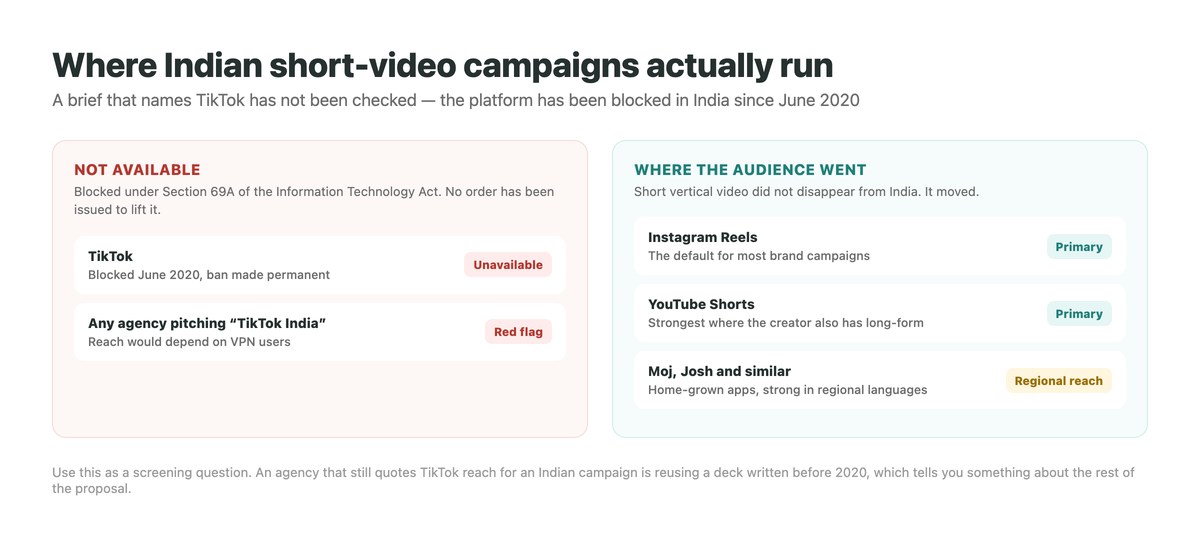
TikTok has been blocked in India since June 2020 under section 69A of the Information Technology Act, and no order lifting the ban has been issued since. A brief that names TikTok, or an agency proposal that quotes TikTok reach for an Indian audience, is working from a deck written before the ban.
This makes a useful screening question. Ask any agency where they would run the campaign and why; the answer tells you whether the proposal was written for you or pulled from a folder. The same screening question works anywhere – our guide to TikTok marketing agencies applies it in a market where TikTok is actually available.
Where the Audience Actually Is
Short vertical video did not leave India, it moved. Instagram Reels is the default for most brand campaigns, YouTube Shorts is strongest where the creator also publishes long-form, and home-grown apps such as Moj and Josh carry real reach in regional languages that the two large platforms serve less well.
If your campaign is aimed outside the metros or outside English and Hindi, the regional apps deserve a question rather than an assumption.
Ten Influencer Marketing Agencies in India
Ordering here carries no meaning. Every entry reflects that agency’s own account of itself, not a verdict. None publishes standard pricing. Each had a working website on the day this was published. Check again before you pick up the phone; this category turns over quickly.
Confluencr
A Bangalore agency that presents itself around data-led campaign planning and measurable outcomes, working across fashion, beauty, fitness and lifestyle creators for clients from startups to large corporates.
Consider it if
Brands that want campaign performance reported in numbers.
Chtrbox
A Mumbai agency working across a wide spread of industries, describing its approach as data-led matching aimed at connections that read as genuine rather than bought.
Consider it if
Multi-category brands wanting one agency across sectors.
WhizCo
A newer agency positioned around performance campaigns and conversions rather than reach alone, working with both startups and established brands.
Consider it if
Campaigns judged on sign-ups or sales, not impressions.
The Marcom Avenue
Offers creator work inside a wider digital and branding practice, positioning itself as an integrated growth partner rather than a creator-sourcing specialist.
Consider it if
Brands wanting creator spend planned with the rest of the media.
HaulPack
Built around shoppable creator content and commission-based earning, which makes it a different commercial model from the retainer agencies on this list.
Consider it if
Commerce brands that want to pay on sales rather than posts.
ANTS Digital
An end-to-end digital marketing agency where influencer work sits alongside the rest of an online presence rather than standing alone.
Consider it if
Smaller brands wanting one supplier for everything digital.
Eleve
Emphasises data-led selection and uses its own tooling to analyse creator profiles and report campaign return.
Consider it if
Brands that want the selection method explained, not asserted.
Whisskers Marketing
Positions itself as a full-service digital marketing and communications company, with creator campaigns as one service among many.
Consider it if
Brands needing communications work beyond creators.
OPA India
Specialises in nano and micro creators, whose audiences are smaller but typically more engaged, which suits category-specific launches.
Consider it if
Testing a product with many small, closely matched audiences.
Socio Influencer
A Delhi agency focused on matching brands to relevant creators and running the campaign through to execution.
Consider it if
Brands wanting north-India creator relationships.
Indian Influencer Agencies at a Glance
Ten names is too many to brief. This is for cutting it to three.
| Agency | Base or model | Shortlist it for |
|---|---|---|
| Confluencr | Bangalore, data-led | Reporting campaign outcomes in numbers |
| Chtrbox | Mumbai, multi-category | One agency across several sectors |
| WhizCo | Performance-focused | Conversions rather than reach |
| The Marcom Avenue | Integrated digital | Creator spend planned with other media |
| HaulPack | Commission on sales | Paying for sales rather than posts |
| ANTS Digital | End-to-end digital | One supplier for everything online |
| Eleve | Own analysis tooling | Selection method explained, not asserted |
| Whisskers Marketing | Full-service communications | Work that extends past creators |
| OPA India | Nano and micro creators | Many small, closely matched audiences |
| Socio Influencer | Delhi, matching and execution | North-India creator relationships |
HaulPack is the odd one out and worth noticing: a commission model is not comparable with a retainer on price, because the risk sits in a different place. Compare it on what it costs when the campaign works, not when it does not.
How to Compare Them Properly
Three written proposals is the right target. These questions separate agencies faster than a credentials deck will.
Ask where they would run it, and why
If TikTok appears, or if the answer is the same for every client, the proposal is a template. A good answer names platforms and explains the audience reasoning.
Ask to see their disclosure clause
The exact wording they put in creator contracts. ASCI puts responsibility on you as the advertiser too, so this is your risk, not just theirs.
Check how they handle finance and health briefs
If your category touches money or health, ask how they verify a creator’s qualifications and how the registration number appears in the post. An agency that has not thought about this has not read the 2023 addendum.
Separate the fee from the creator budget
Every proposal should split them. Two agencies quoting the same total can differ by half in what actually reaches creators.
Ask about regional language campaigns
India is not one audience. An agency whose roster is entirely English-language Instagram will struggle with a campaign aimed at a specific state.
Get two contactable references in your category
Not case studies. Two clients you can email, close enough to your category that the comparison carries information.
Running It Without an Agency
Both routes below cost less and take more of your time, and neither reduces your responsibility under the ASCI guidelines by a single clause.
Going to Creators Yourself
A first campaign run in-house teaches you things no agency will volunteer: what a creator in your category really charges, how long they take to answer, and how many simply never do. That knowledge makes you a much harder client to overcharge later.
The volume is the only hard part, and the DMpro Chrome extension exists for it – reading each profile to compose an opening worth answering, then pacing the sending so your account stays healthy. Our influencer outreach guide sets out what belongs in that first message.
Making the Agencies Compete
Here is the practical obstacle to comparing ten agencies: nine of them hide behind a web form, and filling in ten forms with the same brief is an afternoon nobody wants.
That chore is what contactID removes. Point it at the shortlist, and it locates the enquiry form on each site, lodges your brief under that agency’s name, and flags the ones with no form at all. What you get back is ten responses to an identical ask – the only basis on which proposals can honestly be compared.
Being Ready When It Lands
The hour after a creator posts is when the money is decided, and in India much of it arrives on WhatsApp. DMpro sits across both WhatsApp and Instagram on official connections, clears the repetitive questions itself, and escalates the rest with context attached. Our guide to Instagram DM CRM explains how to stop those conversations evaporating afterwards.
In India the Conversation Moves to WhatsApp
An Indian creator drop behaves differently from a Western one. Interest shows up as a question rather than a click, a good share of it arrives on WhatsApp rather than Instagram, and the buyer expects somebody on the other end straight away.
DMpro keeps that pace: it recognises the questions that repeat – price, delivery, size, is this genuine – and replies at once over each platform’s official connection, then brings a colleague in with the whole exchange already in front of them.
- Replies that fire the moment a question lands
- WhatsApp Business Platform connection, not a logged-in phone
- Triggers on comments, story replies, mentions and DMs
- Buyer details written straight into your CRM
- Works without sharing any account password
- A creator drop at 11pm is not a lost night
- Hindi and English questions answered from one screen
- Your team opens only what genuinely needs a human
- Creator sourcing and rate negotiation stay yours
- Somebody has to write the repeat answers properly once
Conclusion
The agencies on this list are not interchangeable, and the differences that matter are not the ones their websites lead with. A commission-based shoppable business, a micro-creator specialist and a full-service communications agency are three different purchases; decide which one your campaign actually is before you ask anyone for a proposal.
Then run the compliance question early. ASCI’s definition of a material connection reaches unsolicited samples, barters and family ties, the label has to hold for the whole section that mentions you, and responsibility sits with the advertiser as well as the creator. If your category touches money or health, the qualification requirements decide who you can even approach.
And check where the agency would run it. In a market where TikTok has been unavailable for years, a proposal that still quotes TikTok reach has told you most of what you need to know about how it was written.
One connected inbox for WhatsApp and Instagram, on official connections. Free tier available.
Try DMpro free