
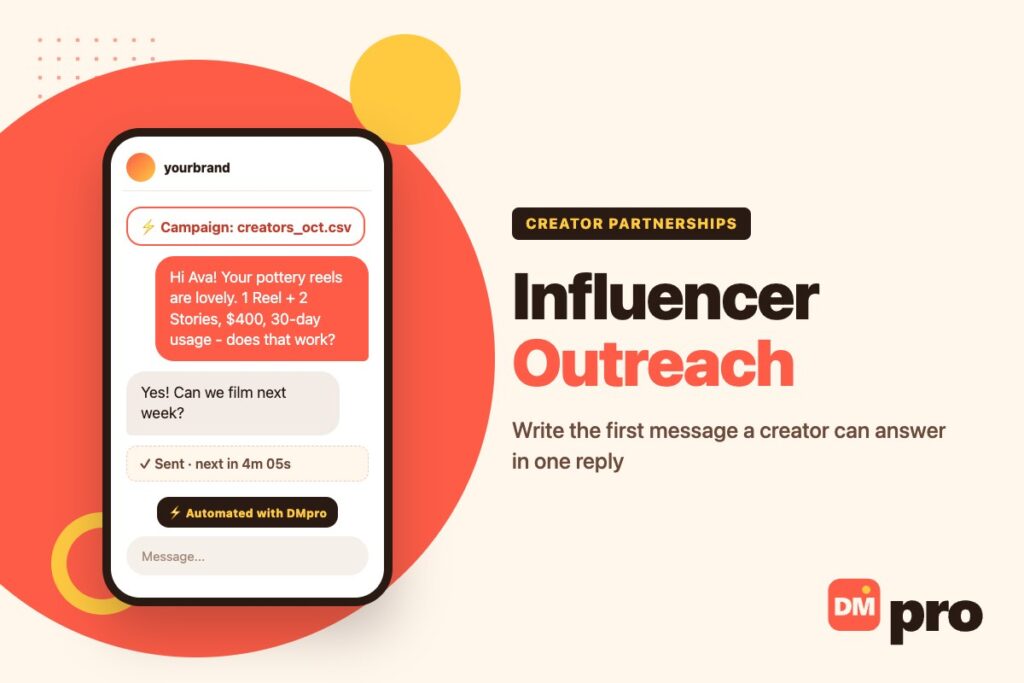
Influencer outreach usually fails at the message, not at the list. A brand spends weeks building a spreadsheet of creators, sends every one of them a note that cannot be answered – no deliverable, no budget, no dates – and decides creators are unresponsive. The creators were not ignoring the brand. They were ignoring a question they had no way to price.
It helps to see where this sits. Creator outreach uses the same inbox as sales prospecting and the same tactics as the rest of Instagram DM marketing, but it is a different job: a prospect is being sold to, while a creator is being asked to quote for work. That one difference changes what belongs in the first message.
This guide is written for the person sending the messages. It covers what a creator needs in order to reply, the six things every first message should state, why naming the fee early works, where to find creators without buying a list, what the FTC requires when you send free product, and how to follow up without burning the relationship. It ends with how to run the whole process with the DMpro Chrome extension, which writes a message for each creator and sends it automatically.
Key Takeaways
What Is Influencer Outreach?
Influencer outreach is the process of contacting creators to propose a collaboration: a paid post, a gifted product, an affiliate deal or a longer ambassadorship. It covers finding the right people, writing the first message, agreeing terms and briefing the content.
A Quote Request, Not a Sales Pitch
In sales, the first message argues that a problem is worth solving, because the recipient asked for nothing. In creator outreach, the person on the other end runs a small production business. They do not need persuading; they need to work out whether your job is worth a slot in their calendar. A message that is enthusiastic but vague makes that impossible.
What the Creator Is Weighing
Your message is being triaged alongside many others. In the few seconds it gets, the creator is looking for answers to four questions.
Scope
What exactly do you want made – how many pieces, in what format, on which platform?
Cost
Filming, editing and the paid work this displaces. A Reel is a production, not a favour.
Terms
Where the content will run and for how long, and whether they will be blocked from working with your competitors.
Fit
Whether your brand suits their audience. A poor fit costs them trust that is worth more than your fee.
What Brands Send vs What Creators Need
Line by line, this is the gap. Everything in the right-hand column can be written before you know anything about the creator except who they are.
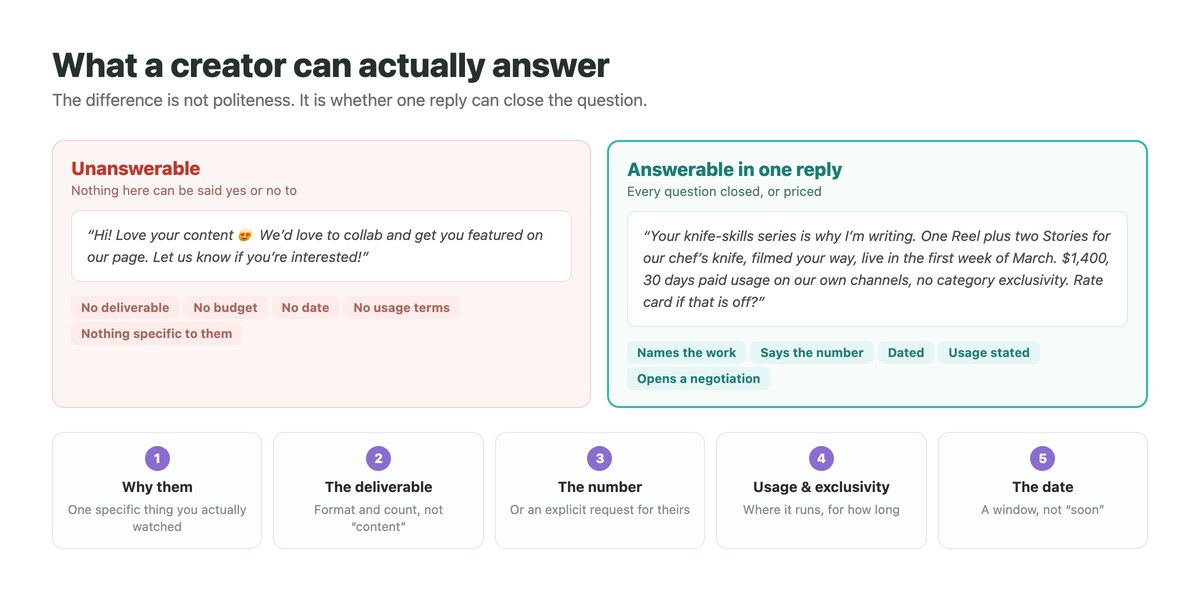
| Brands usually send | Creators need instead |
|---|---|
| “Love your content!” | One specific thing you watched, and why it fits |
| “We’d love to collab” | The deliverable: one Reel, two Stories, a set number of posts |
| “Let’s discuss budget” | A number, or a direct request for their rate card |
| No mention of usage | Where it runs, on whose channels, for how long |
| No mention of exclusivity | Whether they are barred from your competitors, and for how long |
| “Soon” or nothing | A filming window and a go-live date |
| “Great exposure for you” | Nothing. This sentence is why the message gets deleted |
The Six Parts of an Answerable First Message
A first message that gets answered is usually short – five or six lines – because each line does one job. Here is what each one covers.
Why You Chose Them
One specific reference that proves you looked: a recent video, a series they run, a comment their audience left. It tells the creator the message was not sent to three hundred people, and it tells you whether the fit is real.
What You Want Made
The deliverable
Be exact: “one 30-second Reel and two Stories” can be priced; “some content” cannot.
The platform
Instagram, TikTok or both. Cross-posting is extra work and usually an extra fee.
What You Will Pay
A figure, a range, or an honest request for their rate card. For gifting, say that it is gifted and that there is no obligation to post – and that any post should be disclosed.
Usage, Exclusivity and Dates
Usage
Organic reposting on your account for 30 days is different from running their face in paid ads for a year. Say which.
Exclusivity
If you need them to avoid competitors, state the category and the period. If you do not, say so; it removes a worry.
Dates
A filming window and a go-live date let the creator check their calendar before replying.
Say the Number
This is the advice brands resist most and the one that changes reply rates most.
Why a Low Number Beats No Number
The fear is that naming a figure caps what you would have paid, or reveals a budget that looks insulting. In practice, a number that is too low gets a counter-offer and a conversation. No number at all gets silence, because a creator sorting through a crowded inbox has no reason to spend effort finding out whether yours is serious.
When You Do Not Know the Rate
Ask for it directly. “What would you charge for one Reel with 30 days of organic usage?” is a specific question that can be answered in one line. “Let’s discuss budget” asks them to open a negotiation about an undefined job, and most will not.
The Two Terms That Move the Price
Usage and exclusivity change a quote more than anything else. Both are chargeable, both are often assumed by brands without being asked for, and a creator who spots either missing will assume the worst and price accordingly. Our look at how sponsored posts on Instagram perform shows why these terms matter to the result as well as the fee.
Where to Find Creators Without Buying a List
Lists of “top creators in your niche” are worth little, because everyone on them is being contacted by everyone who read the same list. The better searches surface people just below where those lists stop.
Start With People Already Engaging With You
Anyone tagging you, replying to your Stories or mentioning you unprompted is a warmer approach and a more credible endorsement than a stranger with a bigger following. They already like the product; you are asking them to say so publicly.
Work Sideways, Not Upwards
Look at who your customers follow, who leaves thoughtful comments under creators in your category, and who makes similar content one tier below the famous accounts. At that size, engagement matters more than follower count and reply rates are far higher.
Let Creators Choose You
An affiliate product marketplace flips the model: creators pick your product themselves and earn a commission on what they sell. There is no fee to negotiate and no risk of paying for a post that sells nothing. It suits stores with a wide catalogue better than a single hero product.
Which Channel to Use for the First Message
Most creators list more than one way to reach them. The right one depends on their size and how they work.
Instagram or TikTok DM
For small and mid-sized creators, the DM is often the fastest route, because it is where they already spend their day. It is also where a vague message is dismissed fastest, so the six parts above matter even more. Our guide to Instagram DM outreach covers the etiquette of the inbox itself.
Email From the Bio
Creators with a manager or a business email in their bio usually prefer it for paid work, because a brief with attachments and dates is easier to handle there. On its Professional plan, the DMpro extension saves email addresses it finds in Instagram bios, so you can switch channels for creators who ask for email.
A Creator Platform
If you run campaigns on a creator marketplace, creators can apply to a public brief instead of being approached cold. Outreach then becomes an invitation to apply, with the terms already written down.
A Website Contact Form
Once a creator has a manager, a media kit or a site of their own, the business channel they publish is often a form rather than an inbox – and talent agencies work almost entirely that way. Treat the form as the stated preference it is: a pitch sent there reaches whoever handles commercial enquiries, instead of sitting behind a wall of fan messages.
That is a different job from DMing, so it has its own tool. contactID takes a list of web addresses, finds the enquiry form on each and submits your pitch, naming each recipient as it goes. It is the right instrument for a shortlist of agencies and managed creators, and the wrong one for someone whose only presence is an Instagram handle.
Gifting Is Not Free
Sending product instead of money feels like the cheap, low-commitment option. Under US advertising law it is not a different category at all.
What Counts as a Material Connection
The FTC’s Disclosures 101 guidance defines a material connection broadly: a financial, employment, personal or family relationship with a brand. Financial does not only mean money. If a creator receives free or discounted products or other perks and then mentions the brand, they need to disclose it, even if the brand never asked for a post. The FTC’s Endorsement Guides FAQ covers edge cases such as tags and affiliate links.
Settle It in the Brief
This matters to the brand, not only the creator. If your message says “no obligation, just enjoy it” and the creator posts without disclosing, you helped create that problem. Say in the first message that any post should be disclosed, and the ambiguity is gone at no cost.
Where a Disclosure Has to Sit
The FTC is specific about placement, and several common habits do not meet it.
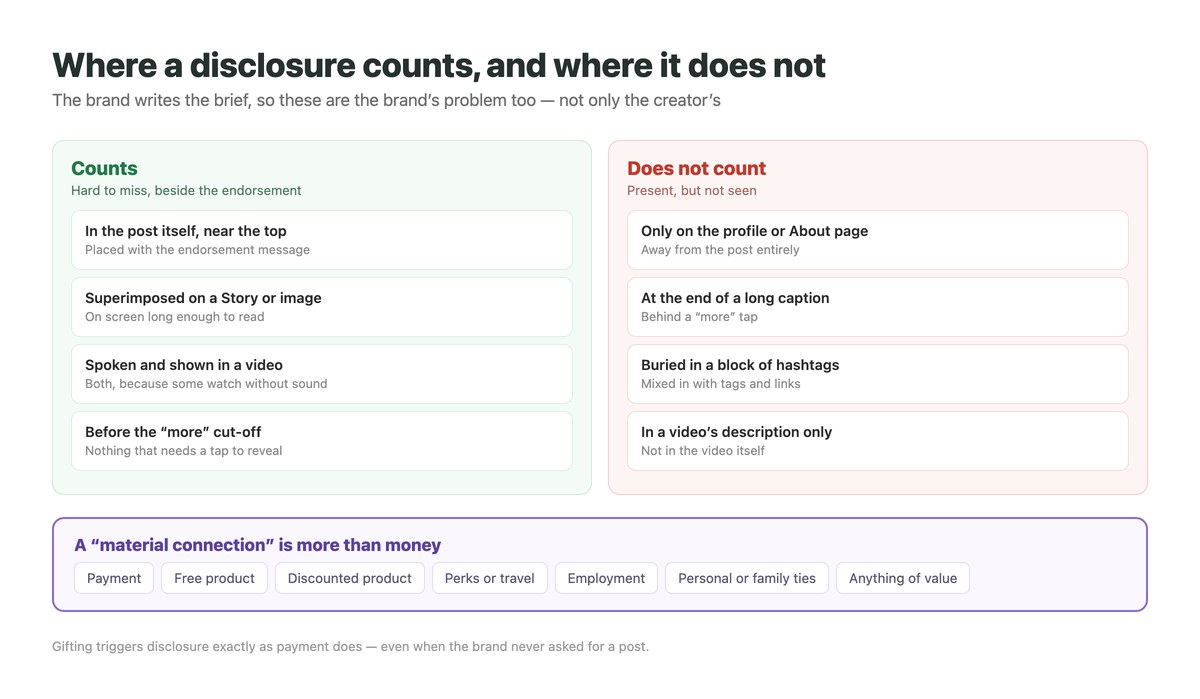
| Placement | Counts? | Why |
|---|---|---|
| With the endorsement, near the top | Yes | Hard to miss, beside the claim it qualifies |
| Superimposed on a Story or image | Yes | If it stays on screen long enough to read |
| Spoken and shown in a video | Yes | Some people watch without sound, others miss on-screen text |
| Only on the profile or About page | No | Away from the endorsement entirely |
| At the end of a long caption | No | Likely hidden behind a “more” tap |
| Mixed into a block of hashtags | No | The FTC names this specifically |
| In a video’s description only | No | It has to be in the video itself |
Creators paid through an affiliate programme have the same duty: the commission is the material connection, and it is disclosed the same way.
How to Run Influencer Outreach With DMpro
The DMpro Chrome extension turns the brief above into a personal DM for every creator and sends it automatically from your own Instagram or TikTok account. It never asks for your password, and the free tier includes 10 AI-written messages a month.
Sign up and choose the Brand persona
Sign-up is passwordless: enter your email and a 6-digit code. Choosing the Brand persona loads a starter prompt for paid collaborations. If you run campaigns on Ainfluencer, connect it and the campaign title, description and apply link become prompt variables.
Write the brief as a prompt
Put the six parts in the prompt once: why this kind of creator, the deliverable, the fee, usage, exclusivity and dates. Variables such as {name}, {bio} and {followers} let the AI open each message with something specific to that creator.
Build the creator list
Paste handles one per line or import a CSV. Duplicates are removed, and each campaign targets one platform, so Instagram and TikTok creators run as separate campaigns.
Set a safe pace
Choose a daily limit and random delays. Safety Mode, on by default, sends up to 20 messages a day with 3 to 6 minute gaps and pauses the campaign if Instagram shows a block signal.
Start, then negotiate by hand
The campaign sends one message at a time and shows sent, failed, skipped or remaining for every handle. Replies arrive in your normal inbox, where you agree the details yourself. Export the results as a CSV to keep a record.

Influencer Outreach Message Templates
Adapt these to your voice and fill in the brackets. Each one contains the parts a creator needs to reply. For more starting points, see our Instagram DM templates.
Templates for the First Message
Paid post
“Hi [name], your [series or video] is exactly the tone we want for [product]. We would like one Reel and two Stories for $[fee], with 30 days of organic reposting on our account and no exclusivity. Filming [dates]. Does that work, or what would you charge?”
Gifted product
“Hi [name], we make [product] and think it suits your [topic] content. We would like to send you one, no obligation to post. If you do share it, please tag it as gifted. Want one?”
Rate card request
“Hi [name], we are planning a [month] campaign for [product] – one Reel, organic usage only. Could you share your rate card?”
Template for the Follow-Up
“Hi [name], following up on the [product] Reel. We can extend usage to 60 days at the same fee, or keep it to Stories only if that is easier. Either option work for you?”
Following Up Without Becoming a Problem
Follow-ups decide whether a creator remembers your brand fondly or as the one that would not stop.
One Follow-Up, With Something New
Send one follow-up after about a week, and only if it adds something: a longer usage window, a revised fee, a simpler deliverable. “Just bumping this” gives them no new reason to reply.
When to Stop
A creator who has ignored two messages has answered. A third turns your brand into a name they recognise for the wrong reason and costs you future campaigns too – a failure mode any sound outreach strategy plans around.
Keep a Record
At any volume, track who was contacted, what was offered and what came back, so a creator who declined in March does not receive the identical opener in June. A campaign export per list is enough to start.
Run Creator Outreach With the DMpro Extension
The hard part of influencer outreach at scale is keeping every message specific. The DMpro Chrome extension does that part: you write the brief once, and the AI writes a separate DM for each creator from their name, bio and stats, then sends it automatically from your own account.
Campaigns run from a pasted list or a CSV with daily caps and random gaps, and Brand users can pull campaign details straight from Ainfluencer. Plans start free with 10 AI messages a month; Starter is $19 for 500, and the Professional plan adds email extraction from Instagram bios.
- A personal DM for every creator, written from their profile
- Brand persona with a paid-collaboration starter prompt
- Campaign variables auto-filled from Ainfluencer
- Campaigns from pasted handles or a CSV, with CSV export
- Safety Mode: 20 a day, 3 to 6 minute gaps, auto-pause
- Instagram and TikTok in one extension
- Never asks for your social media password
- Free tier to test the whole flow
- It cannot make a vague brief answerable – that part is yours
- Automated DMs can still breach Instagram’s terms, so keep volumes modest
Conclusion
Write the message a creator can answer in one reply: why them, what you want made, what you will pay, where it will run and for how long, and by when. Six short lines will outperform any amount of warmth. If you would rather buy software than write every message yourself, our guide to influencer marketing platforms covers what each category of tool genuinely does.
Then settle disclosure in the brief instead of hoping it happens. Free product is a material connection whether or not you asked for a post, and where the disclosure sits is a rule, not a preference. Specify it up front, follow up once with something new, and keep a record of every offer.
Write the brief once – DMpro writes and sends a personal DM for each creator, paced safely.
See the DMpro extension