
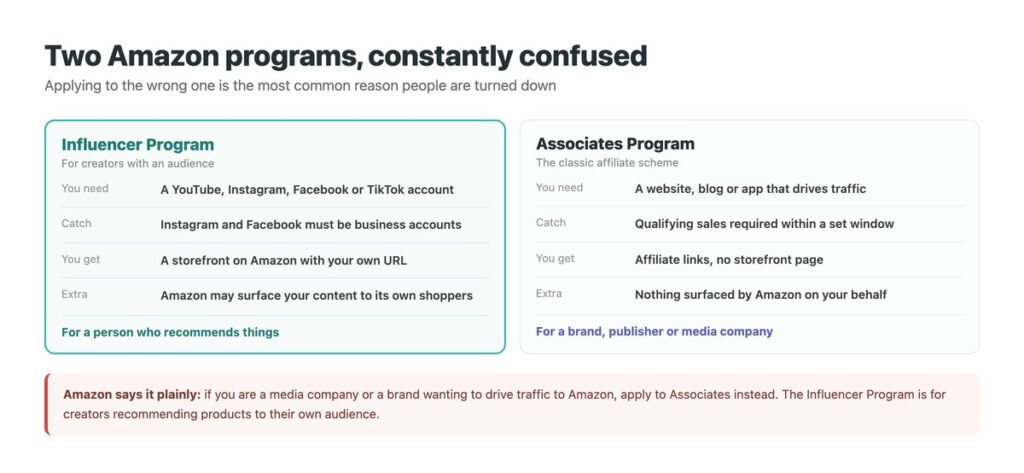
The Amazon Influencer Program gives creators a storefront on Amazon and a commission on what their audience buys through it. The idea is simple; the application is where people get stuck, usually for one of two reasons that have nothing to do with how big their following is.
The first is that they applied to the wrong programme. Amazon runs two, they are aimed at different people, and it says so plainly – brands and media companies belong in Associates, not here. The second is a single account setting that is easy to miss and causes a rejection with no useful explanation.
Below: what Amazon actually publishes about eligibility, the follower question answered honestly, what the storefront does, and what to use instead if you are a brand rather than a creator.
Key Takeaways
What the Programme Actually Gives You
Three things, and the third is the one most people do not know about.
You get a storefront: your own page on Amazon with a personalised URL, where you curate products and publish livestreams, shoppable photos and videos. It is a shopping destination you can send an audience to from anywhere.
You get commission on qualifying purchases made through your storefront or your affiliate links. The rate depends on the product category rather than on your following, which is why a small account in a well-paid category can out-earn a large one in a badly-paid one.
And – the part worth knowing – Amazon may surface your storefront content to its own shoppers. That means earnings from people who were never your audience, which is a genuinely different proposition from an ordinary affiliate link and the strongest reason to take the storefront seriously rather than treating it as a link dump.
The Mistake That Causes Most Rejections
Amazon runs two affiliate programmes and the wording on its own sign-up page is unambiguous: if you are a media company or a brand and want to drive traffic to Amazon, you should apply to the Amazon Associates Program instead.
So the Influencer Program is for a person recommending products to an audience they built. Associates is for a website, blog, app or publisher sending traffic. Applying as a brand to the creator programme produces a rejection that feels arbitrary and is not.
The distinction also changes what you get. Associates gives you affiliate links; the Influencer Program gives you a storefront on Amazon’s own site plus the chance of Amazon showing your content to shoppers who have never heard of you. They are different products, not two doors to the same room.

Eligibility, Without the Invented Numbers
Amazon publishes exactly two hard requirements and one soft one, and the soft one is where every article on this subject starts guessing.
The hard requirements: you need a YouTube, Instagram, Facebook or TikTok account, and if you apply with Instagram or Facebook it must be a business account. That second one is the single most common avoidable rejection, because a personal account is the default and switching takes about a minute.
The soft one is the follower question. Amazon says it reviews the number of followers you have in addition to other engagement metrics, and that it accepts applications from all types of influencer. That is the whole of the published guidance. Any article giving you a specific threshold – a thousand, five thousand, ten thousand – invented it, and the invented numbers do not agree with each other, which is the tell.
What follows from this is practical rather than mysterious: an account with modest reach and genuine engagement is a better application than a larger one with dead comments, because engagement is explicitly part of what is reviewed.

Published Requirements Versus Common Claims
Worth setting side by side, because the second column is what most of the internet will tell you.
| Question | What Amazon publishes | What articles claim |
|---|---|---|
| Follower minimum | None stated; followers reviewed with other engagement metrics | 1,000 / 5,000 / 10,000 – and they disagree |
| Which accounts qualify | YouTube, Instagram, Facebook or TikTok | Usually right |
| Account type | Business account required for Instagram and Facebook | Frequently omitted entirely |
| Who should apply | Creators; brands and media companies go to Associates | Rarely mentioned |
| Cost to join | Nothing | Usually right |
| What you earn | Commission by product category | Often quoted as a single flat rate |
Applying, in the Order That Avoids a Re-Application
Fix the account first. Reapplying with the same account unchanged produces the same answer, so the preparation matters more than the form.
Pick the account with real engagement, not the biggest one
Amazon reviews engagement alongside follower count, so a smaller account where people genuinely comment is a stronger application than a larger, quieter one.
If it is Instagram or Facebook, switch it to a business account
This is a requirement rather than a preference, and it is where most avoidable rejections come from. It takes about a minute in settings.
Make sure there is recent, consistent activity
A dormant account gives the review nothing to assess. A few weeks of normal posting before applying is not wasted time.
Apply through the Amazon Influencer Program page and connect the account
You sign in with a regular Amazon account and link the social account you chose. There is no fee at any point.
Build the storefront before you send anyone to it
An empty storefront converts nothing. Curate real categories around what your audience already asks you about, because that is what Amazon may surface to its own shoppers.
What Determines What You Earn
Four variables, and only one of them is your audience size – indirectly.
| Variable | Effect on earnings | Within your control |
|---|---|---|
| Product category | The largest single factor – rates differ sharply by category | Yes, through what you feature |
| Conversion rate | Recommendations your audience trusts convert far above average | Yes |
| Amazon surfacing your content | Earnings from shoppers who never followed you | Partly – better content is likelier to be surfaced |
| Audience size | Matters only through volume of clicks | Slowly |
| Qualifying purchases | Not everything counts; the operating agreement defines what does | No |
Amazon publishes its commission rates by category in the operating agreement, and the rates that applied to your own sales appear in your reports. It is worth checking them against what you actually plan to recommend before assuming the programme is worth your time.
If You Are a Brand, Not a Creator
A meaningful share of people searching for this are looking for the opposite thing: software to run Amazon influencer campaigns as a brand, not a storefront for themselves. That is a different problem and the Influencer Program does not solve it.
What a brand needs is a way to get many creators recommending its products, which is the commission model rather than the storefront model. Instead of negotiating a fee with each creator, an affiliate product marketplace lets creators browse a catalogue, pick what suits their audience, and earn on what they sell – no brief, no negotiation, and nothing paid unless something converts.
The trade-off is control: you decide what is in the catalogue, but not who picks it up. For a brand with a wide range of products that is usually the right trade, and the four models of working with creators sets out where it sits against the alternatives.
The Part That Decides Whether It Works
A storefront is a shop with no footfall until you send people to it, and the sending is where most storefronts quietly die.
The link in your bio is the obvious route and the weakest one, because it asks people to leave a conversation they were already having. The stronger route is answering the question that prompted the interest: someone asks which mat you use, and you reply with the answer and the link, in the thread. That conversion rate is not comparable to a bio link, because the person asked – the same reason a sponsored post from someone the audience already trusts outperforms an ad.
Which is why creators who do well with this end up with an inbox problem rather than a traffic problem – the same questions, several times a day, each deserving a real answer. Automating the repeat answers is what keeps that sustainable, and the rest is ordinary selling in the DMs.
Every Storefront Sale Starts With a Question
DMpro answers the ones that repeat – which product, which size, where to buy it – instantly, across Instagram, TikTok and WhatsApp, with your link attached and the conversation kept.
Which turns the storefront from a link in a bio into the answer to something somebody actually asked.
- Instant answers to the product questions that repeat daily
- Your storefront link sent in context, not parked in a bio
- Instagram, TikTok and WhatsApp conversations in one inbox
- Full history, so a returning buyer is recognised
- Free plan covering 250 conversations a month
- The recommendation arrives when the person asked for it
- Repeat questions answered once and reused
- Nothing lost while you are filming rather than typing
- Free plan covering 250 conversations a month
- It cannot approve your Amazon application – that is Amazon’s call
Conclusion
Check you are applying to the right programme, switch a Meta account to business before you apply, and stop looking for the follower threshold – Amazon has never published one, and the numbers in circulation contradict each other.
Then treat the storefront as a destination rather than a link. The commission depends on the category and on whether people trust the recommendation, and both of those are decided long before anybody clicks.
Instant replies across Instagram, TikTok and WhatsApp, with your storefront where it belongs.
See how it works