
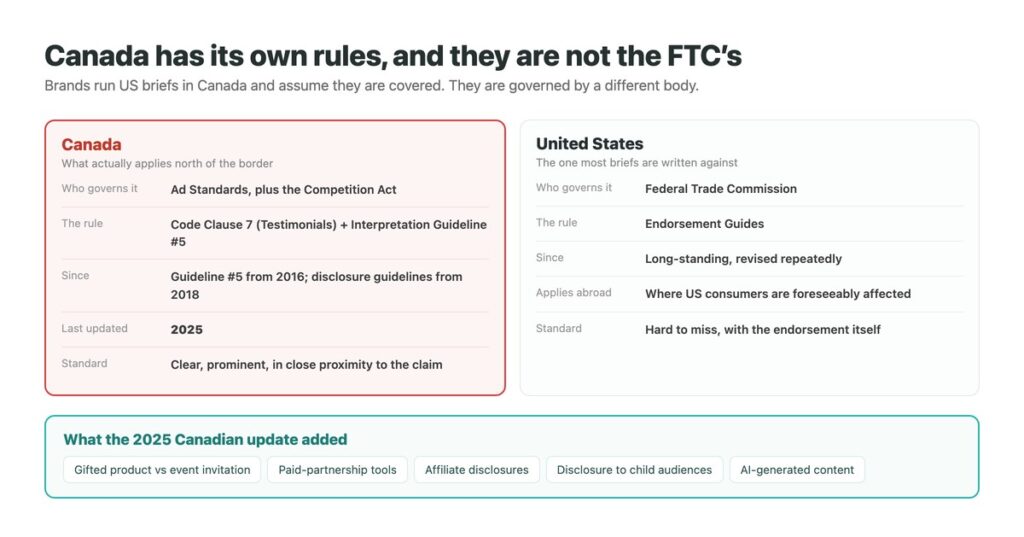
A Canadian creator campaign fails in two predictable ways, and neither is about finding names. The first is running a US brief unchanged and assuming the disclosure rules travel with it. They do not – Canada has its own regulator, its own guidelines, and a 2025 update that most brand templates have never caught up with.
The second is buying a Canadian audience that is not Canadian. Proximity to the US market means many creators based in Toronto or Vancouver have followings that are majority American, which is fine for a continental campaign and useless if you only ship within Canada.
So this page covers what is genuinely different about the market, the rules that actually apply, and how to build a shortlist that is accurate today. If what you need is the message rather than the market, writing outreach a creator will answer is the other half.
Key Takeaways
The Regulator Is Not the One in Your Template
Most brand briefs in circulation are written against the FTC’s Endorsement Guides, because most of the internet writing about influencer disclosure is American. In Canada a different framework applies.
The Canadian Code of Advertising Standards governs it, specifically Clause 7 on testimonials, which covers “testimonials, endorsements or other representations of opinion or preference” across every medium – including influencer content. Alongside it sits the Competition Act, which requires that claims be honest, reflect a genuine and current opinion, and rest on actual experience of the product.
The operative instrument is Interpretation Guideline #5, introduced in 2016. It requires any material connection between the creator and the brand to be disclosed, and that the disclosure be clear, prominent, and in close proximity to the representation being made. That last phrase is the one to put in your brief: a disclosure sitting in a profile bio, in the comments, or at the end of a long caption is not in close proximity to anything.

What the 2025 Update Added
The Influencer Marketing Disclosure Guidelines were created in 2018 by an industry steering committee and were most recently updated in 2025. The update matters because it covers the situations brands actually get wrong now rather than the ones they got wrong in 2018.
- Gifted products versus event invitations. These are treated differently, and brands routinely assume an invitation is not a material connection. It is.
- Paid partnership tools. Guidance on using the platforms’ own labels properly rather than as a substitute for a written disclosure.
- Affiliate marketing. A commission is a material connection, and affiliate arrangements need disclosing like any other.
- Child audiences. Disclosure has to be understandable to the audience receiving it, which changes the wording when that audience is young.
- AI-generated content and AI influencers. The newest section: content generated or significantly altered by AI should be identified, and a virtual influencer being not a real person does not remove the obligation to disclose its brand relationships.
The Country Is Two Markets
This is the structural fact that changes campaign design, and it is invisible on any list of names.
Quebec is French-first, with its own creators, its own references and its own media culture. An English-language brief distributed nationally reaches roughly three quarters of the population and misses a market where brand competition for creators is markedly lower – which means better rates and better reply rates for anyone who bothers.
It also has a legal dimension. Quebec’s language legislation governs commercial communication in the province, and a campaign running there in English only is making a decision whether or not it realises it. If Quebec is a real market for you, brief in French with French-speaking creators; if it is not, say so explicitly rather than discovering it in the results.
Four Differences Worth Designing Around
None of these appear on a list of top creators, and each one changes who you approach.
| What is different | What to do about it | |
|---|---|---|
| Language | Quebec is a French-first market with its own creators | Brief separately in French, or exclude the province deliberately |
| Audience | Many Canadian creators have majority-US followings | Ask for audience country before anything else |
| Scale | Audiences are smaller than US equivalents at the same tier | Judge by engagement, not by follower count |
| Competition | Fewer brands chasing the same creators | Expect better reply rates than a US campaign |
| Currency | Rates quoted in CAD | Confirm the currency in writing – a 30% error is easy |
| Regulation | Ad Standards and the Competition Act, updated 2025 | Rewrite the disclosure clause in your brief |

Building a Shortlist That Is Accurate Today
Published lists of Canadian creators go stale the same way every other list does – people move, change niche, sign exclusivity deals, or stop posting – so the method matters more than any set of names.
Start with your own followers and anyone already tagging you from a Canadian location. That is the warmest approach available and the most credible endorsement you can buy, because you are not buying it.
Then work through Canadian-specific surfaces: creators who repeatedly tag Canadian venues, chains and events; hashtags tied to specific cities rather than the country; and the comment sections of creators you have already identified, since creators in the same city and category know each other.
The same five verification checks apply as anywhere, with one promoted to the top: audience location. The checks worth running before you pay anyone covers the rest, and they take minutes each.
What to Put in a Canadian Brief
Four lines that a US template will not contain, and that cost nothing to add.
- Name the standard. Disclosure must be clear, prominent and in close proximity to the claim – not in the bio, not in the comments, not after a “more” tap.
- Cover gifting explicitly. Free product and event invitations are material connections. Say so, so nobody has to decide for themselves.
- Cover AI. If any part of the content is AI-generated or significantly AI-altered, it should be identified. This is new and most creators have not read the update either.
- State the currency. “$1,500” means two different numbers depending on which side of the border wrote it.
The Four Clauses a US Brief Is Missing
Add these and the brief is compliant on both sides of the border. Each costs one line.
| Clause | What to write | Why it is missing |
|---|---|---|
| Placement standard | Clear, prominent, in close proximity to the claim | The FTC wording differs, so templates carry that instead |
| Gifting | Free product and event invitations are material connections | Brands assume an invitation is hospitality, not compensation |
| Affiliate | Commission arrangements are disclosed like any other connection | Often treated as a separate programme with separate rules |
| AI content | AI-generated or significantly AI-altered content is identified | Added in 2025 – most templates predate it entirely |
After the Post Goes Live
The campaign does not end at publication, and this is where Canadian campaigns quietly leak the same way any other does.
A creator post drives a burst of questions – about shipping, about whether you deliver to their province, about pricing in CAD – and those arrive in your DMs rather than in a comment thread anyone is watching. If they sit overnight, the burst is over by the time you answer.
That is a capacity problem rather than a marketing one, and it is the same one behind a notification nobody saw. Worth solving before the campaign rather than during it – a shared inbox with the history kept is what turns a spike into orders instead of a missed evening.
A Creator Post Is a Spike You Have to Be Awake For
DMpro answers the questions a campaign produces – shipping, sizing, price, availability – instantly, across Instagram, TikTok and WhatsApp, with the whole thread kept and searchable afterwards.
Which matters more in Canada than most places, because a burst arriving across five and a half time zones will not be conveniently timed for anyone.
- Instant first replies during a campaign spike
- Instagram, TikTok and WhatsApp conversations in one inbox
- Saved answers for shipping, currency and availability questions
- Full searchable history per contact
- Shared access so a burst is not one person’s problem
- A spike arriving overnight is still answered
- The same three questions answered once and reused
- Nothing lost in the requests folder
- Free plan covering 250 conversations a month
- It handles the conversations, not the creator negotiation
Conclusion
Ask where the audience actually lives, decide deliberately whether Quebec is in scope, and rewrite the disclosure clause in your brief against the Canadian guidelines rather than the FTC’s. Those three steps cover most of what goes wrong.
Then build the shortlist yourself rather than from a list published last year. It is an afternoon of work, and in a market with less brand competition than the US it produces creators your competitors did not find in the same article you did.
One inbox for Instagram, TikTok and WhatsApp – campaign questions answered as they arrive.
See how it works