
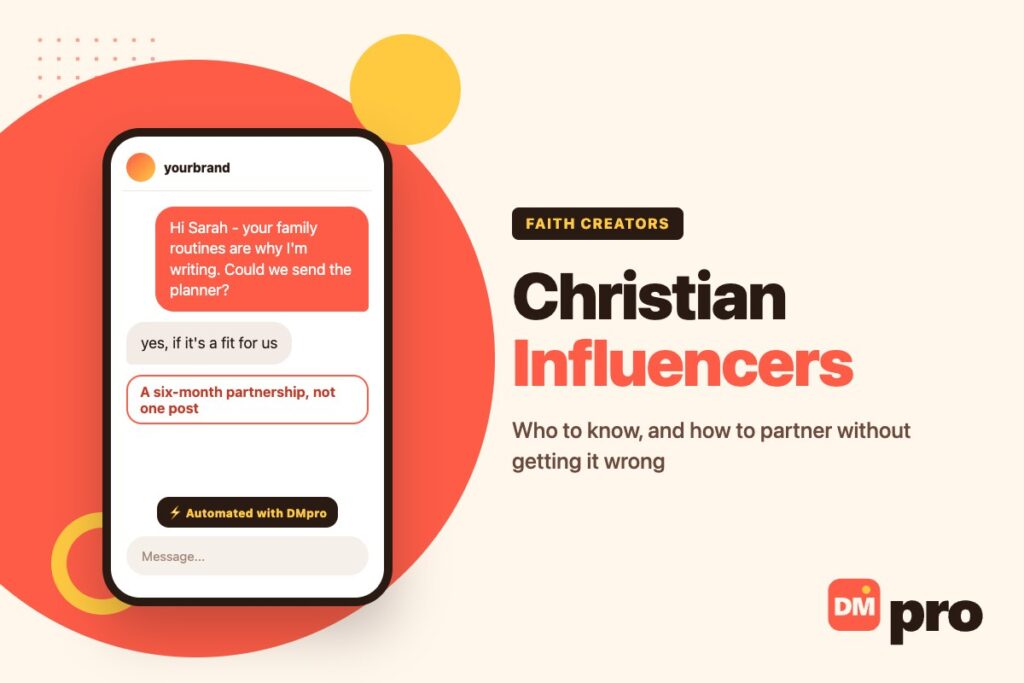
Christian influencers reach one of the most loyal audiences online, and one of the least forgiving. Faith communities follow creators for years, buy what they genuinely recommend, and notice immediately when a partnership feels like a brand renting someone’s beliefs for a quarter.
That makes this a category where fit matters more than reach. Below are fifteen Christian influencers across Instagram, TikTok and YouTube, grouped by what they actually create – worship and music, family life, teaching and apologetics, comedy, lifestyle – rather than ranked by a follower count that changes every week.
After the list: a five-question check before you pitch, what faith creators commonly will and will not do, and a section for churches and ministries on answering every prayer request and service question that a good post generates.
Key Takeaways
Why Faith Creators Are Different
Three things set this category apart from lifestyle or beauty, and each changes how you approach it.
The Audience Is a Community, Not a Following
People follow a Christian creator because they share something that matters to them, not because they like an aesthetic. That produces unusually high trust – and unusually sharp reactions when a creator appears to trade it for a fee.
Creators Guard Their Credibility Carefully
Many faith creators turn down more partnerships than they accept, and some have rules about categories, Sunday content or mixing scripture with advertising. That is not difficulty; it is the reason their recommendations work.
Christian Is Not One Audience
A Gen Z worship-music audience, a homeschooling family audience and an apologetics audience have almost nothing in common except faith. Ask for audience insights the way you would anywhere else, and do not assume a large Christian account reaches your specific customer.
15 Christian Influencers Worth Knowing
Handles link to the live profiles so you can check current numbers and recent content before you write.
Worship and Music
Forrest Frank — @hiforrest
Singer, songwriter and producer who first found an audience as half of the pop duo Surfaces before building a large following for his own Christian music. His feed mixes new songs with family life.
CeCe Winans — @cecewinans
One of the most celebrated gospel artists of her generation. Her account is scripture, music and milestones – a reference point for how a legacy artist uses social media.
Ariel Fitz — @ariel.fitz
Canadian singer-songwriter who built her following on TikTok with comedic conversations with God, then signed with Capitol Christian Music Group and Motown Gospel.
Travis Clark — @TravisandKatie1
Musician and church worker who shares family life, travel and his own music on the Travis and Katie channel.
Family and Motherhood
The largest commercial category in Christian influencer marketing. Our mom influencer list covers the wider field.
Kori Robertson — @bosshogswife
Known from Duck Dynasty, co-author with her husband Willie and a film producer. Her feed centres on family moments with her children.
Sarah Litvinchuk — @sarah_lit
California mother of six sharing family adventures and fashion, with an Amazon storefront of family, home and kids’ products – see our Amazon influencers guide for how those work.
Milena Ciciotti — @milenaciciotti
Mom, fashion and beauty creator who hosts the As For Me and My House podcast with her husband about marriage, parenting and faith.
Jeanine Amapola — @JeanineAmapola
Texas-born mom and fashion creator and author of Becoming Happy & Healthy; her channel mixes style, faith and dating advice.
Teaching, Books and Encouragement
Sara Jakes Roberts — @sarajakesroberts
Author of Lost and Found and Woman Evolve, and founder of the Woman Evolve community for women’s personal and spiritual growth.
Sadie Robertson Huff — @SadieRobertson
Author of Live Original and Live Fearless, actor, and host of the WHOA That’s Good podcast. One of the most recognised young Christian voices online.
Ashley Morgan Jackson — @ashley.morgan.jackson
Author of Tired of Trying, writing about holding on to faith through frustration and mental health struggles; her account is encouragement and Q&A.
Stuart Knechtle — @stuartknechtle
Pastor and co-founder, with his father Cliffe, of Give Me an Answer – open-air dialogue with people who have questions about Christianity. Apologetics reaches a very different audience from lifestyle content.
Comedy and Gen Z
Maurice Dowell — @mauricedowell
Oklahoma creator whose comedic testimonies, skits and dubs made him one of the most visible Gen Z Christian voices on TikTok.
Health, Fitness and Lifestyle
Moses Cuevas — @cuevas_moses
Fitness creator who pairs workout challenges with scripture and short spiritual messages.
Cambria Joy — @CambriaJoy
Nutritional therapy practitioner and personal trainer whose channel covers health routines grounded in faith; author of Milk & Honey.

How to Partner With a Christian Influencer
The mechanics are the same as any creator partnership. The judgement calls are not.
Before You Pitch
Read a year of their feed
Not a week. You are looking for the categories they avoid as much as the ones they post.
Read your own brand the way their audience will
Past campaigns, founder comments, anything a community might find jarring. It will surface; better that you find it first.
Ask for audience insights
Age, country and gender split. A large Christian account is not automatically your customer.
Writing the Brief
Brief the product, not the faith. Say what the product is, who it is for and what you would like them to show – then leave the framing to them. A creator who chooses to connect a product to their faith will do it far better than any copywriter, and a creator who chooses not to has a reason.
Ask what they will not do
Some creators do not post sponsored content on Sundays, some will not pair ads with scripture, some decline whole categories. Asking first is respectful and saves a wasted brief.
Offer a longer arrangement
A six-month partnership reads as a genuine recommendation to a loyal audience. A one-off post reads as exactly what it is.
Put disclosure in writing
The FTC’s influencer guidance applies here like anywhere else, and faith audiences are especially unforgiving of anything that feels hidden.
Reaching Out
Management email for the larger names, a short, specific DM for everyone else. Mention a post, say in one line why your product belongs in their life, and give them an easy way to decline. The DMpro Chrome extension can work through a shortlist from your own Instagram or TikTok account, writing an opener from each profile and holding the pace to a daily number you set – our influencer outreach guide covers what to say.
Matching the Creator to the Goal
Most brand mistakes in this category are mismatches rather than bad content.
| Your goal | Creator type | Watch out for |
|---|---|---|
| Family products, home, kids | Family and motherhood creators | Products that clash with the family’s stated values |
| Books, courses, events | Teaching and encouragement creators | Anything that reads as monetising faith itself |
| Reaching Gen Z | Comedy and music creators | Humour that punches at faith rather than with it |
| Health and wellness | Fitness and lifestyle creators | Claims that overreach – faith audiences check |
| Ministry growth | Teaching and apologetics voices | Denominational differences that matter to the audience |

For Churches and Ministries: Answering Everyone
The same thing that makes faith creators powerful – a community that responds – creates a problem for churches and ministries. A good post produces dozens of prayer requests, service-time questions and small-group enquiries, often late at night, and a volunteer team cannot answer them all quickly.
Move the Conversation Somewhere Private
Invite people to comment a single word – “PRAY”, “VISIT”, “GROUP” – and reply privately in their messages. DMpro does this through Instagram’s official messaging API, answering the moment the comment arrives, the same mechanism Meta documents under automated chats. Our comment-to-DM guide explains the setup.
Offer Choices, Then a Person
Buttons instead of forms
Prayer request, service times, join a small group, talk to a pastor – one tap each.
Collect only what you need
A first name and, if they want a follow-up, an email or phone number. Nothing else.
Hand over to a named volunteer
Every conversation lands in one shared inbox with its history, so the person who follows up already knows what was asked.
The Pastoral Rule
Automation should answer, route and acknowledge. It should never counsel. Anything involving grief, abuse, self-harm or crisis must go straight to a trained person – and, where there is immediate danger, to emergency services. Write that into the flow before you switch it on. Our guide to Christian Instagram bios covers how to invite these conversations from your profile.
Answer Every Prayer Request and Question, Kindly and Quickly
DMpro lets churches, ministries and faith creators reply privately the moment someone comments a keyword, answers a story or sends a message – with buttons for prayer, service times or groups, and a shared inbox where volunteers pick up each conversation with its history.
It connects through official APIs to Instagram, TikTok, Messenger, WhatsApp and Telegram, and the free plan covers 250 conversations a month – enough for most congregations to start.
- Comment keywords like PRAY answered privately
- Buttons for prayer, services, groups or a pastor
- Optional email or phone capture for follow-up
- A shared inbox for your volunteer team
- Instagram, Facebook Messenger and WhatsApp together
- Nobody’s request waits until Monday morning
- Official connection – no passwords shared with anyone
- Free plan that covers most small churches
- It routes and acknowledges; pastoral care stays human
- It cannot message new followers – there is no follow event
Conclusion
The Christian influencers above reach communities rather than audiences – people who stay for years and act on what they trust. That is the value, and it is also the risk: a partnership that feels opportunistic costs more here than anywhere else.
So choose fit before reach, brief the product and leave the faith to the creator, ask what they will not do, and offer a relationship rather than a post. And if you run a ministry, make sure that every person who reaches out because of a post gets an answer – quickly, privately, and from a person when it matters.
Private replies to comments, story replies and messages, handed to your team – free for 250 conversations a month.
Start free with DMpro