
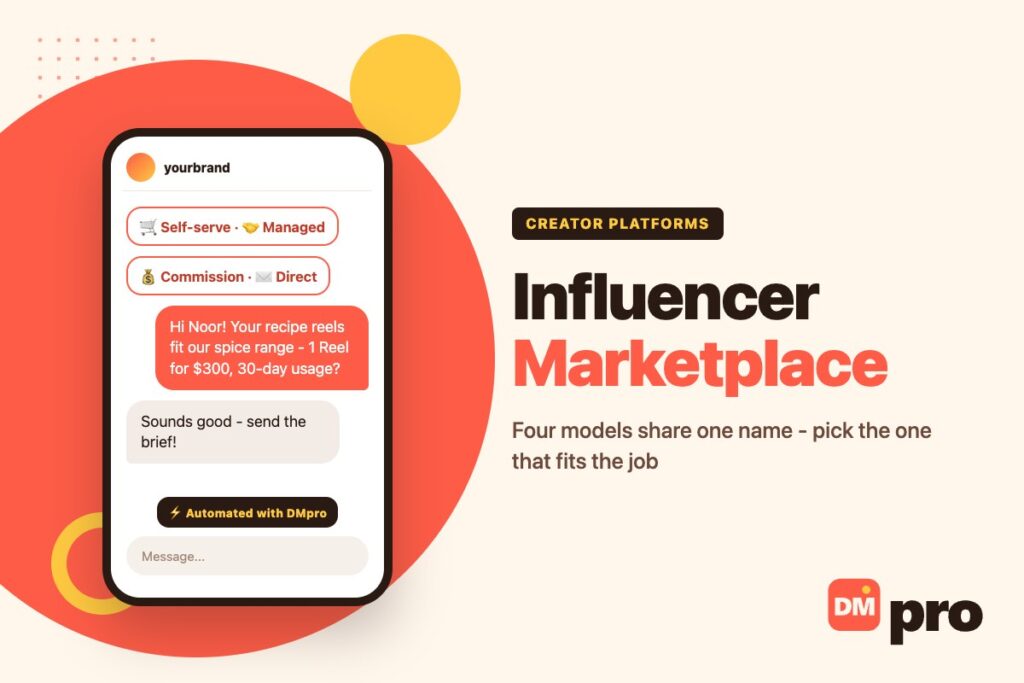
Search for an influencer marketplace and you get lists: twelve platforms, fifteen platforms, ranked against each other as if they were the same kind of product. They are not.
At least four distinct models get filed under the same phrase, they charge in completely different ways, and two of them are not really marketplaces at all. A managed agency and a commission-only affiliate platform are not competing for the same budget, so ranking one above the other tells you nothing. Choosing well is part of the same job as the rest of your creator DM marketing: getting the right person to say yes.
This guide sorts the four models, sets out how each is priced, gives six questions to ask before you pay anyone, and explains when to skip platforms and use the DMpro Chrome extension to contact creators yourself. If what you need is the message rather than the platform, our guide to influencer outreach covers writing something creators answer.
Key Takeaways
Four Things Called an Influencer Marketplace
Before comparing anything, work out which of these you are shopping for. Most disappointing platform decisions are a mismatch between the model bought and the job needed.
Self-Serve Marketplace
A searchable pool of creators who opted in to being found. You filter, message, agree terms and pay through the platform. You do the work; the platform provides the inventory and the plumbing.
Managed Service
A team selects creators, negotiates and runs the campaign while you approve. It is an agency with a software front end, and it is priced like one, usually with a minimum spend.
Commission-Based Platform
Creators choose your product from a catalogue and earn a percentage of what they sell. There is no negotiation and no flat fee – and no risk of paying for a post that sells nothing.
Direct Outreach
Not a platform at all: you find creators yourself and message them. It costs nothing but time, and for a small number of high-value partnerships it is often the right answer. It follows the same discipline as any other direct outreach.

How Each Model Charges You
The pricing structure tells you more about a platform than its feature list, because it shows what the platform is optimising for.
| Model | You pay | You carry the risk when | Fits |
|---|---|---|---|
| Self-serve marketplace | Subscription, or a fee per deal | A paid post underperforms | Regular campaigns, in-house team |
| Managed service | Retainer or a share of spend | You pay whether or not it works | Large budgets, no internal capacity |
| Commission / affiliate | A percentage of sales made | Rarely – you pay on results | Ecommerce with a wide catalogue |
| Direct outreach | Your time, plus any tools | Your time was the budget | A few high-value partnerships |
The commission model is the least understood and the easiest to test, because a failed campaign costs little. An affiliate product marketplace lets creators browse a catalogue, pick what suits their audience and earn on each sale – which suits a brand with many products better than one with a single hero item.
Opted In, or Scraped?
This is the most useful question to ask a self-serve platform, and the answer is rarely on the pricing page.
Two Kinds of Inventory
Opt-in marketplaces
Creators signed up, built a profile, set rates and agreed to receive briefs.
Search engines over public data
Accounts indexed whether or not their owners opted into anything.
Why It Matters
A brief sent to someone who joined a platform to receive briefs is expected. The same brief sent to a profile found through a hashtag is a cold DM with extra steps, and it performs like one. If a platform advertises hundreds of millions of creators, it is almost certainly the second kind – which is fine, as long as you know you are buying a search tool. Our comparison of Collabstr alternatives shows both kinds side by side.
Six Questions Before You Pay Anyone
None of these are answerable from a comparison list, and each has cost somebody a quarter’s budget.
About Money
Who pays the creator, and when?
Escrow on delivery, net-30, or you handling invoices. It decides whether good creators take your brief seriously.
What does the fee attach to?
A subscription bills whether or not you run anything; a commission bills only when something sells.
About Creators and Content
Are the creators opted in?
A searchable index of public profiles is not a marketplace, whatever it is called.
Who owns the content afterwards?
Usage rights are the term brands assume and creators charge for. Ask for the platform’s default.
Is disclosure built into the brief?
The legal obligation exists regardless; a platform that handles it removes a risk you would otherwise carry.
About Leaving
Can you leave with your relationships?
If the creators you found are reachable only inside the platform, the subscription stops being optional.

What You Still Have to Do Yourself
A platform is worth its fee when it removes work you would otherwise do.
The Work Each Model Takes Off You
Self-serve platforms find creators and handle payment; managed services take nearly everything; commission platforms remove negotiation entirely; direct outreach leaves it all with you. Commission platforms remove the most steps, but you give up control over who represents you.
The Job Almost Nobody Takes
Keeping track of who was offered what, which briefs went out and who declined is left with you in three of the four models. It is the part that breaks first – usually somewhere around the fortieth creator.

Why Every Platform List Is Slightly Wrong
This category consolidates constantly, and the articles ranking for it do not keep up.
Two Examples
Klear
A well-known influencer platform whose domain now redirects to Meltwater’s influencer marketing suite – a product line inside a larger company, not a marketplace you sign up to.
YouTube BrandConnect
Started as FameBit, became BrandConnect after the self-serve side was shut down, and in 2026 was folded into YouTube Creator Partnerships.
The Practical Lesson
Check the platform’s own site before building a plan around it. A redirect tells you more about a company’s future than a review does.
The Honest Case for Skipping Platforms
If you need three creator partnerships a year, no platform will pay for itself.
What Works at Small Scale
Start with people already interacting with your account, work sideways through their category rather than upwards through follower counts, and write each approach yourself. Warm, specific messages get better replies than platform briefs – which is also why sponsored posts on Instagram from creators who already liked you outperform ones bought cold.
Doing It Faster With the DMpro Extension
The DMpro Chrome extension takes the slow part out of direct outreach. It reads each creator’s name, bio and follower count and drafts a separate DM from a brief you write once, then sends it from your own Instagram or TikTok account. Our Instagram DM outreach guide covers how to keep it personal.
Brand persona
Loads a paid-collaboration starter prompt, and connecting Ainfluencer fills in campaign details automatically.
A record of every send
Campaigns show sent, failed, skipped or remaining for each handle and export as a CSV – the start of the tracking sheet most teams never build.
What it does not do
It does not discover creators, and replies arrive in your normal Instagram inbox rather than a separate tracker.
Reach the Creators You Choose With DMpro
Whether you find creators on a marketplace, a search tool or your own followers, the message that gets a yes is written for one person. The DMpro Chrome extension writes that message from each creator’s profile and sends it from your own account, at a pace you set.
There is no platform fee on the creators you hire, and the free tier covers 10 AI-written messages a month; Starter is $19 for 500.
- A personal DM drafted from each creator’s profile
- Brand persona with a collaboration starter prompt
- Ainfluencer campaign details pulled into messages
- Send status per handle, exportable as CSV
- Daily limits and random gaps between sends
- No marketplace fee on top of creator fees
- Keeps creator relationships in your own account
- Free tier before you pay
- It does not discover creators for you
- No built-in reply tracker – replies arrive in your Instagram inbox
Conclusion
Decide which of the four models you are buying before you compare anything, because the comparison only makes sense inside a model. Self-serve costs a subscription, managed costs a retainer, commission costs little until something sells, and direct outreach costs your time.
Then ask the six questions and check each platform’s own website rather than a list. At small scale, skip the platform, contact the right creators yourself and keep a record of every offer – that is the part no marketplace does for you.
The DMpro extension turns one brief into a personal DM for every creator on your list.
Explore the DMpro extension