
Instagram never publishes its messaging limits, and that is deliberate. The ceiling moves with your account’s age, its history and how human your sending looks, which is why one account gets restricted at forty messages and another runs for months at far more.
So any article quoting an exact daily number is guessing. What can be described accurately is the shape of the system: the ranges people report in practice, the one cap that really is fixed, the behaviours that trigger blocks, and the warning signs that come before one.
This guide covers all four, plus how to ramp a new account safely and how the limits differ between outreach and replies – the distinction that matters most if your inbox is busy. It sits alongside our wider guide to DM marketing.
Key Takeaways
What the Limits Look Like in Practice
These are ranges people consistently report, not official figures. Treat them as a ceiling to stay well below rather than a target to reach.
| Account type | Rough daily range | Practical hourly pace | Notes |
|---|---|---|---|
| Brand new account | Very low, often under 20 | A handful | Warm the account for weeks before any volume |
| Under 6 months old | Modest | 10-15 | Ramp gradually, watch for delivery failures |
| Established personal account | Higher | 20-30 | History and engagement raise the ceiling |
| Established business account | Highest | 30-50 | Still no published number, still variable |
| Any account sending identical text | Effectively zero | – | Repetition is detected regardless of volume |
The One Limit That Is Fixed
Unlike sending volume, the character cap is consistent: a single Instagram direct message tops out at roughly 1,000 characters. Longer text is rejected or has to be split.
What Counts Toward It
Everything visible
Letters, spaces, emoji and links all count toward the total.
Group messages too
The same cap applies in group threads.
Splitting works, within reason
Two messages are fine; five in a row reads as spam.
Why It Rarely Matters
A message anywhere near 1,000 characters will not be read. Four short lines outperform a wall of text on every measure, which is the core lesson of Instagram DM outreach.
What Actually Triggers an Action Block
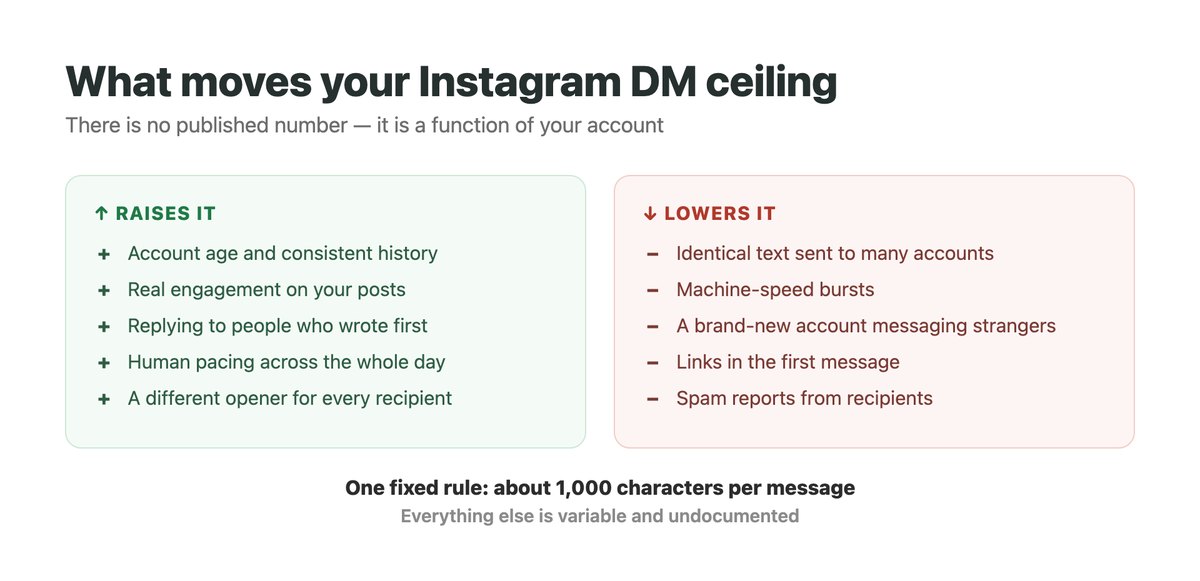
Volume is the thing people worry about and rarely the thing that gets them blocked. Meta’s spam policy names high-frequency and repetitive messaging specifically, whether it is manual or automated.
The Pattern Triggers
Speed
Sending faster than a person could physically type is the clearest signal there is.
Repetition
Identical text to many accounts is detected regardless of how slowly you send it.
Bursts
Forty messages in ten minutes reads very differently from forty across a day.
The Account Triggers
Cold accounts sending immediately
A new profile messaging strangers on day one is the classic pattern.
Being reported
A handful of spam reports lowers your ceiling fast.
Links in first messages
They attract filtering far more than plain text does.
Warning Signs, in Order
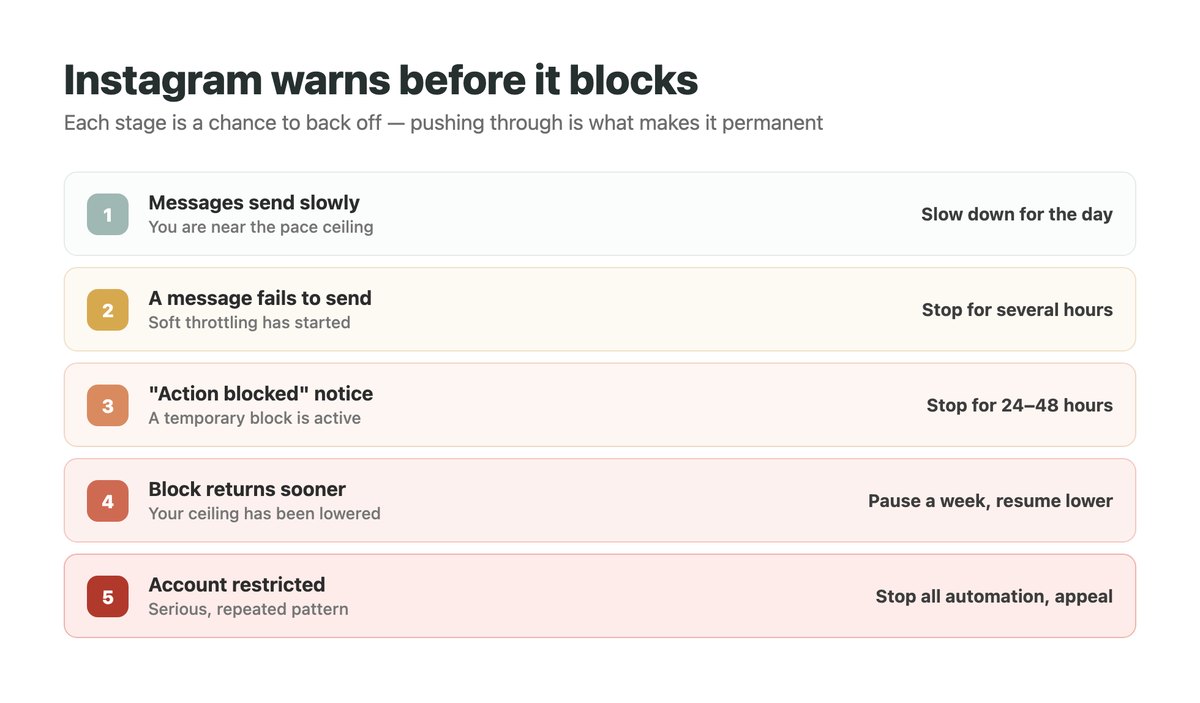
Instagram rarely blocks without warning. Each stage is a chance to back off.
| Signal | What it means | What to do |
|---|---|---|
| Messages send slowly | You are near the pace ceiling | Slow down for the rest of the day |
| A message fails to send | Soft throttling has started | Stop sending for several hours |
| “Action blocked” notice | A temporary block is active | Stop entirely for 24 to 48 hours |
| Block repeats sooner | Your ceiling has been lowered | Pause for a week, then resume far lower |
| Account restricted | A serious, repeated pattern | Stop all automation and appeal |
How to Send at Volume Without Losing the Account
The rules are boring and they work.
Warm the account first
Post, follow, comment and reply normally for a week or two before any outreach. A new account that starts messaging strangers is the pattern Instagram looks for.
Start far below the ceiling
Begin at a fraction of what you eventually want and increase over weeks. There is no way to shortcut this.
Randomise the gaps
Sending every 60 seconds exactly is machine behaviour. Irregular gaps look human because they are.
Vary the message
The opener should differ per recipient. Identical text is the most detectable pattern there is, which is why the cold DM blast stopped working.
Stop at the first warning
A failed send is information. Continuing after one is how a 24-hour block becomes a week.

Outreach Limits vs Reply Limits
This is the distinction that changes what the limit means for your business.
Replies Are Treated Far More Leniently
Instagram is much more permissive about conversations you did not start. A busy support inbox rarely hits limits, while a cold outreach campaign does, because one is a response and the other is an approach.
What That Means Practically
If your volume is inbound, the practical constraint is your own time rather than Instagram’s ceiling – and that is a tooling problem. The DMpro platform answers comments, DMs, story replies and mentions through the official API within Meta’s 24-hour window, across six channels, so a spike in questions does not become a backlog.
If Your Volume Is Outbound
Then the ceiling is real and you have to plan around it: fewer, better-targeted messages, spread across the day, with every opener different. Our guide to mass DMing on Instagram covers the ramp in detail.
Pacing is the part worth handing to software, because it is the part people get wrong when they are in a hurry. The DMpro Chrome extension holds the gaps between sends at random intervals, stops at the daily number you set, and pauses by itself the moment Instagram pushes back – which is exactly the behaviour the limits above reward.
Random gaps, a daily ceiling you choose, a different opener for every profile, and an automatic stop at the first warning.
Get the DMpro extensionLimits on the Other Channels
If Instagram is your bottleneck, it is worth knowing the others meter messaging differently.
How Each Behaves
WhatsApp and Messenger
A 24-hour service window after the person’s last message, rather than a daily count.
WhatsApp also meters by cost rather than by count: Meta charges per delivered message and gives every business number 1,000 free service messages a month, so the ceiling there is a bill rather than a block. Our guide to the WhatsApp chatbot covers those rates and what Meta’s AI rules permit.
TikTok
Text-only DMs with their own pacing rules and a 48-hour window.
Telegram
The most permissive of the six, with bots and channels.
Comment triggers today; DM sending is not available.
Spreading the Load
Reaching the same number of people across several channels is safer than pushing one channel to its ceiling – which is the practical argument for running more than one.
When the Limit Is a Sign You Are in the Wrong Channel
One case deserves separating out, because people reach for a workaround when they should be changing channel. If the accounts you are trying to reach are businesses rather than individuals, Instagram’s ceiling is not really your problem – the problem is that a company inbox on Instagram is usually unattended, so the messages that do get through are not read either.
Reaching those organisations through their own websites is a different job with different tooling: contactID works from a list of web addresses, finds each site’s contact form and submits the enquiry. None of this raises an Instagram limit, and nothing can. It just stops you spending that limit on recipients who were never going to answer there.
Limits and Automation
Automation does not raise your limit. Any tool promising unlimited sending is either wrong or planning to burn your account.
What Good Tooling Actually Does
It respects the ceiling for you. The DMpro Chrome extension spaces sends with random gaps, holds you to a daily cap you set – 20 a day with 3 to 6 minute gaps in Safety Mode – writes a different message for every profile, and pauses the campaign automatically when Instagram shows a warning.
When Sending Stops for Another Reason
Not every failure is a limit. If an automation stops firing entirely, the cause is usually a setting, a disconnected account or a permission, as our guide to DM automation not working explains. Instagram’s help centre sets out its own position on automated activity.
Send Inside the Limits, on Both Sides
The DMpro platform handles the inbound half, where the limits are far more generous: automatic replies to comments, DMs, story replies and mentions across six channels through official APIs, with every thread in one inbox. The free plan covers 250 conversations a month.
For outbound, the DMpro Chrome extension is built around the ceiling rather than against it: random gaps, a daily cap you choose, a different opener per profile, and an automatic stop at the first warning.
- Random gaps rather than a fixed interval
- A daily cap you set, with Safety Mode defaults
- A different opener for every recipient
- Automatic pause on the first delivery warning
- Inbound replies across six channels via official APIs
- Designed around the limit, not against it
- Backs off before a block rather than after
- Free plan to trial the pacing
- No tool can raise your ceiling – none
- Outbound automation still carries risk under Instagram’s terms
Conclusion
There is no published Instagram DM limit, and anyone quoting an exact number is guessing. The ceiling depends on your account’s age, history and behaviour, and it moves.
The fixed rule is the roughly 1,000-character cap on a single message. The other channels meter this differently, and our guide to WhatsApp messaging limits covers the 24-hour window model those channels use instead. The practical rules are pacing, variation and stopping at the first warning. Treat the limit as a wall you never touch rather than a target to reach, and the account stays healthy indefinitely.
Automatic replies across six channels, and outbound sending that paces itself – free to start.
Start free with DMpro