
Instagram already filters a good deal of spam before you ever see it, into a folder that produces no notifications at all. Most people complaining about spam messages are either looking in that folder, or being reached by someone the filters deliberately do not apply to.
Those are two different problems with two different fixes, and knowing which one you have saves a lot of pointless settings-fiddling.
This covers where spam actually goes, the three filters worth switching on, the gap Instagram documents but rarely gets credit for being honest about, and what happens when you report something.
Key Takeaways
Where Instagram Already Puts Spam
Before changing any settings, look in the place the spam has probably been going. A good share of “I keep getting spam” turns out to be a folder somebody has never opened.
The Spam Folder
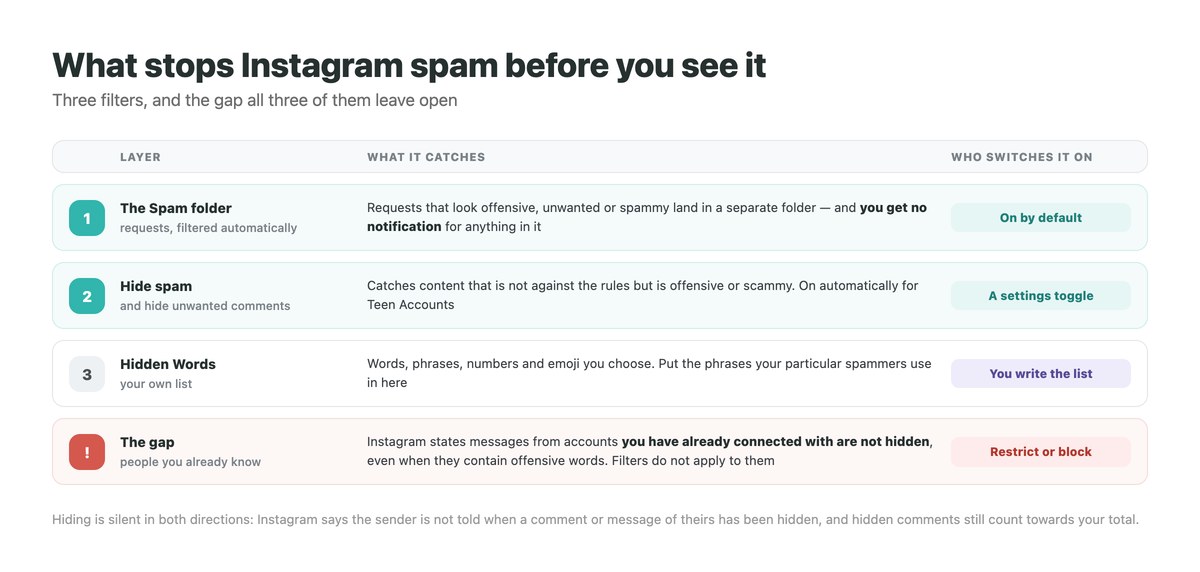
Instagram’s page on viewing, deleting or reporting spam explains that message requests which look offensive, unwanted or spammy – or which match your Hidden Words – go into a separate Spam folder, and that you receive no notifications for anything in it.
On desktop you reach it from Messages, then requests at the top left, then Spam. On a phone it sits behind the Requests tab in your inbox.
Clearing It in One Go
There is a Delete all control at the bottom of that folder. Nobody needs to work through spam message by message, which is the premise of a surprising amount of advice on this subject.
Opening an individual message gives you the choice to Block or Leave, Delete, or Accept – and accepting moves that conversation into your main inbox permanently.
Why Some Previews Look Blank
Instagram notes that some message previews are hidden according to your Hidden Words preferences, so a request can appear in the folder with nothing readable in the preview. That is the filter working rather than a bug.
The Three Filters Worth Turning On
Two are toggles and one is a list you write yourself. The one you write is the one that works, because it can name the specific thing your spammers keep sending.
Hide Spam, and Hide Unwanted Comments
Instagram’s page on hiding comments and message requests covers these. They catch content that does not break the Community Standards but is offensive, disrespectful or scammy – racial slurs, swearing, scams.
For Teen Accounts these are on automatically, and teens under sixteen need a parent or guardian’s permission to change them.
Hidden Words, Which You Write
A custom list of words, phrases, numbers and emoji you never want to see. This is where to put the specific phrasing you keep receiving – the investment-scheme vocabulary, the crypto words, the particular emoji a bot wave is using.
It applies to comments as well as message requests, which makes it the single highest-value five minutes in your settings.
Take the words from your own folder
Open the Spam folder first and write the list from what is actually arriving, rather than copying a generic blocklist that was built for somebody else’s problem.
Numbers and emoji count too
A wave of bots often shares a phone-number format or a single emoji. Either can go in the list, and either can be more precise than a word.
Mind the false positives
A word common in your own niche will hide real customers. Prefer phrases over single words where the word has ordinary uses.
Message Controls
Under Settings, below How others can interact with you, then Messages and story replies, then Message controls, you choose whether message requests from people on Instagram reach your requests folder or whether you receive them at all.
Turning them off entirely is a real option for a personal account. It is a poor one for a business, because the customers you want are also strangers – our guide to Instagram DM requests covers that trade-off.
What Hiding Does Not Do
Instagram is explicit that when a comment or message is hidden, the person who sent it is not told. It also notes that hidden comments still count towards your total comment count, which is why the number can look wrong after a filtering clean-up.
The Gap Every Filter Leaves Open
This is the part worth knowing, because it explains the case where somebody has turned everything on and is still getting messages they do not want.
Filters Do Not Apply to People You Know
Instagram states it directly: messages from accounts you have already connected with will not be hidden, even if they include offensive words, phrases or emoji.
That is a deliberate design choice rather than an oversight – you would not want a filter quietly swallowing messages from a friend or a customer. But it means that for anyone already in your contacts, no amount of Hidden Words configuration will do anything at all.
Restrict Is the Quiet Option
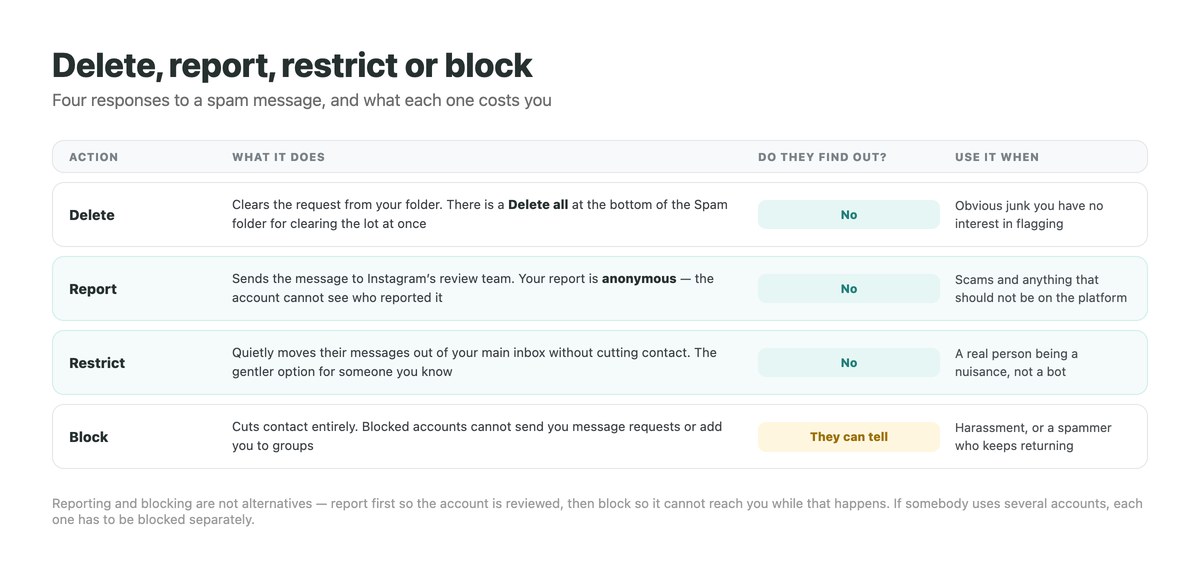
For a real person being a nuisance rather than a bot, restricting moves their messages out of your main inbox without cutting contact and without telling them. It is the option that avoids the conversation a block invites.
Block Is the Complete One
Blocking ends it: Instagram says blocked accounts cannot send you message requests or add you to groups. The cost is that it is visible to the other person, and that somebody determined will simply use a second account – each of which has to be blocked separately.
Our guide to blocking messages on Instagram goes through what each option looks like from both sides.
What Reporting Actually Does
Reporting is the action people skip because they assume nothing happens. Two details are worth knowing before deciding that.
It Goes to a Review Team
Instagram says the content of a reported spam message is sent to its Help Team for review. You are not reporting into a void, though you should not expect to be told the outcome either.
It Is Anonymous
The account you report cannot see who reported it. Instagram states this plainly, with one exception: reports of intellectual property infringement are not anonymous.
That anonymity is the reason to report rather than only block. Blocking protects you; reporting is the only action that can affect whether the account keeps doing it to other people.
Report First, Then Block
In that order, because reporting requires access to the message. Blocking first can make the content harder to reach, and the two are not alternatives.
Which Problem Do You Actually Have?
The fix depends entirely on which row you are in, and the wrong fix is why people conclude the filters do not work.
| What you are seeing | What is going on | What fixes it |
|---|---|---|
| Spam you only find when you go looking | It is already being filtered correctly | Nothing. Delete all, occasionally |
| Spam arriving in your main inbox | It is slipping past the automatic filters | Hidden Words, using the actual phrasing |
| Unwanted messages from someone you know | Filters never apply to existing contacts | Restrict, or block after reporting |
| The same person returning on new accounts | Blocking is per-account | Report each one, block each one |
| A flood of genuine customer questions | Not spam at all – a volume problem | Automate the repeating answers |
| Blank previews in the requests folder | Hidden Words is hiding the preview | Nothing. That is the filter working |
The fifth row is the one most often misdiagnosed, and turning on message controls to fix it removes the customers along with the noise. Our guide to Instagram business chat covers the tools a business account has for that case.
A Ten-Minute Clean-Up
In order. This handles both the backlog and the recurrence.
Open the Spam folder and read it once
Not to answer anything, but to see what is actually being filtered. You will usually find both genuine spam and one or two real messages that were caught by mistake.
Rescue anything real, then Delete all
Accept the legitimate ones so they move to your main inbox, report anything that is a scam, then clear the rest in a single action.
Write your Hidden Words list
Take the phrasing from what you just read. Specific beats general – the actual words your spammers use, rather than a generic blocklist copied from somewhere.
Turn on Hide spam and Hide unwanted comments
Two toggles under the same settings area. They cover the category that is offensive without breaking the rules.
Decide on message controls
Requests to the folder, or none at all. Personal accounts can reasonably choose none; business accounts should not.
Deal with the people who are already connected
Filters will not touch them. Restrict the nuisances, block anyone harassing you, and report before you block.
When the Problem Is Volume, Not Spam
A separate situation that gets called spam and is not: a business account receiving more genuine messages than anyone can answer. The filters above are the wrong tool, because the messages are real.
Do Not Switch Requests Off
The instinct is to turn message requests off and reclaim the inbox. For a business that deletes the customers along with the noise – almost everyone enquiring for the first time is a stranger, which is exactly who message controls block.
Answer the Repetition Automatically
DMpro connects through Instagram’s official API and answers the questions that keep arriving – opening hours, price, delivery, availability – the moment they land, then passes anything that is not routine to a person with the thread attached.
It is triggered by incoming messages, comments, story replies and mentions. It does not send unsolicited messages to anyone, and nothing connected through the official API can: a conversation has to be started by the other person. Our guide to Instagram DM requests covers the folder that volume arrives in.
A Note on Tools That Promise the Opposite
Anything offering to blast unsolicited DMs to strangers at volume is describing the behaviour this article is about stopping, and Instagram treats repetitive messaging to people who have not contacted you as spam regardless of what sent it.
Legitimate outreach is a different thing: researched, personal, paced, and sent from your own account. Our guides to Instagram DM limits and mass DMing on Instagram cover where the real ceilings sit and what crosses the line.
When the Inbox Is Full of Real People
Instagram’s filters handle the junk. What they cannot help with is a business inbox holding forty genuine questions, most of which are the same four questions.
DMpro answers those the moment they arrive, through Instagram’s official API, and hands the conversations that need judgement to a person with the whole thread already in front of them.
- Instant answers to the questions that repeat
- Triggered by messages, comments, story replies and mentions
- Official API connection, no password shared
- The same inbox for WhatsApp, Messenger, TikTok and Telegram
- Hand-off to a person with full context
- Genuine enquiries are not buried under repetition
- Nothing waits unanswered overnight
- Your team opens only what needs them
- It cannot message anyone who has not contacted you first
- The repeat answers need writing properly once
Conclusion
Most Instagram spam is already being filtered into a folder that never notifies you, so the first move is to open it rather than to change any settings. Clear it with Delete all, rescue anything real, and report the scams – reporting is anonymous and it is the only action that affects anyone other than you.
Then write a Hidden Words list using the actual phrasing you just read, rather than a generic blocklist. It is the one filter you control, it covers comments as well as messages, and it takes about five minutes.
Worth separating the opposite case too: messaging people who asked to hear from you is not spam, and our guide to the Instagram lead magnet covers delivering something people opted into. And remember what none of it reaches. Instagram does not filter messages from accounts you have already connected with, however offensive the content. For those, restrict or block is the only route – and reporting before blocking is what gives it any effect beyond your own inbox.
Official API connection, instant answers to the questions that repeat. Free plan available.
Try DMpro free