
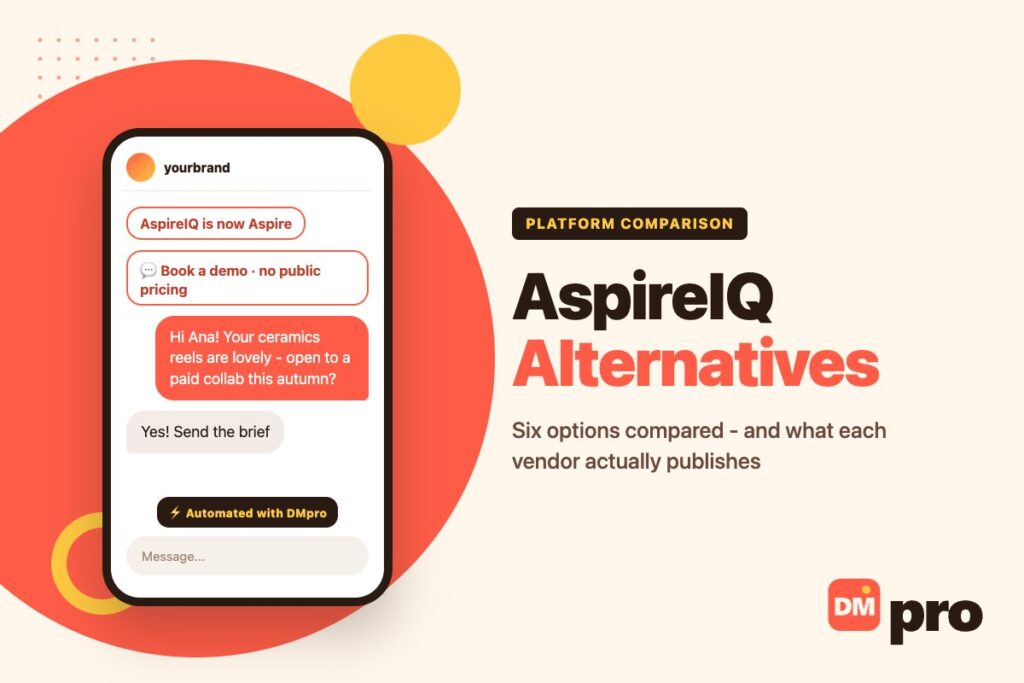
If you are searching for AspireIQ alternatives, start with one thing that has changed: AspireIQ now trades as Aspire. The product is still an enterprise influencer platform aimed at ecommerce brands, and like most tools in this category it publishes no prices at all – the site sells through a demo booking.
That is the real difficulty with comparing these platforms. Published feature lists are long and published prices are rare, so most comparison articles quote numbers that were estimates when they were written and are wrong by the time you read them. What you can compare reliably is the model: who the creators are, who does the outreach, who pays them, and what you can take with you when you leave.
This guide covers why brands look past Aspire, six alternatives with what each vendor actually shows publicly today, the questions to ask before switching, and when direct outreach with the DMpro Chrome extension is cheaper than any platform. It pairs with our wider guides to the influencer marketplace models and to influencer outreach.
Key Takeaways
What Happened to AspireIQ?
AspireIQ rebranded to Aspire. Its site positions the product around ecommerce: recruiting creators who already buy from you, product seeding, creator storefronts and campaign workflows.
Why the Rename Matters
Reviews, comparison posts and pricing pages written under the old name are still in circulation, and some describe packaging that no longer exists. When you research, check the current site rather than an article – including this one.
Why Brands Look Elsewhere
No public pricing
You cannot compare cost without a sales call, and quotes are usually annual.
Enterprise fit
The feature set and the price point assume a team running continuous programmes.
Different job
If you need ten creator partnerships a year, a platform licence is rarely the cheapest way to get them.

6 AspireIQ Alternatives
Grouped by what they actually are. Where a vendor publishes no pricing, this guide says so rather than guessing.
1. Ainfluencer – Marketplace With No Platform Fees
Ainfluencer runs the opposite model to a licensed platform: creators join it, you publish a brief, and they apply to you. On its website the company states that brands pay no platform fee and that a marketplace campaign can reach upwards of five million creators; a done-for-you option sits alongside the self-serve one.
Best for
Brands that want creators to come to them without a licence fee.
Pairs with
If you also message creators directly, the DMpro extension can drop that campaign’s title and apply link into each message automatically.
2. Influencity – Self-Serve Search and Campaigns
Influencity is the most self-serve option on this list: plans are published on its site, all plans come with a 7-day free trial, and it combines creator search and analytics with campaign management and reporting.
Best for
Teams that want to start without a sales process.
Check first
Which limits apply to your plan – searches, profile analyses and reports are usually metered.
3. CreatorIQ – Enterprise Discovery and Reporting
CreatorIQ sits at the enterprise end: creator discovery, a CRM for relationships, campaign workflows and detailed reporting, sold through a demo rather than a pricing page.
Best for
Large brands and agencies running continuous programmes.
Check first
Minimum term, seats included and what onboarding costs.
4. Grin – Creator Management for DTC Brands
Grin focuses on direct-to-consumer brands: creator recruitment, product seeding, ecommerce integrations and campaign tracking. Pricing is quote-only.
Best for
Ecommerce brands running gifting and affiliate programmes at volume.
Check first
How payments to creators are handled and which store platforms are supported.
5. Upfluence – Discovery Plus Affiliate Tools
Upfluence combines creator search with affiliate and ecommerce features, and offers a browser extension for looking up profile metrics as you browse. Pricing is a custom quote. Our Upfluence alternatives guide compares it with similar tools.
Best for
Brands that want influencer and affiliate programmes in one place.
Check first
The contract length and what happens to affiliate links if you leave.
6. Later Influence – Managed Programmes
Later Influence now leads with full-service programmes, campaign services and a creator network rather than a self-serve subscription; its old influencer pricing page no longer exists and the site directs you to a strategy call.
Best for
Brands that want the programme run for them.
Check first
What is managed service and what is platform access, and how each is billed.
Six Questions Before You Switch
A demo answers none of these unless you ask directly. Ask all six of every vendor, including Aspire.
Money and Commitment
What is the all-in annual cost?
Licence, onboarding, add-ons and minimum term, in writing.
Who pays the creators?
Escrow, platform payouts, or your own finance team – it changes how quickly good creators say yes.
Inventory and Fit
Are creators opted in, or indexed?
An index built by crawling public accounts behaves nothing like a pool of creators who signed up, and the reply rates show it.
Does it cover your channels and markets?
Instagram, TikTok and YouTube coverage varies, and so does regional depth.
Exit and Ownership
What happens to your data?
Can you export creators, conversations and campaign results when you leave?
Who actually does the outreach?
The platform, their managed team, or still you and your inbox.

Which Alternative Fits Which Situation
Start from your constraint rather than from the feature list.
| Your situation | Look at | Why |
|---|---|---|
| No budget for a licence | Ainfluencer | Marketplace model with no platform fee, per its site |
| Want to start today without a sales call | Influencity | Published plans and a 7-day trial |
| Large, continuous programme | CreatorIQ or Aspire | Built for scale, sold via demo |
| Ecommerce gifting and affiliates | Grin or Upfluence | Store integrations and affiliate tooling |
| Want it run for you | Later Influence or an agency | Managed programmes rather than software |
| Your shortlist is already made | DMpro extension (ours) | Messages them directly, with no licence or commission |
When Direct Outreach Beats a Platform
Platforms earn their fee on discovery, payments and reporting at volume. Below that volume, the maths rarely works.
The Small-Programme Case
If you need a handful of partnerships a year, an annual licence costs more than the time it saves. Shortlist creators from your own followers and category, then write to each of them properly. Our Collabstr alternatives guide makes the same comparison for marketplaces.
Doing It Without the Grind
The DMpro Chrome extension keeps the outreach personal while removing the repetition: working from a single brief, it studies each profile it opens and produces a fresh message for that creator, then delivers it through your logged-in Instagram or TikTok session, spacing the sends out and stopping at the limit you set. Ten AI-written messages a month are free, and Starter is $19 for 500.
What Stays Yours
The shortlist, the offer and the relationship. Replies arrive in your normal Instagram inbox, and nothing is locked inside a platform you might leave next year – which is also the answer to the data question above. For long-running programmes, see our IZEA alternatives comparison.
Talk to Creators Without a Licence Fee
Every platform on this list is a way to find creators. The part that gets a yes is still a message written for one person. The DMpro Chrome extension builds that message out of what the creator’s profile actually says and sends it under your own handle, so your spend goes on conversations instead of software seats.
Use it alongside a marketplace or on its own: paste a shortlist of handles, set a daily limit, and let it work through the list while you handle the replies.
- Every creator gets a message written for them
- Pairs with any discovery tool or marketplace
- Campaign details filled in from Ainfluencer
- Works through a pasted or uploaded shortlist
- Starts new accounts on cautious limits
- No licence, seats or marketplace commission
- Your account, your relationships
- Free tier to test the message
- Discovery is not its job – bring your own shortlist
- Automating DMs remains against the letter of Instagram’s terms
Conclusion
AspireIQ is now Aspire, and like most platforms in this category it sells through a demo rather than a price list. That makes model, coverage and exit terms the things worth comparing – not feature counts.
Pick the model that matches your programme: a marketplace if you want creators to apply, a self-serve search tool if you want to start today, a managed service if you want it run for you. And if you already know which creators you want, message them yourself – it is the cheapest test there is.
Write the brief once; every creator on your shortlist gets their own message. Ten a month cost nothing.
See the DMpro extension