
A chatbot on Instagram DMs is an easy sell and an easy thing to get wrong. The pitch is that it answers everyone instantly; the failure mode is that it answers everyone instantly and some of those answers are wrong.
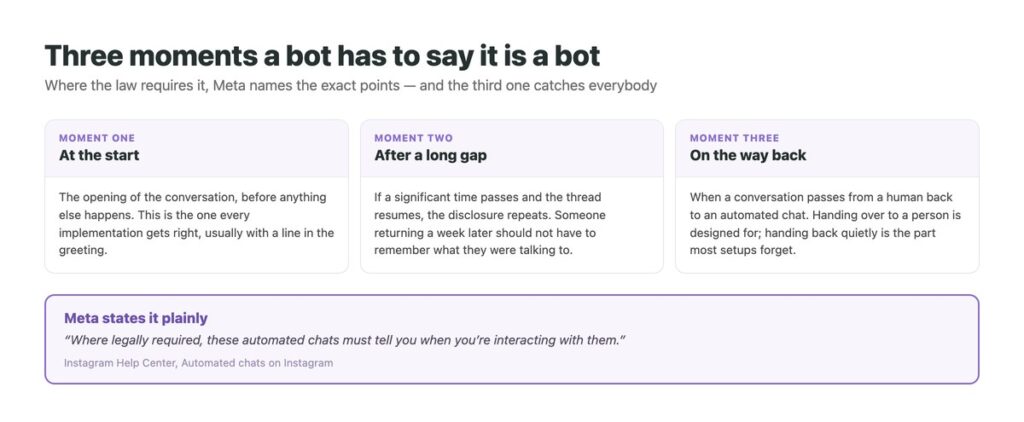
There is a rule most implementations do not know about, which is that where the law requires it a bot has to disclose that it is a bot – and Meta names three separate moments where that applies, not one. The third of them is missed almost universally.
Beyond compliance the real question is narrower than build or do not build: which messages should a machine answer at all. That line is not about technical difficulty, it is about what being wrong costs, and it can be drawn quite precisely. The wider setup this sits in is covered in our guide to managing Instagram conversations.
Key Takeaways
What a Chatbot Can Legally Be on Instagram
Automated chats run through Meta’s developer platform rather than through anything inside the Instagram app, which means they inherit every rule that applies to the API. The most consequential is that a bot cannot open a conversation – apart from a single private reply to a comment and Meta’s gated Follow to DM beta for new followers, someone has to message you first, as our guide to what the DM API permits sets out.
So an Instagram chatbot is a reply system rather than an outreach system, whatever the marketing around a given product suggests. That single constraint removes most of the ways chatbots go wrong elsewhere, because everyone it talks to chose to start talking.
It also means the whole value sits in the quality of the reply. There is no volume lever to pull, and the number of conversations is set by your marketing rather than by the bot. What drives that volume is covered in our guide to using DMs as a marketing channel.
The Disclosure Rule, and the Moment Everyone Misses
Instagram’s page on automated chats states that where legally required, automated chats must tell you when you are interacting with them. It then names the moments, and this is the part worth copying down.
At the beginning of the conversation, which every implementation does. After a significant lapse of time, which some do. And when the conversation is passed from a human back to an automated chat – which almost nothing does, because handover is designed in one direction only.
That third moment is a genuine design problem rather than a copywriting one. If a person answers at 2pm and the automation resumes at 6pm, the customer is still in the same thread and has no way of knowing the voice changed. Building the return path is more work than the greeting line, and it is the one auditors would look at.

The Line: What Being Wrong Costs
The useful way to decide what a bot should answer is not how hard the question is. It is what happens when the answer is wrong.
If a bot gives the wrong opening hours, someone asks again and the cost is one follow-up message. If it tells someone their refund was processed when it was not, the cost is a customer and possibly a public complaint. Those two mistakes are equally easy for a machine to make and are not remotely equivalent, which is why difficulty is the wrong axis.
This produces a workable rule: automate anything with one correct answer that can be looked up, and hand over anything where a confident wrong answer causes harm. Money already paid, complaints, and anything medical, legal or financial sit firmly on the far side of that line. Scam messages arriving in the same inbox are a separate reason to have a person looking, as our notes on spotting scam DMs explain.

The Common Failures, and What Causes Them
Ranked by how often they are the actual problem rather than the one being blamed.
| What people blame | What is usually happening | The fix |
|---|---|---|
| The bot’s understanding | It answers when it should escalate | Make not knowing a valid outcome |
| Poor conversation design | There is no working handover | Build the route to a person first |
| Customers disliking bots | They cannot tell they are talking to one | Disclose it, including on the way back |
| Not enough training data | It invents specifics it cannot know | Look values up, never generate them |
| The tool being weak | Nobody reads what it said | Review transcripts weekly, not metrics |
Where AI Changes This, and Where It Does Not
A rule-based bot follows a script and fails visibly when a message does not match one. That is unhelpful but honest: the customer sees immediately that they need a person.
A language model does not fail that way. It produces a fluent, plausible answer to almost anything, including questions it has no information about – which converts a visible failure into an invisible one. That is a real improvement in the ninety per cent of cases where it knows the answer and a real regression in the rest.
The practical consequence is that the more capable the model, the more the design work moves into constraining it: answering from a lookup rather than from memory, having a confident escalation path, and being explicit that it does not know. None of which is about the model.
Rule-Based, Model-Based, or Both
The choice is usually presented as old versus new. The useful framing is how each one fails.
| Rule-based | Language model | Lookup-backed | |
|---|---|---|---|
| Handles unexpected wording | Badly | Well | Well |
| How it fails | Visibly | Invisibly | By saying it cannot |
| Invents specifics | Never | Readily | Never |
| Setup effort | Low | Low | Higher |
| Safe for order status | Only if scripted | No | Yes |
| Best used for | Menus and routing | Understanding the question | Producing the answer |
The combination in the last column is what most good setups converge on – a model to work out what was asked, and a real lookup to answer it, so nothing is composed from memory. It is more work than switching a chatbot on, and it is the difference between a tool that saves time and one that quietly creates it. The same split applies to automatic welcome messages, where a fixed greeting is safe precisely because it claims nothing.
Setting One Up Without the Usual Regrets
In this order, because two of these are much harder to add later than to build in.
Write the handover path before the greeting
Decide how a conversation reaches a person, what they see when it does, and how the customer is told. Everything else is easier once this exists.
Automate the first reply and nothing else, at first
It is the highest-value change and the lowest-risk one. Being answered in seconds rather than hours changes outcomes on its own.
List the questions with exactly one correct answer
Hours, location, shipping times, stock. These are the safe set, and they are safe because the answer is looked up rather than composed.
Make “I do not know” a real outcome
A bot that escalates cleanly is more useful than one that always produces something. This is the single biggest quality decision.
Read transcripts every week
Not the resolution rate – the actual conversations. It is the only way to find the confident wrong answers, because they never appear as failures in the metrics.
What to Measure
Resolution rate is the metric every tool shows and it rewards exactly the wrong behaviour: a bot that answers everything scores well, including the answers it should not have given.
Better questions are how many conversations reached a person when they should have, how long that took, and what proportion of customers asked the same thing twice. That last one is the cheapest signal available – a repeat question almost always means the first answer did not land.
And the one that matters commercially: reply rate to your first message. Speed is the part automation genuinely fixes, and it is the part that shows up in revenue. It is the same measurement argument as in our notes on outreach that gets answered, where sends are similarly the number that flatters and replies are the number that counts.
Automated Where It Helps, Human Where It Counts
Most chatbot disappointment comes from the same place: the automation was built to answer everything, and the route to a person was an afterthought bolted on later.
DMpro is built the other way round. The first reply goes out in seconds, routing decides what a person needs to see, and handover happens inside the same thread with the history intact – across Instagram, WhatsApp and TikTok, so the customer never repeats themselves because they switched app.
- Instant first replies, with handover built in rather than added later
- Routing that escalates on what the message actually says
- One thread and one history when a person takes over
- Instagram, WhatsApp and TikTok answered from the same place
- Transcripts you can read, not just a resolution percentage
- Nobody waits hours for an answer that was always going to be simple
- The messages that need judgement reach a person quickly
- History survives the handover, so nothing is asked twice
- It still cannot message anyone first – Meta’s rule, not ours
Conclusion
Three things decide whether an Instagram chatbot helps or embarrasses you. Disclosure, which applies at three moments and not only in the greeting – the handover back from a human is the one nearly everyone misses.
The line between machine and person, which is not about difficulty but about what a wrong answer costs. One correct lookup-able answer is safe; money already paid, complaints and anything medical, legal or financial are not.
And what you measure. Resolution rate rewards a bot for answering things it should have escalated. Read the transcripts instead, and watch how often people ask the same question twice.
Instant first replies, clean handover, one history across every channel.
See the handover work