
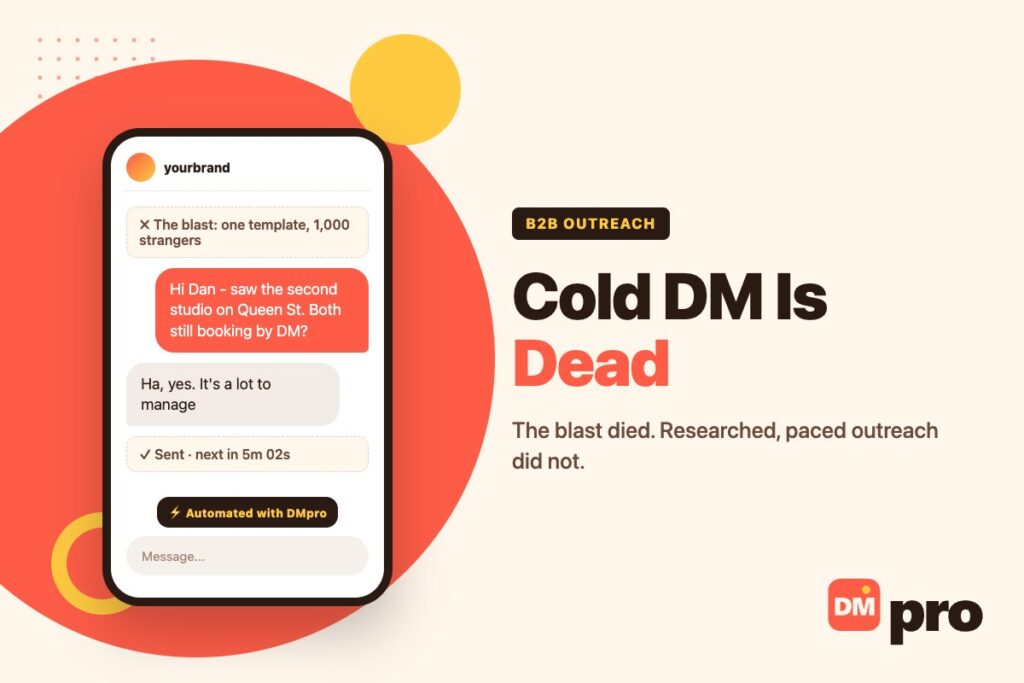
Send the same cold DM to a thousand strangers today and you will not get a thousand conversations. You will get silence, a pile of message requests nobody opens, and a real chance your account gets restricted. That version of cold DM is dead, and it is not coming back.
What is not dead is outreach itself. Buyers still reply to strangers – just not to obvious templates. The researched, one-to-one message is still one of the most effective parts of DM marketing, and some of the volume the blast used to carry has moved to a quieter B2B channel: the contact form on a company’s website.
This guide covers what actually changed, how cold DM compares with contact forms and email, what the working version looks like step by step, and how to run it at a sensible scale with the DMpro Chrome extension for DMs and contactID for contact forms.
Key Takeaways
Is Cold DM Really Dead?
Yes and no, and the distinction matters more than the headline.
What Died: The Blast
Copy one message, paste it to a bought list and send it as fast as the platform allows, and you will spend more time restricted than in conversations. Nobody is coming to rescue that technique.
What Survived: The Researched Message
A targeted, one-to-one DM is very much alive, and it is how plenty of agencies and software teams still fill their calendars. The message that dies is the one that could have been sent to anyone; the one that works could only have been sent to that person. For how it works in practice, see our guide to Instagram DM outreach.

Why Cold DM Blasts Stopped Working
Four things changed at roughly the same time, and together they closed the door on template blasting.
The Platform Side
Message requests became a graveyard
A DM from an account someone does not follow lands in a separate requests folder, and many people never open it.
Pacing became a signal
Sending faster than a person plausibly could is one of the clearest automation signals. Meta’s spam policy names high-frequency and repetitive messaging, whether manual or automated.
The Buyer Side
Buyers learned the patterns
“Hey [first name], loved your content!” is now a recognised template opener. Recognition is fatal; the reader stops reading.
Everyone got the same tools
When any competitor can send the same volume, volume stops being an advantage and relevance becomes the only differentiator.
The Real Death Certificate
None of these say people stopped replying to strangers. They say people stopped replying to obvious templates from strangers.
Cold DM vs Contact Form vs Cold Email
Most B2B teams now run more than one channel. Each reaches a different kind of buyer.
Cold DM: People
Best for founders, creators and consumer brands who run their own social accounts. Personal and immediate, but with strict pacing and a requests folder to get past.
Contact Forms: Companies
Best for businesses with a website, including the many that publish no email address. The message lands in an inbox someone checks as part of their job, and no bought email list is needed.
Cold Email: Reach
Best for anyone with a public business address and for longer, formal pitches. It scales widely but competes with spam filters and crowded inboxes.
Outreach Channels Compared
No channel wins outright. Match the channel to where your buyer actually replies, then build an outreach strategy around the pair you choose.
| Channel | Reaches | Main strength | Main weakness |
|---|---|---|---|
| Cold DM | Founders, creators, consumer brands | Personal and immediate | Strict pacing, requests folder |
| Website contact form | Companies with a website | Monitored inbox, no email list needed | Less personal, one company at a time by hand |
| Cold email | Anyone with a business address | Wide reach, formal format | Spam filters, crowded inboxes |
| Warm intro or referral | Your network’s reach | Highest conversion | Cannot be scaled on demand |
Contact Form Outreach: The Quiet B2B Channel
Contact form outreach means sending your pitch through the Contact Us form on a company’s own website instead of to a guessed or bought email address. It sounds almost too simple, which is part of why it works.
Why It Works for B2B
It is monitored
Someone reads that inbox as part of their job.
It needs no bought list
You only need the company’s website, which keeps you away from the messiest data-sourcing questions under EU data protection rules.
It uses the channel they published
The company put the form there to receive messages; a relevant business enquiry is an ordinary use.
The Honest Trade-Off
A form has no profile picture and no conversation history, and filling hundreds by hand is slow. It complements DMs rather than replacing them, and it works best when the buyer is a company rather than a person. Keep it relevant, identify yourself clearly, and never write again to a business that has declined.
What Replaced Cold DM: Warm, Paced and Personal
The outreach that survived differs from the blast in five specific ways.
Build a small, specific list
Fifty researched accounts out-earn five thousand scraped ones. Look for a trigger – a hiring post, a launch, a new location. If you cannot say why this person, they should not be on the list. It is the same discipline behind good client outreach.
Open with something only they would recognise
The first line is the whole game. Delete any opener that would still make sense with a different name pasted in.
Pace like a person
Spread sends across the day with irregular gaps and stay well below any limit you have hit before. Instagram publishes no official DM number; our guide to mass DMing safely covers the ranges by account age.
Follow up twice, with something new
Most replies arrive after the first message. Each follow-up should add a case, a result or a smaller ask – never “just bumping this”.
Keep a record of every thread
Outreach usually falls apart at the reply stage. Log who you contacted, on which channel and what they said, so warm leads do not go cold in a notification list.


Cold DM Mistakes That Still Kill Reply Rates
These habits survived from the blast era and still quietly ruin campaigns.
Message Mistakes
Pitching in the first message
The first DM has one job: earn the second.
A wall of text
DMs are read on a phone. Three short lines beat three paragraphs.
Fake personalisation
A merge tag is not research, and readers can tell instantly.
Setup Mistakes
Sending from a bare profile
People check who messaged them; an empty profile reads as a bot.
A big ask from a stranger
Make the first ask small enough to say yes to.
Scaling before it converts
Sending more of a message that does not work just produces silence faster.
The B2B Outreach Metrics That Matter
Reply rate alone will mislead you. Track the sequence so you can see which step is leaking.
| Metric | What it tells you | What to do when it is low |
|---|---|---|
| Delivered or submitted | Whether messages arrive at all | Slow down, warm the account, fix sender details |
| Profile views | Whether your profile earns a look | Fix the photo, name field and bio |
| Reply rate | Whether the opener earns a response | Rewrite the first line, not the pitch |
| Positive reply rate | Whether you targeted the right people | Tighten the list, not the copy |
| Meetings booked | Whether the ask is easy to accept | Make the first ask smaller |
How to Run the Working Version at Scale
The research and the first line are what make modern outreach work – and what make it slow. Two tools take over the repetitive part without turning it back into a blast.
For People: the DMpro Extension
The DMpro Chrome extension drafts a separate DM for each Instagram or TikTok profile from its name, bio and follower count, based on a brief you write once, and sends it from your own logged-in account.
Pacing built in
Daily limits and random delays you choose; new users start in Safety Mode at 20 DMs a day, 3 to 6 minutes apart.
Automatic brakes
Campaigns pause when Instagram shows a warning, at the daily cap, or when credits run out.
Honest limits
Automated DMs can still breach Instagram’s terms – see Instagram’s help centre – so volumes should stay modest.
For Companies: contactID
contactID takes a list of company websites, finds each contact form and submits your message with tags such as {{website_name}} filled in, plus optional AI personalisation per site. A pre-flight report flags sites without a form and companies you already contacted, and you are charged only for forms that go through.
Send the Version That Still Works
The blast is dead because every message was the same. The DMpro Chrome extension is built for the opposite: a different message for every profile, sent from your account with gaps that look like a person at a keyboard. You can try it free with 10 AI-drafted DMs a month.
For the formal B2B side, contactID handles contact-form outreach to company websites, so each channel reaches the buyer it suits.
- A different opener for every profile
- Random delays and daily caps you control
- Automatic pause on warnings or at the cap
- Contact-form outreach to companies via contactID
- Per-prospect send status with CSV export
- The opposite of a blast, by design
- Sends from your own account – no password shared
- Free tier to start small
- It will not rescue an offer that has never converted
- Replies arrive in your own inbox; there is no built-in reply tracker
Conclusion
Cold DM is dead in the only sense that ever mattered: you can no longer win by sending more. The channel is still open and still one of the most personal ways to reach a buyer. The entry fee is now research and restraint instead of volume.
Pick fifty accounts you can say something true about, write three or four lines, pace them like a person and follow up twice. Pair that with contact-form outreach for companies, and you have a pipeline that does not depend on a channel everyone else has burned out.
A personal DM for every profile, drafted by AI and sent from your account at a human pace.
See the DMpro extension