
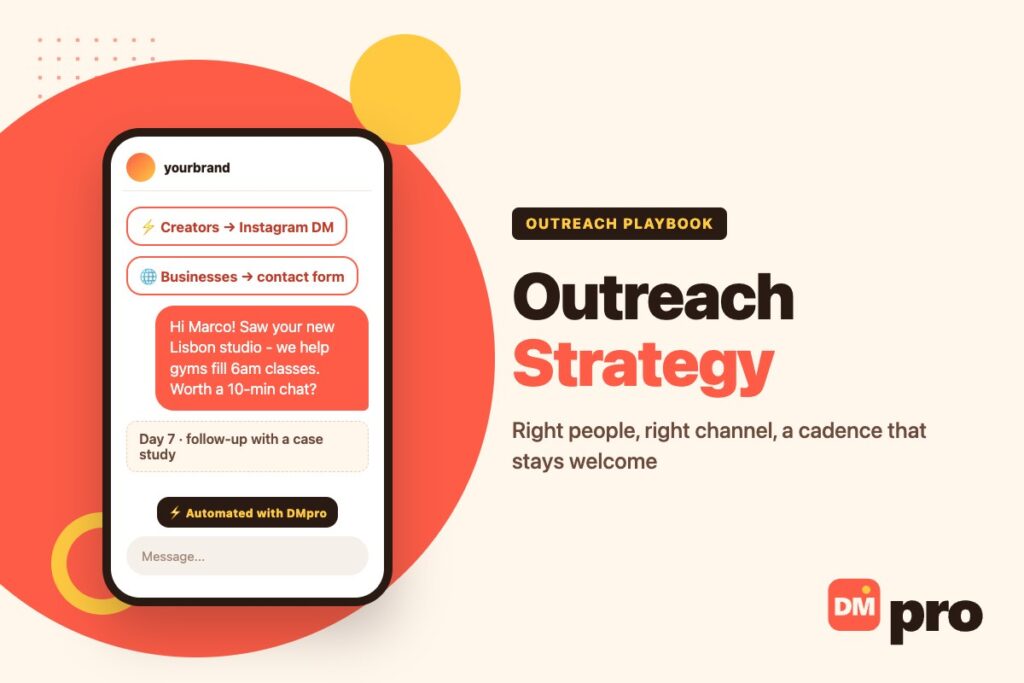
An outreach strategy is the difference between sending messages and getting replies. Without one, outreach turns into bursts of activity whenever the pipeline looks thin: a list pulled together in a hurry, the same note pasted to everyone, no follow-up, and a conclusion that “outreach does not work”. With one, the same hours produce a steady flow of conversations, because every message goes to the right person, on the channel they actually read, at a pace they will tolerate.
Social messaging is now a core outreach channel, and it sits alongside the rest of DM marketing. But it is not the only one. A creator reads Instagram DMs; a local business owner reads the inbox behind their website’s contact form; a procurement team reads email. A strategy starts by matching each audience to its channel.
This guide walks through the five layers of an outreach strategy, how to pick channels, how to write a first message that can be answered, a 14-day cadence, the numbers worth tracking, and the mistakes that quietly kill results. It also shows how to run the two most time-consuming channels with tools built for them: the DMpro Chrome extension for Instagram and TikTok DMs, and contactID for website contact forms.
Key Takeaways
What Is an Outreach Strategy?
An outreach strategy is a written plan for contacting people who do not know you yet – customers, partners, creators, publishers – in a deliberate and repeatable way. It answers five questions before a single message goes out: who you are contacting, what you are offering them, where you will reach them, how often you will follow up, and how you will know it worked.
Strategy Versus Campaign
A campaign is one push: a list, a message, a date range. A strategy is the system every campaign runs on. When the strategy is written down, each campaign starts from what the last one taught you instead of from a blank page, and a teammate can run it without guessing.
Who Needs One
Anyone whose growth depends on starting conversations. The details differ by goal:
Sales and B2B teams
Booking calls with decision-makers who have never heard of you. See our guide to sales outreach for the prospecting side.
Brands and creators
Partnerships, collaborations and gifting, where the first message is really a request for a quote. Influencer outreach covers that case in depth.
Agencies and freelancers
Winning clients in a specific niche or city, often by contacting many small businesses that all look alike on paper.
The Five Layers of an Outreach Strategy
Every working outreach strategy stacks the same five layers. Most people start at the message and skip the audience, which is exactly backwards: a perfect message sent to the wrong people still fails.
Audience
A narrow, relevant list beats a large random one. Define the person by role, situation and a trigger that makes your offer timely – a new location, a product launch, a hiring spree, a creator starting a new series.
Message
One specific reason you chose them, one clear offer, one easy question. Everything else is decoration.
Channel
The place they already read messages. The same pitch lands very differently in a DM, a contact form and an email.
Cadence and Follow-Up
Most replies come after the first message, so the follow-ups are planned in advance: how many, how far apart, what each one adds, and when to stop.

How to Choose Your Outreach Channels
A multichannel outreach strategy does not mean using every channel on every person. It means choosing the right first channel for each audience and, at most, one fallback.
Instagram and TikTok DMs
Best for creators, consumer brands, shops and anyone whose business runs on social media. A DM is personal and often read the same day, which is also why a lazy one is ignored instantly. Our Instagram DM outreach guide covers inbox etiquette and account safety.
Watch the limits
Instagram publishes no official DM limit, but new accounts get restricted quickly. Keep volumes low, gaps random and every message personal.
Mind the policy
Meta’s spam policy covers high-frequency and repetitive messaging, whether manual or automated.
Website Contact Forms
Best for local and small businesses, agencies, SaaS companies and publishers. The form on a company’s website usually goes to an inbox the owner or the right team actually checks, and many small businesses list no email address at all. It is one of the most under-used B2B channels because filling forms one by one is slow.
Best for formal B2B pitches, longer proposals and follow-ups with attachments. In the US, commercial email must follow the CAN-SPAM Act: an honest subject line, your real identity and address, and a working way to opt out. Other countries have stricter consent rules, so check where your recipients are.

How to Build an Outreach Strategy in 6 Steps
Work through these once and write the answers down. The document you end up with is your strategy; each campaign is a copy of it with a new list.
Define the audience and the trigger
Describe who you are contacting and why now. “Gyms in Lisbon that opened in the last year” is a strategy; “fitness businesses” is a wish.
Build and clean the list
Collect handles or websites that fit, then remove duplicates, inactive accounts and anyone you contacted recently. A few hundred well-chosen targets beat thousands of random ones.
Match each segment to a channel
Creators and consumer brands by DM; small businesses and B2B companies by website contact form or email. Pick one first channel and one fallback.
Write the first message and one variant
Keep it under about 100 words, lead with the specific reason, and end with a question that can be answered in one line. Write a second version so you can compare them.
Set the cadence
Plan the follow-ups before you send the first message: what each adds, how far apart, and the point at which you stop.
Track, review and refine
After each batch, look at who replied and why. Keep what worked, rewrite what did not, and update the written strategy.
Writing First Messages That Get Answered
The first message decides whether there is a second. It has three jobs and should do nothing else.
Lead With a Specific Reason
Mention one real detail: a recent post, a new location, a product they launched, a gap you noticed on their site. It proves the message was written for them and gives them a reason to keep reading.
Make One Clear Offer
State what you do for businesses like theirs in one sentence, ideally with a concrete result. Resist listing everything you offer; a single offer is easier to say yes to.
Ask One Easy Question
End with a question that takes seconds to answer – “Worth a 10-minute call next week?” or “Who handles partnerships on your side?” – rather than a request for a meeting link and a calendar slot in one go.
For a DM
Two or three short sentences, no link in the first message, a question at the end.
For a contact form or email
A clear subject that names the business, up to about 100 words, your name and company, and one link at most.

Setting a Cadence and Following Up
Follow-up is where most replies are won and where most reputations are lost. The difference is whether each touch adds something.
Three Messages and One Warm Touch
A first message on day 0, a genuine comment or story reply a few days later, a follow-up with something new around day 7, and a short, gracious last note around day 14. After that, the sequence ends on its own.
When to Switch Channels
If a DM gets no answer, one message through the website’s contact form or by email is fair – it may reach someone else on the team. Contacting the same person on three channels in one week is not persistence; it is pressure.
When to Stop for Good
Any reply takes the person out of the sequence. Anyone who declines or asks you to stop is removed permanently and recorded, so no future campaign contacts them again by accident.
Running the Strategy With the Right Tools
The written strategy is the thinking. Tools should handle the repetitive part – writing variations and sending them at a safe pace – so your time goes into replies. Choose the tool by channel.
Instagram and TikTok DMs: the DMpro Extension
The DMpro Chrome extension works in the Instagram or TikTok session already open in your browser and never asks for your password. You write the brief once as a prompt; the AI writes a separate DM for each profile from its name, bio and follower count, and Auto-Send or a campaign sends it automatically.
Campaigns from a list
Paste handles or import a CSV, set a daily limit and random delays, and the campaign sends one message at a time, pausing at the cap, on a block signal or when credits run out. Statuses export as a CSV.
Safety Mode
On by default for new users: up to 20 DMs a day with random 3 to 6 minute gaps. For a deeper walkthrough, see how to mass DM on Instagram.
Website Contact Forms: contactID
contactID is a Chrome extension that finds the contact form on each website in your list and fills it in with your details and your message. You set up an agent once – name, email, company, subject and message – and tags such as {{website_name}} name each business, with optional AI personalization per site.
Targets and safeguards
Paste URLs or import a CSV, TXT or Excel file. A pre-flight report shows which sites have no form and which you already contacted before, so nobody is messaged twice by accident.
Testing and cost
A/B split testing divides a list between two or more agents and shows the success rate of each. You spend one credit only when a form is actually submitted; failures and sites with no form cost nothing. Replies arrive in the email inbox you entered on the form.
Outreach Metrics Worth Tracking
You do not need a dashboard to run an outreach strategy, but you do need a handful of numbers per campaign.
| Metric | What it tells you | What to change if it is low |
|---|---|---|
| Delivery or submission rate | Whether messages actually arrived | Clean the list; fix missing sender details |
| Reply rate | Whether the message and audience fit | Rewrite the opener; narrow the audience |
| Positive reply rate | Whether the offer is wanted | Change the offer, not the wording |
| Meetings or deals | Whether replies turn into revenue | Tighten the follow-up after the first reply |
| Opt-outs and complaints | Whether you are wearing out the channel | Slow down, cut volume, improve targeting |
Common Outreach Strategy Mistakes
When a campaign underperforms, it is almost always one of these. Check them before rewriting everything.
| Mistake | What to do instead |
|---|---|
| Messaging everyone who might possibly buy | Pick one narrow segment with a timely trigger |
| The same copy for every recipient | One specific detail per person, written or generated |
| Using the channel that is easiest for you | Use the one the recipient actually reads |
| One message, then silence | Plan three messages over about two weeks |
| Following up forever, on every channel | Switch channel once, then stop |
| No record of who was contacted | Log every contact and every opt-out |
Put Your Outreach Strategy to Work
DMpro’s family of tools covers the two outreach channels that take the most manual effort. The DMpro Chrome extension writes and sends a personal Instagram or TikTok DM for each profile on your list, paced safely from your own account. Plans start free with 10 AI messages a month.
contactID handles the other half: it fills in the contact form on every website in your list with a message personalized for that business, and charges only for forms actually submitted, from $0.15 per site on pay-as-you-go.
- AI-written DM for every Instagram or TikTok profile
- DM campaigns from handles or a CSV, with Safety Mode
- Contact-form outreach to any list of websites
- Pre-flight check and Contacted before guard
- A/B split testing of contact-form messages
- Each channel handled by a tool built for it
- No social media passwords shared
- Pay only for contact forms actually submitted
- Neither tool tracks replies for you yet – they arrive in your Instagram or email inbox
- Automated DMs can still breach Instagram’s terms, so keep volumes modest
Conclusion
An outreach strategy is five decisions made in advance: who, what, where, how often, and how you will measure it. Make them once, write them down, and every campaign becomes faster to launch and easier to improve.
Match each audience to the channel it actually reads – DMs for creators and consumer brands, contact forms and email for businesses – and plan three messages over about two weeks, then stop. Automate the sending, keep the thinking human, and review the numbers after every batch.
The DMpro extension writes and sends a personal DM for every profile on your list – start with 10 free a month.
See the DMpro extension