
Most guides to Amazon dropshipping suppliers are a list of ten logos and a price next to each. The prices are usually out of date, and the list does not help with the thing that actually ends dropshipping businesses, which is a policy violation nobody realised they were committing.
Amazon permits dropshipping. What it does not permit is a customer receiving a parcel with somebody else’s name on the invoice – and that is the default behaviour of a good number of suppliers, including the arrangement most beginner guides describe as the business model.
So this starts with the policy, in Amazon’s own words, because it decides which suppliers are usable at all. Then the four categories of supplier and what each is genuinely for, then the questions to put to one before you list a single product.
Key Takeaways
What Amazon’s Policy Actually Requires
This is the part worth reading twice, because it is short, it is unambiguous, and the penalty is your Merchant Fulfilled selling privileges rather than a warning.
You Must Be the Seller of Record
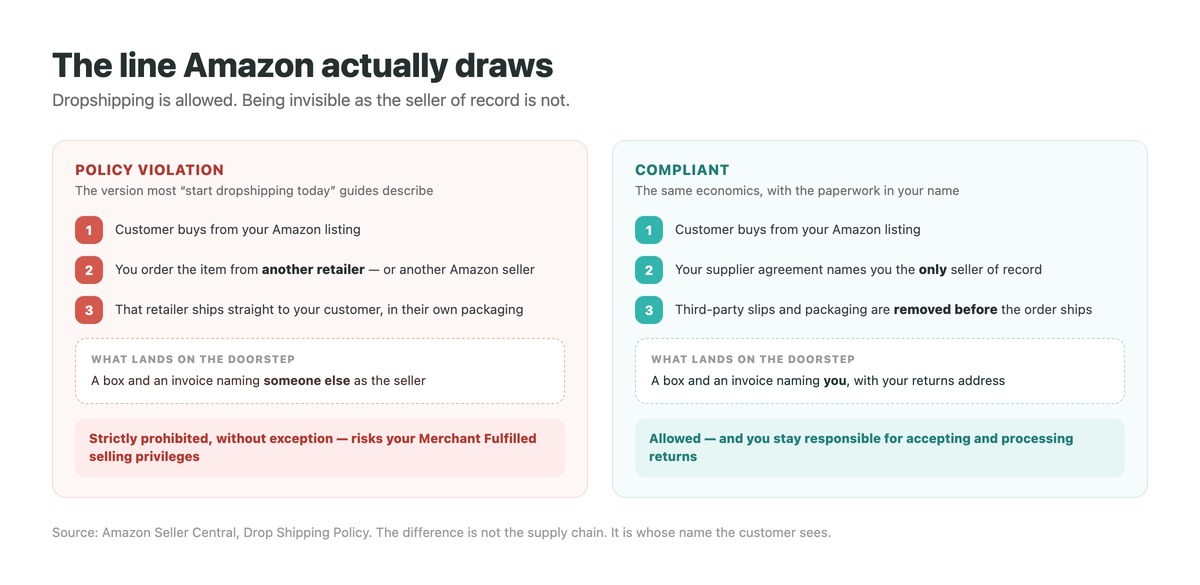
Amazon’s drop shipping policy opens by saying that letting a third party fulfil orders on your behalf is not acceptable unless it is clear to the customer that you are the seller of record. Everything else in the policy is an application of that one sentence.
In practice the customer only learns who the seller is from the parcel: the packing slip, the invoice and the outer packaging. Those three things are the policy.
The Prohibition That Has No Exception
Buying a product from a third party – Amazon explicitly includes itself and other sellers in its own stores – and having that third party ship directly to your customer is, in the policy’s wording, strictly prohibited without exception whenever the shipment does not identify you as the seller of record or anyone else appears on the paperwork.
This matters because it is exactly the arrangement sold as easy retail arbitrage: list it, and when it sells, order it from the cheaper store and ship to the buyer’s address. That is the prohibited version, not a grey area.
What You Have to Do Before Shipping
Note what the third requirement rules out: a supplier who will not take returns has not given you a problem you can pass on. It stays yours.
Have the agreement in writing
An agreement with the supplier where you are the only seller of record and the only business named on slips, invoices, packaging and anything else included with the product.
Strip third-party paperwork
Remove any packing slip, invoice, packaging or other material identifying a different seller or supplier before the order goes out.
Keep the returns
Remain responsible for accepting and processing customer returns, and keep complying with the Business Solutions Agreement.
The Four Kinds of Supplier
Almost every tool marketed as an Amazon dropshipping supplier is one of four things. They solve different problems, and buying the wrong category is the usual first mistake. If holding no stock is the appeal rather than the products themselves, the Amazon Influencer Program is a different route to the same marketplace.
Directories
SaleHoo and Worldwide Brands are lists of vetted wholesalers and manufacturers that you then approach yourself. You are buying research and a filter against the fake-wholesaler problem, not an integration. Nothing syncs, nothing automates, and you still have to negotiate terms – which is the point, because terms are where blind shipping is agreed. Our guide to direct outreach covers how to open that conversation.
Marketplaces
AliExpress, Banggood and CJdropshipping are consumer-facing marketplaces with enormous catalogues and very mixed sellers. They are the cheapest place to test whether a product sells and among the hardest to make Amazon-compliant, because the paperwork and packaging are the seller’s rather than yours. Treat anything sourced here as needing a blind-shipping agreement in writing before it touches a listing.
Curated Networks
Spocket and Zendrop sit between the two: a smaller, screened catalogue weighted towards suppliers in the US and Europe, which mainly buys shorter shipping times and a better chance that branding is negotiable. You pay a subscription for the curation.
Automation Layers
AutoDS, Wholesale2B and Doba are plumbing rather than sources – stock sync, price rules, order routing, listing management across several suppliers at once. They solve the operational problem of overselling a sold-out product, and they solve nothing about compliance. A policy violation runs faster when it is automated.
Which Category Solves Which Problem
Read the right-hand column before paying for anything. Most of the frustration with these tools comes from expecting one category to do another’s job.
| Category | What you are actually buying | What it will not do |
|---|---|---|
| Directory | A screened list of real wholesalers to approach yourself | No integration, no stock sync, no shipping speed |
| Marketplace | Catalogue breadth and the lowest unit cost for testing | Compliance – the paperwork is theirs by default |
| Curated network | Shorter shipping times and suppliers used to dropshipping | A wide catalogue, and it costs a subscription |
| Automation layer | Stock sync, repricing and order routing at volume | Nothing about who is named on the invoice |
| Manufacturer direct | The best margin and full control of packaging | Low or no minimum order – expect to commit |
All ten of the suppliers named above were trading when this was written. Prices and catalogue sizes have been left out deliberately: they change every quarter, and an article full of stale numbers is worse than one without them. Our guide to generating leads with social media covers the demand side once the supply side is settled.
How to Vet a Supplier Before You List Anything
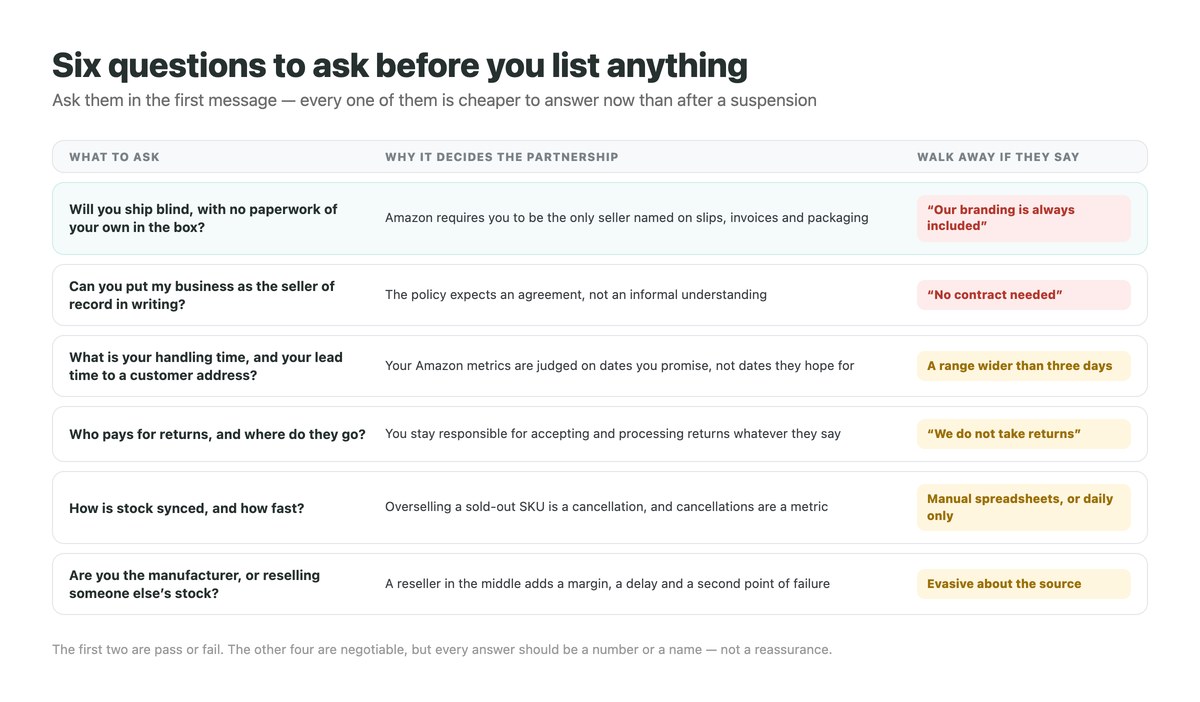
Do this in the first exchange, before you spend time on product research. Two of these are pass-or-fail and the rest tell you whether the partnership will survive a busy month.
Ask whether they ship blind
No paperwork of their own in the box, no branding on the outer packaging. If the answer is anything other than yes, the supplier is unusable for Amazon regardless of price – and you have saved yourself the rest of the conversation.
Get seller-of-record in writing
The policy expects an agreement, not a friendly understanding. A supplier who will not put it in a document is telling you how the first dispute will go.
Pin down handling time and lead time separately
Handling time is how long until they dispatch; lead time is how long until it arrives. Your Amazon metrics are judged against the date you promised, so you need both numbers rather than a cheerful range.
Establish who owns returns, and where they go
You remain responsible for accepting and processing them whatever the supplier says. The question is only whether they will take the stock back or whether you are absorbing it.
Check how stock syncs, and how often
Selling something that is out of stock means cancelling, and cancellations are a metric. Daily sync is not enough for anything that moves.
Ask whether they manufacture or resell
A reseller in the middle is another margin, another delay and another party who can get your paperwork wrong. Not disqualifying, but you should know.
Order one yourself, to your own address
The only way to see what the customer sees. Do this before the first listing goes live, not after the first complaint.
Getting Through to Suppliers in the First Place
Sourcing is an outreach problem before it is a negotiation problem. A shortlist of thirty wholesalers is thirty first messages, and most of them never get answered.
Why the First Message Decides the Terms
Wholesalers triage enquiries by how much work each one looks like. A message that names your business, your category and your expected volume, and asks the blind-shipping question directly, reads as a buyer. A message asking to ‘learn more about your products’ reads as a student, and goes to the bottom of the pile. The structure is the same one that works for any cold approach – our guide to client outreach breaks it into parts.
Where to Send It
Independent wholesalers and manufacturers rarely take enquiries anywhere except the form on their own site – no public inbox, often no direct email, and a sales team that only sees what the form routes to them. That is the channel, whether or not you like it.
Doing It Across a Whole Shortlist
contactID exists for this shape of job: you hand it the supplier websites, it finds the enquiry form on each one and submits your message with the business named, and it reports which sites had no form at all so you know who needs a different approach. A credit is spent only on a submission that actually goes through.
The honest limit is worth stating: it is for independent supplier and wholesaler sites. Marketplaces like AliExpress do not have an enquiry form to submit, and seller messaging there happens inside their own platform.
Set the message up once
Your company details and the sourcing enquiry, with the supplier’s name filled in per site, so thirty enquiries are not thirty pasted paragraphs.
Keep the shortlist honest
It flags businesses you have already contacted, which matters when a sourcing round runs over several weeks.
Read the failures
A site with no form is not a non-reply, it is a supplier who needs a phone call or a trade show. Knowing the difference saves a fortnight.
After the First Order
Dropshipping moves the operational burden rather than removing it. The questions that would have been yours in a warehouse become yours in a message queue.
The Questions That Repeat
Where is my order, can I change the address, why did it ship from there, how do I return it. On a dropshipped catalogue these arrive constantly, because the shipping times are longer and the tracking is less predictable than a customer expects.
Answer Them Where They Are Asked
DMpro connects through official APIs and answers the repeating questions on Instagram, Messenger, WhatsApp, TikTok and Telegram, then hands anything unusual to a person with the thread attached. It has nothing to do with Amazon’s own buyer-seller messaging, which runs inside Seller Central – but most dropshipping brands sell on their own social channels too, and that is where the questions arrive at midnight. Our playbook on selling on Instagram DM covers the conversation that follows.
The Questions Dropshipping Creates, Answered Instantly
Longer shipping times mean more ‘where is my order’ messages, and they arrive at every hour because your customers are not in your timezone.
DMpro answers the repeating ones immediately on Instagram, Messenger, WhatsApp, TikTok and Telegram, captures contact details, and passes the real problems to a person while the customer is still in the conversation.
- Instant answers to shipping and returns questions
- One inbox across five messaging channels
- Official API connections, no password sharing
- Hand-off to a person with the full thread
- Contact details captured and sent to your CRM
- Nothing sits unanswered overnight
- The same answer wherever the customer asked
- Staff only see what genuinely needs them
- It does not touch Amazon’s own buyer-seller messaging
- The repeating answers still need writing properly once
Conclusion
The supplier you choose matters far less than the agreement you reach with them. A mediocre wholesaler who ships blind and puts you on the invoice is a workable Amazon business; an excellent one who insists on their own packaging is not a business at all, because the first few orders are also the last.
So run the policy question first, get blind shipping and seller-of-record in writing, and only then argue about price and catalogue. The four categories above tell you where to look – directories to find candidates, marketplaces to test demand cheaply, curated networks to buy speed, automation to stop overselling – but none of them settles the compliance question for you.
And order one yourself, to your own address, before the first listing goes live. It is the only way to see the parcel the way your customer will.
Instant replies across five channels through official APIs – free to start.
Start free with DMpro