
Anyone who has tried to wire Instagram DMs into n8n, Make or Zapier arrives at the same wall, usually after the credentials are already connected and working. The messages come in fine. Sending is where it stops.
The reason is one sentence in Meta’s documentation, and it is not a rate limit or a missing permission. It is a rule about who spoke first, and it decides the shape of everything you can build – which is why the answer to can n8n send Instagram DMs is the same as the answer for every other tool.
That sounds discouraging and mostly is not. A good deal is buildable inside the rule; what fails is specifically the thing people usually set out to build. Both halves are worth knowing before you spend a weekend on it. It sits inside the broader picture of automating Instagram messages generally.
Key Takeaways
The Sentence That Decides Everything
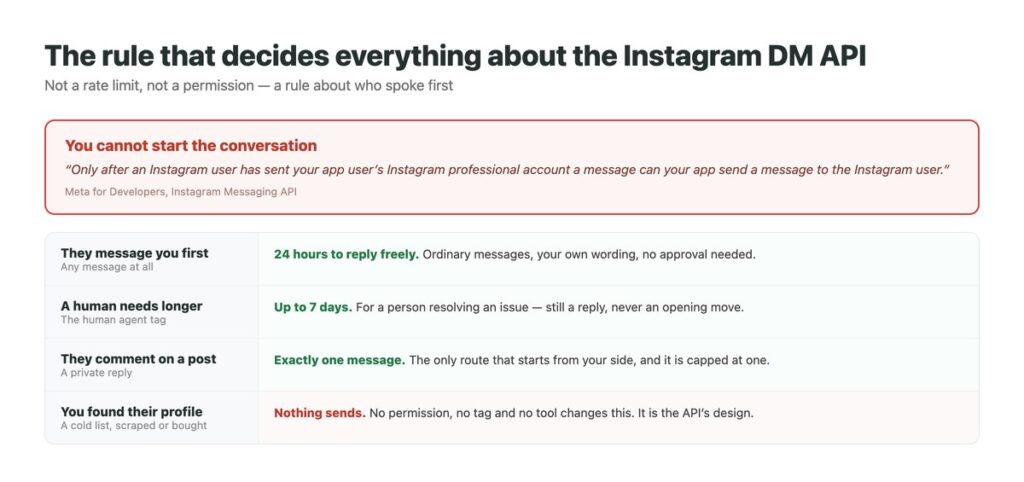
Meta’s documentation for the Instagram Messaging API states it without hedging: only after an Instagram user has sent your Instagram professional account a message can your app send a message to that user.
Read carefully, that removes an entire category of project. There is no permission to request, no app review outcome, and no tier of access that changes it. You are not being throttled or trusted less than someone else – the capability does not exist.
The Send Messages documentation is the place to confirm it for yourself, and doing so is worth the two minutes, because a large amount of tooling is marketed in ways that imply otherwise.
What Opens After They Write to You
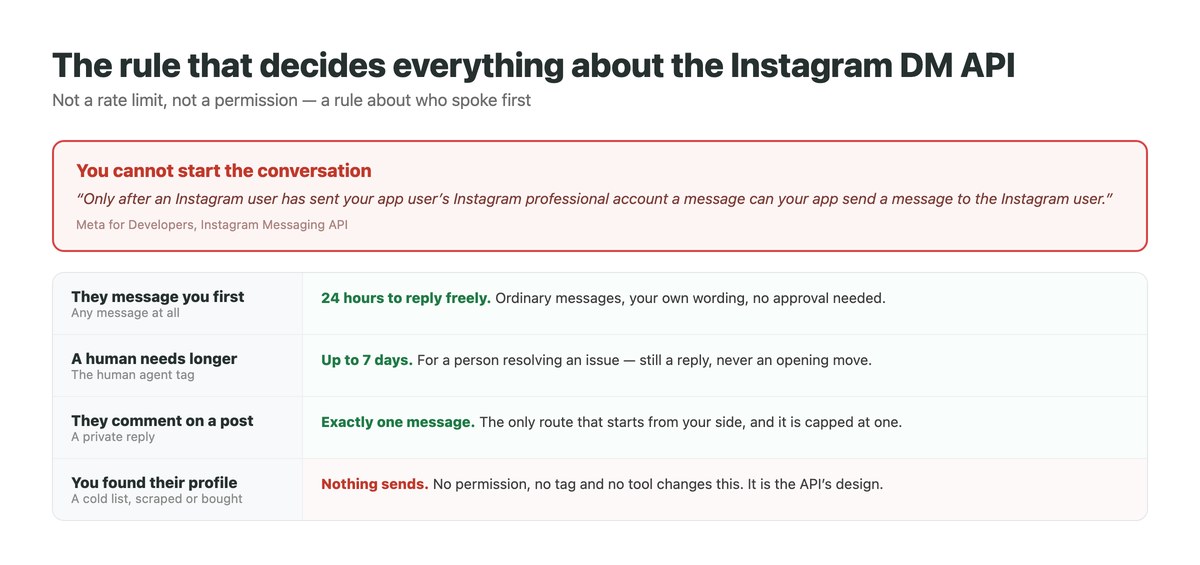
Once someone messages your professional account, a 24-hour window opens and inside it you can reply freely – ordinary messages, your own wording, no template and no approval.
If a person rather than a script is handling the conversation, the human agent tag extends that to seven days. It exists for the case where an issue cannot be resolved inside a day: the business is closed for the weekend, or the problem needs investigating. It is not a loophole for outbound – Meta is explicit that it still only applies to responding to a message the user already sent.
The one route that begins on your side is a private reply to a comment, and it is capped at a single message within seven days of the comment. That is a real opening, but a narrow one, and it has its own rules – covered in our guide to comment-triggered DMs.
The Three Windows, Side by Side
Each one is opened by a different action, and none of them is opened by you.
| Window | What opens it | How long | What you may send |
|---|---|---|---|
| Standard | They message you | 24 hours | Anything, in your own words |
| Human agent | They message you | 7 days | A human’s reply, tagged as such |
| Private reply | They comment on a post | 7 days from the comment | Exactly one message |
| None | You found their profile | n/a | Nothing at all |
So Can n8n, Make or Zapier Send Instagram DMs?
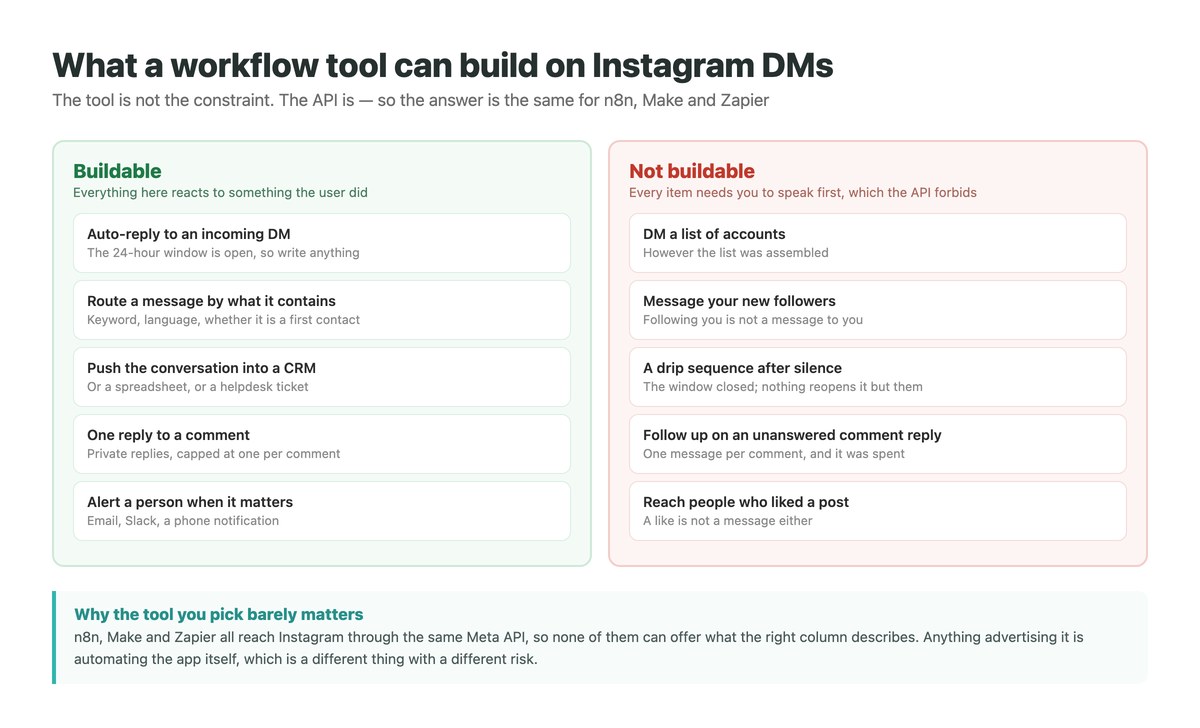
Yes, and with the same limits, because all of them reach Instagram through the same Meta API. The differences between them are about how comfortable the building is, not about what is permitted.
This is worth saying plainly because the question is usually asked as though one of them might have a way around it. None does, and one that appeared to would be automating the app itself rather than using the API – a different technique with a different risk profile, and the same one behind the tools discussed in our notes on what gets DM sending restricted.
The practical differences that do matter: whether the tool holds Advanced Access for the Instagram permissions, since without it the integration works in testing and fails in public; whether it maintains the connection when Meta rotates tokens; and what happens to your conversation history if you stop paying.
Setting Up a Connection That Survives
The order matters, because two of these are discovered halfway through by almost everyone.
Convert to a professional account and link a Page
The Instagram Messaging API requires a professional account connected to a Facebook Page. A personal account cannot use it at any level.
Create the Meta app and add the permissions
Instagram messaging permissions are what the connection actually runs on. Note which ones the tool is asking for and whether they match what you intend to build.
Get Advanced Access, not just Standard
With Standard Access your app only works for people who have a role on it. That is fine while testing and useless the moment real customers message you. This is the step that surprises people.
Subscribe to the messaging webhook
Incoming messages arrive as events rather than something you poll for. Your workflow starts here – which is also the moment the 24-hour window opens.
Handle token expiry deliberately
Tokens do not last forever. A workflow with no refresh path works for weeks and then stops silently, usually noticed when someone asks why nobody replied.
Common Projects, and Whether They Are Possible
Checked against the initiation rule rather than against any particular tool.
| What you want to build | Possible? | Why |
|---|---|---|
| Auto-reply to every incoming DM | Yes | The window is open the moment they write |
| Route messages into a CRM or sheet | Yes | Reading is not restricted the way sending is |
| Reply to commenters automatically | Yes, once each | Private replies, one per comment |
| DM everyone who follows you | No | Following is not a message; Follow to DM is a gated Meta beta, not a public API feature |
| DM a list of target accounts | No | You would be speaking first |
| Chase someone who went quiet | No | The window closed and only they can reopen it |
Why the Rule Exists, and What It Implies
It is tempting to read this as Meta protecting its own advertising business, and that is probably part of it. But the effect is that Instagram DMs are still a place people read messages, which is precisely why they are worth automating at all.
The design consequence is that the whole discipline shifts from sending to being messaged. Everything that produces an inbound message becomes the growth lever – a comment, a story reply, a link, an ad that opens a conversation – and the automation’s job starts at the reply.
That is a harder marketing problem than a send button and a better one to have, because a reply to someone who chose to write to you converts at a rate no cold sequence has ever matched. The argument is the same one behind why cold messaging keeps failing, arrived at from the technical side instead of the strategic one.
When Building It Yourself Stops Making Sense
A workflow that auto-replies to incoming DMs is a genuinely good weekend project and worth doing. The trouble arrives afterwards, and it is rarely the part anyone plans for.
Token refresh breaks silently. Two people answering the same inbox overwrite each other. Conversation history lives in whatever the workflow happened to write it to, so nobody can see what was said last month. Handover to a human means copying a thread into another system by hand. None of these is hard individually; together they are a product rather than an automation.
The honest dividing line is volume and people. One person, a modest number of messages, one channel – build it. Several people answering, or Instagram plus WhatsApp at once, or a history you need to search later, and you are rebuilding something that already exists.
The Same Rules, Without the Maintenance
Everything above still applies to a product: nothing can message someone who has not messaged first. What a product changes is the part after the connection works – tokens that refresh themselves, two people answering without collisions, and a history that survives your workflow being edited.
DMpro runs on the official API, so the constraints are the ones Meta sets rather than ones we invented. Instagram, WhatsApp and TikTok arrive in one inbox, first replies go out immediately, and a person can take a conversation over mid-thread without the customer starting again.
- Built on the official Instagram Messaging API, not on app automation
- Token and connection handling maintained rather than left to you
- Instagram, WhatsApp and TikTok in a single inbox
- Full searchable history that outlives any workflow change
- Handover from automated reply to a person inside the same thread
- Nothing to maintain when Meta changes something
- Several people can answer without stepping on each other
- The conversation history is somewhere you can actually search
- It obeys the same initiation rule – no tool can send a cold DM
Conclusion
One sentence in Meta’s documentation answers most questions about this: the API can only message someone who messaged you first. No permission, tag or tool changes it, which is why n8n, Make and Zapier all give the same answer.
Inside that rule there is real room. Twenty-four hours to reply freely, seven days when a human is handling it, and one message in response to a comment. Auto-replies, routing and CRM integration all fit comfortably.
What does not fit is anything starting from your side: messaging followers, working a list, or chasing silence. Those are not gaps in your setup, and building them is what unofficial tooling is for – along with the account risk that comes with it.
Auto-replies, routing and shared history across Instagram, WhatsApp and TikTok.
See what it handles