
Can several people answer the same WhatsApp number is one of the first questions any growing business asks, and the answer it usually gets is yes, through linked devices. That is true and it is not the whole answer.
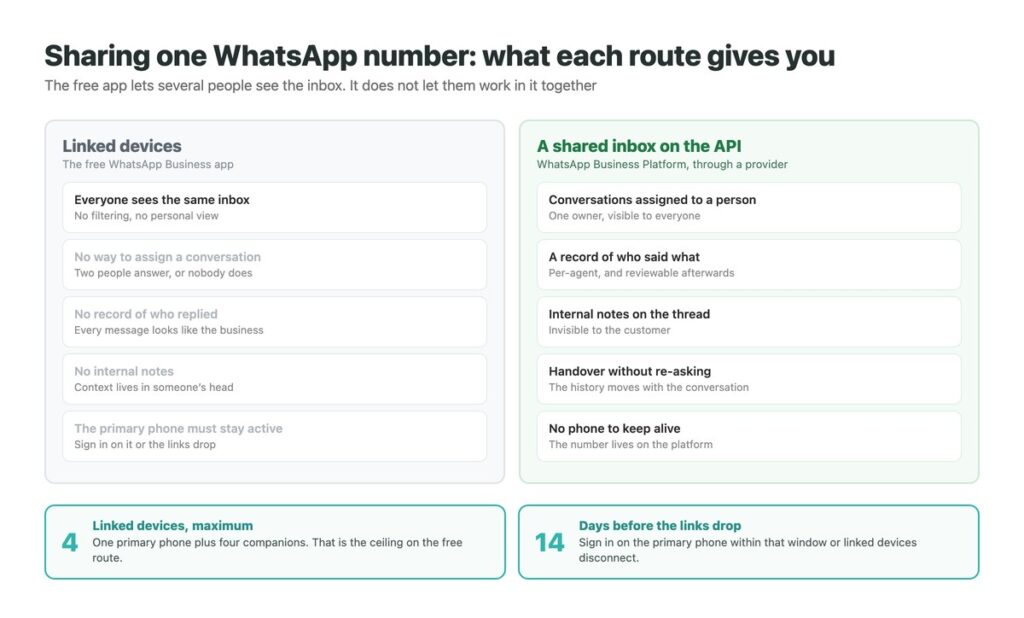
Linked devices let up to five people look at one inbox. What they do not do is let those people work in it together – there is no way to assign a conversation, no record of who replied, and nothing that stops two of you answering the same customer within a minute of each other.
The distinction takes about a month to become obvious and is much cheaper to understand in advance. It also has a clean test, which is at the end. The wider question of what WhatsApp permits and at what tier is covered in our guide to WhatsApp automation.
Key Takeaways
What Linked Devices Actually Give You
The WhatsApp Business app supports linking companion devices to a primary phone, so the same account can be open on a laptop, a tablet and someone else’s phone at once. WhatsApp’s own page on linked devices sets the limit at four companions alongside the primary phone.
There is a maintenance requirement attached that catches people out: you have to sign in on the primary phone at least every fourteen days, or the linked devices disconnect. If the primary is an old handset in a drawer, this is the thing that breaks at the worst moment.
Within those limits it works well for what it is. Everyone sees every conversation, replies go out as the business, and there is nothing to configure. For one person working across a phone and a laptop it is genuinely all that is needed.

The Four Things Sharing a View Does Not Solve
Everything below is absent from the free app by design rather than by oversight, because the app was built for a business run by one person.
There is no assignment, so no conversation belongs to anybody. There is no record of who replied, because every message is from the business and the app keeps no per-person history. There are no internal notes, so anything one person knows about a customer stays in their head. And there is no handover, only a colleague reading the same screen and hoping you noticed.
None of these matters with one person answering. All four start mattering at once the moment two people are in the inbox during the same hours, which is why the transition feels abrupt when it arrives.
The Two Routes, Compared Honestly
The free option is genuinely good until a specific point. This is that point.
| Free Business app | Shared inbox on the API | |
|---|---|---|
| People who can see the inbox | 5 (one primary, four linked) | As many as you need |
| Assign a conversation | No | Yes |
| Know who replied | No | Yes, per person |
| Internal notes on a thread | No | Yes |
| Handover with history | No | Yes |
| Depends on a phone staying active | Yes, every 14 days | No |
| Cost | Free | messaging tiers, plus the tool |
The Collision Problem
The failure that pushes businesses off the free app is rarely dramatic. Two people open the inbox, both see an unanswered message, and both start typing.
The customer gets two replies that do not quite agree, or one person answers and the other spends five minutes writing a second answer to a question already handled. Nobody did anything wrong; the tool has no concept of a conversation being taken. WhatsApp does document a multi-agent concept, but on the free app the practical mechanism for avoiding collisions is people telling each other what they are doing.
That works at two people and stops working at three, and the usual response is a rota – one person on the inbox each morning. That is a real solution and it is also a decision to answer more slowly, since the person on duty is the only one who can reply.

Why a Staff Group Chat Is Not the Answer
The first workaround most teams invent is a WhatsApp group with the staff in it, where customer messages get forwarded and someone claims them. It is free, it is immediate, and it solves the collision problem for about a fortnight.
What it does not solve is the customer’s side. The reply still goes from one shared identity with no record of who sent it, the context still lives in a second place that has to be kept in sync by hand, and forwarding strips the conversation of everything except the words. It also quietly doubles the work: every message now has to be read twice.
It is a reasonable stopgap and a bad destination. If a group chat is already how you coordinate, that is usually the clearest evidence that the inbox itself needs to do the job – not that the group needs better rules. The same instinct produces shared logins on Instagram, which our notes on treating DMs as a CRM problem look at from the other side.
Making the Free App Work as Long as Possible
Before spending anything, these buy back most of the pain and take an afternoon.
Keep the primary phone on a real device
Not a spare handset in a drawer. The fourteen-day sign-in is what keeps every linked device connected, and it fails silently.
Put one person on the inbox at a time
A rota removes collisions completely. It costs response speed, which is the trade you are making. Whatever the rota, point the away message schedule at the hours nobody is on it, so customers are never told the inbox is empty while someone is there.
Set up away and greeting messages properly
They cover the gaps a rota creates, which is most of what a customer notices. Our guide to what the app automates covers the setup.
Agree a convention for taking a chat
Something as crude as marking it unread when you have not handled it. Crude conventions work at two people.
Write down what only one person knows
The absence of internal notes is the gap that hurts longest. Anywhere shared is better than nowhere.
What Moving to the API Actually Involves
The honest version, because the marketing tends to skip three of these.
| What changes | What it means | Worth knowing |
|---|---|---|
| The number moves to the platform | It stops living on a phone | Migrating a number is one-way in practice |
| You pay per conversation | Plus whatever the inbox tool costs | Cost scales with volume, not seats |
| Templates outside 24 hours | Pre-approved messages only | Same rule as everywhere else on WhatsApp |
| Chat history does not come with you | The old app’s history stays on the phone | Export before you migrate, not after |
| You choose a provider | They hold the connection to Meta | Ask who owns the number: it should be you |
The Test That Settles It
Ask one question: has two people ever replied to the same customer without either knowing the other had?
If that has happened once it will happen weekly, because it is not a mistake anyone made. It is what a tool with no concept of ownership produces when two people use it at the same time, and no amount of care or good intentions fixes it.
If it has not happened – one person answers, or two people work different shifts – the free app is doing its job and there is nothing to buy. Comparing products before you have that answer is how people end up paying for seats they do not use, which our rundown of messaging tools by what they are for tries to head off. That is a genuinely common answer and worth hearing, because a shared inbox bought too early is cost and setup for a problem you do not have yet. When it does become the answer, the conversations usually need joining up with the ones arriving on Instagram too.
One Number, Several People, No Collisions
Once two people share an inbox, the thing you are buying is not more seats. It is knowing which conversations are handled, who handled them, and what was said before the customer came back.
DMpro assigns conversations to people, keeps the history with the customer rather than the device, and lets someone take a thread over without asking the person to repeat themselves – across WhatsApp, Instagram and TikTok, since customers rarely stay on one. If some of yours are on Telegram, its business account has greeting and away messages of its own – see Telegram auto reply.
- Conversations assigned to a person, visible to everyone
- Internal notes on a thread that the customer never sees
- A record of who replied and when
- Handover mid-conversation with the history intact
- WhatsApp, Instagram and TikTok in the same inbox
- Two people stop answering the same customer
- Context survives when somebody is off
- One thread per person, whichever app they used
- It cannot message a cold list – no compliant WhatsApp tool can
Conclusion
Linked devices are a real answer to sharing a number and a limited one: five people maximum, a primary phone that has to be signed into every fortnight, and everyone looking at the same undifferentiated inbox.
What is missing is ownership. No assignment, no record of who replied, no internal notes and no handover. Those are absences by design, because the free app was built for a business run by one person, and they become visible the moment two people work the same hours.
So the question is not how big the team is. It is whether two of you are ever in the inbox at the same time – and if the answer is no, the free app is still the right tool.
Assignment, notes and history across WhatsApp, Instagram and TikTok.
See the shared inbox