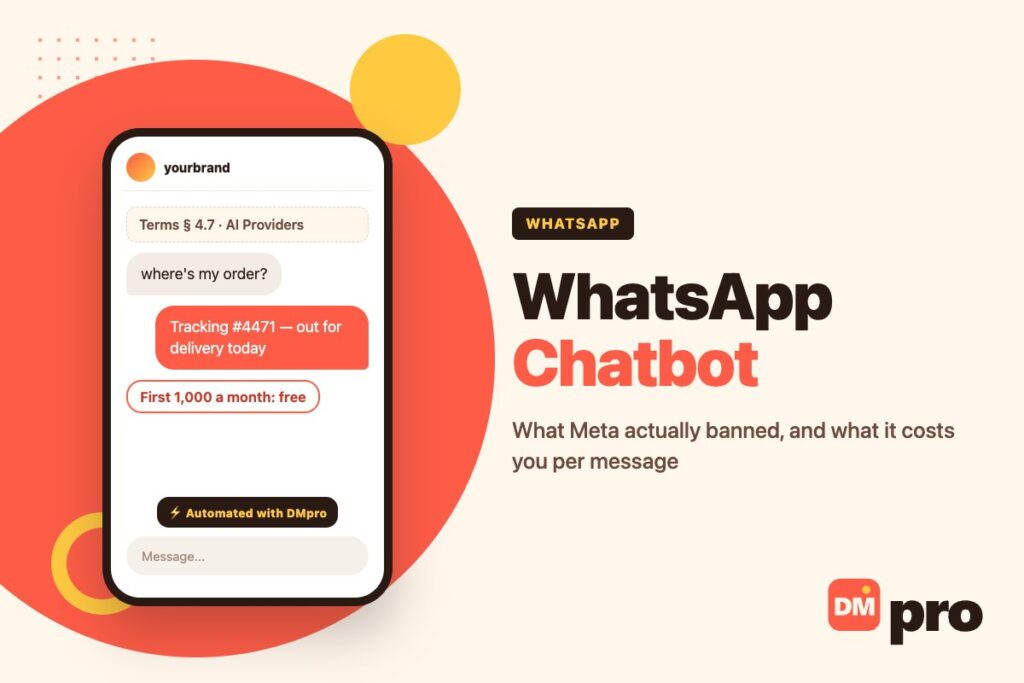
There is a widely repeated claim that Meta has banned AI chatbots from WhatsApp. It is close enough to the truth to be believed and wrong enough to lead people to the wrong decision. The rule exists, it is in section 4.7 of the terms, and what it restricts is AI providers using WhatsApp as a channel for their own assistant – not a shop answering questions about its own orders.
The more useful story is the money, and almost nobody writes about it. Meta publishes its rates, and in July 2026 it gave its own AI agent a billing category of its own. A keyword bot answering customers runs inside a free monthly allowance. Meta’s AI agent is excluded from every free allowance there is and costs roughly four to five cents a message from the first one.
So: what the terms actually say, what each kind of bot costs, and how to decide which one you need.
Key Takeaways
What the Rule Actually Says
Worth reading the clause rather than the coverage of it, because the two lead to different decisions.
Who It Binds
Section 4.7 of the Meta Terms for WhatsApp Business Platform defines AI Providers as providers and developers of artificial intelligence or machine learning technologies – large language models, generative AI platforms, general-purpose AI assistants, or similar, as determined by Meta.
Those parties are prohibited from using the platform to deliver such technologies. The subject of the sentence is the provider, not the business buying software.
The Test Is Primary Versus Incidental
The prohibition applies when the technology is “the primary (rather than incidental or ancillary) functionality being made available for use”. That phrase is the whole rule.
A general assistant that will discuss anything, reached through WhatsApp, is the primary case – the AI is the product. A bakery’s bot that answers questions about opening hours and order status is the incidental case: the product is the bakery, and the model is how the answer gets written.
Ask what your bot refuses
If it will happily write a poem or explain quantum physics, it is a general assistant wearing your logo. If it says it can only help with your orders, it is not.
Scope is the safeguard
A bot restricted to your own catalogue, policies and order data is defensible in a way that an open model with your name on it is not.
Meta decides
The phrase “as determined by Meta in its sole discretion” appears twice in one clause. There is no test you can run to be certain, which is itself worth knowing.
Using an AI Vendor Is Explicitly Allowed
The terms say it directly: notwithstanding the prohibition, you may retain an AI provider as your solution provider. So the panic about having to drop an AI-powered tool is misplaced – what changed is what those providers may offer as the product, not whether businesses may use them.
The Data Clause People Skip
There is a second restriction in the same section, and for some businesses it matters more. You may not allow WhatsApp Business Platform data – including anonymised, aggregated or derived forms – to be used to create, train or improve any AI model.
The carve-out: you may use it to fine-tune a model for your own exclusive use, provided that does not end up improving any other model. If a vendor proposes to improve its product using your customer conversations, that is the clause to point at. The section also survives termination, so it does not lapse when you leave.

What a WhatsApp Chatbot Costs
Meta publishes all of this, and it changes the build-versus-buy question more than the policy does.
You Pay for Delivery, One Way
Since July 2025 Meta has charged per message rather than per conversation, by category and by the recipient’s country. You are charged when a message is delivered, and only for messages from you to the customer.
Messages from customers to you are never charged, which is worth remembering when somebody quotes you a cost per conversation.
The Thousand Free Ones
Every business phone number gets 1,000 free service messages each month. They do not roll over, they reset monthly, and charging begins at the 1,001st.
“Service” here means any non-template reply not powered by Meta’s own agent – and Meta’s documentation says explicitly that these can be powered by a third-party AI solution or by people. So a keyword bot, a vendor’s AI, and a human typing all draw on the same free thousand.
A thousand is more than it sounds
For most small businesses that is the whole month. The allowance runs out when you are answering a few dozen customers a day, not before.
It is per number, not per account
Several numbers each get their own thousand.
Templates are separate
Marketing, utility and authentication templates are their own categories with their own rates – see our guide to WhatsApp message templates.
Meta’s Own Agent Is Its Own Category
In July 2026 Meta added a fifth billing category for Meta Business Agent, separating its AI agent from ordinary service messages. It is priced on tokens rather than messages: $2 per million, with a typical message consuming 20,000 to 25,000 tokens, which Meta puts at roughly four to five cents each.
There are no volume tiers and no free messages, and it is charged even inside the free entry point window where everything else is not. For an inbox handling a few hundred questions a month the difference between that and the free allowance is the entire budget.
The Window That Makes It Cheap
If someone reaches you through a click-to-WhatsApp ad and you reply within the service window, that reply opens a free entry point window lasting up to seven days, during which marketing, utility, authentication and service messages are not charged.
It is the single largest discount available on the platform and it is tied to the ad. Our guide to click-to-WhatsApp ads covers that route. The exception, again, is Meta Business Agent – charged throughout.

Which Kind of Bot You Actually Need
Having read the policy and the rates, the choice is usually clearer than people expect.
Keyword Flows Handle More Than Expected
Most business inboxes are five or six questions repeated endlessly: price, delivery time, opening hours, where is my order, do you have this in stock. A keyword flow answers all of them, costs nothing until the thousandth message, and never invents anything.
The weakness is phrasing. A keyword matches literal text, so the question asked an unusual way matches nothing – and if you sell abroad, a question asked in another language matches nothing either, which is covered in our guide to translation and keywords.
Where a Model Earns Its Keep
An AI step is worth paying for when the questions are genuinely open – a wide catalogue, a technical product, or a support surface where nobody can predict the phrasing. It is also the honest answer when your keyword list has grown past thirty entries and still misses things.
What it should not do is answer anything outside your business. That is both the policy line and simply good practice, because a model with no scope will confidently answer a question about a refund policy you do not have.
Most Good Setups Are Both
Keywords for the predictable majority, a model or a person for the rest, and a clear handoff. That keeps the expensive path for the messages that need it rather than running every “hi” through a language model at five cents a time.
The same architecture on Instagram is described in our guide to DM chatbots, where the disclosure rules differ.
Before the Bot, Finish the Free App
A surprising number of businesses asking about a chatbot have not set up the greeting and away messages that come free with the WhatsApp Business app. They are two unconditional messages and they are not a chatbot, but they close the gap that makes people feel ignored – WhatsApp Business auto reply covers what they do and where they stop.
Building One Without the Usual Mistakes
In order. The first step is the one that determines whether the rest is worth doing.
Read a month of your actual inbox
Count the questions. If six of them are most of the volume, you need a keyword flow and not a model, and you will know that in an afternoon.
Decide the scope in one sentence
“It answers questions about our products, orders and opening hours, and nothing else.” Write it down. It is your policy position and your design brief at once.
Build the predictable answers as keywords
Including the misspellings and the other languages you receive. These run inside the free thousand and they never hallucinate.
Add the escalation before you add the AI
Anything unmatched should reach a person. A bot with no exit is worse than no bot, and this step also shows you what to automate next.
Only then consider a model, with a budget
At four to five cents a message for Meta’s agent, a thousand AI answers is around fifty dollars. That is fine or it is not, but decide it before you switch it on rather than after.
Check what your vendor does with the conversations
The terms forbid your WhatsApp data being used to train anyone’s model. Ask directly, and get the answer in writing.
Measure resolution, not deflection
A bot that answers everything and resolves nothing shows beautiful numbers while customers quietly leave.
The Three Routes Priced
Same inbox, three ways of answering it, with the cost structure that actually applies.
| Route | What it handles | What it costs |
|---|---|---|
| Free WhatsApp Business app | A greeting and an away message, both unconditional | Nothing, and nothing beyond that |
| Keyword flows on the Platform | The predictable questions, in the languages you list | Free to 1,000 service messages a month, then per message |
| Third-party AI as your solution provider | Open-ended questions, scoped to your business | Draws on the same free service allowance, plus the tool |
| Meta Business Agent | Open-ended questions, Meta’s own agent | $2 per million tokens, about 4-5c a message, no free tier |
Whichever route you pick, the 24-hour window and the sending caps apply on top – WhatsApp messaging limits covers those, and WhatsApp automation compares the routes in general.
What DMpro Does Here
Stated with the limitation first, because on this channel the limitation is the relevant part.
No AI on WhatsApp
DMpro does not run AI replies on WhatsApp. The block exists in the flow builder for other channels and it is not wired for this one, so anything you build here is keyword-driven.
Which, given everything above, is the cheap tier rather than the poor one – keyword replies draw on the free thousand and cost nothing until you are busy. But it is a limitation and you should know it before choosing.
What It Does Run
A WhatsApp Business account connected through Meta’s own signup flow, triggering on inbound messages with keyword matching. From there it sends a message of up to 4,096 characters with an attachment, products from your WhatsApp catalogue, a location pin, a contact card or a sticker, and it can call a webhook mid-conversation and send the answer back – which is how an order number becomes a delivery date.
Flows branch, wait for the reply, pause between steps and cap how often somebody is contacted. Anything unmatched goes to a person rather than nowhere.
Where the AI Does Work
On Instagram, Messenger, Telegram and TikTok the AI step runs normally, so a mixed setup is common: a model on the channels that support it, keywords on WhatsApp, one inbox for all of them.
For outbound, which is a different product entirely, the DMpro Chrome extension drafts Instagram DMs from your own account and contactID handles contact-form outreach. Neither is a chatbot and neither touches the WhatsApp Business Platform.
What Nobody Can Do
Message somebody who has not written to you first, outside an approved template. Send unsolicited messages at volume. Or promise you a bot that is exempt from the 24-hour window. If a vendor offers any of those, they are describing an unofficial route and the number is the thing at risk.
Most of Your Inbox Is Six Questions
Price, delivery, stock, opening hours, where is my order, do you ship here. They arrive all day, they have the same answer every time, and none of them needs a language model to write it.
DMpro answers them on WhatsApp’s official connection, pulls a real order status in through a webhook when one is needed, and hands anything unusual to a person.
- Answers that run inside Meta’s free monthly allowance
- Live order and stock status pulled in through a webhook
- Your WhatsApp catalogue, a map pin or a contact card in the reply
- A tested handoff the moment a question is not one of the six
- Model-based replies on the four channels that permit them
- The predictable majority is answered inside Meta’s free allowance
- Keyword replies cannot invent an answer you never wrote
- Escalation to a person is part of the flow, not an afterthought
- AI replies are not available on the WhatsApp channel
- It cannot message anyone who has not contacted you first
Conclusion
The policy answer is that Meta restricted AI providers from using WhatsApp to distribute general assistants, and said in the same clause that you may retain an AI provider as your solution provider. If your bot only ever talks about your business, that rule was not written about you. If it will answer anything at all, it was.
The commercial answer is the one that will decide what you build. A keyword bot is free for the first thousand service messages every month and cheap after that. Meta’s own agent is around four to five cents a message with no free tier, no volume discount, and no exemption in the window where everything else is free.
Which points at the same architecture almost every time: keywords for the questions you can predict, a model or a person for the rest, and a handoff you have actually tested. Start by counting the questions in a month of your own inbox – that number decides this, not the policy.
Keyword flows on WhatsApp’s official connection. Free plan to start.
Start free